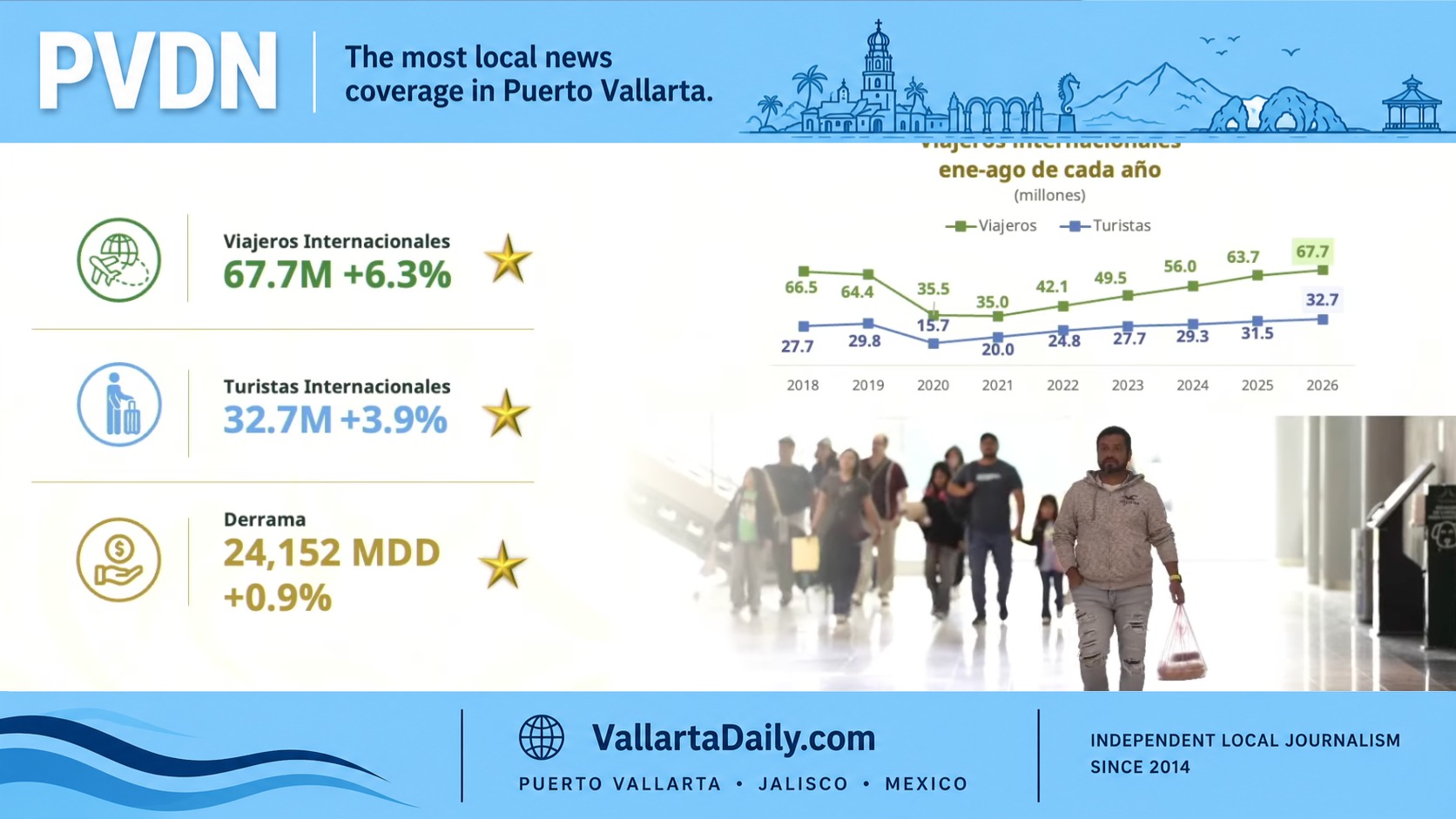
Puerto Vallarta, Jalisco, October 15, 2026 – Mexico reported record international visitor spending of $24.152 billion for January–August 2026, up 0.9% from a year earlier, federal tourism officials said.
For Puerto Vallarta residents whose livelihoods depend on visitors, the immediate question is whether that national growth is reaching businesses here.
Local airport figures point in a different direction. According to Grupo Aeroportuario del Pacífico’s August traffic report, international passenger traffic at Puerto Vallarta’s airport fell 19.7% during those same eight months. Total traffic, including domestic flights, declined 12.4%.
Those figures measure passenger movements, including arrivals and departures, rather than individual tourists. They also do not measure spending. They therefore cannot show how local tourism revenue changed, but they do show why a national record does not automatically translate into more customers in Puerto Vallarta.
Tourism Secretary Josefina Rodríguez Zamora presented the national results on October 14. In Sectur’s announcement, the department reported 67.69 million international visitor arrivals through August, up 6.3% from the same period in 2025.
Of those arrivals, 32.68 million were international tourists who stayed at least one night, up 3.9%. The larger visitor total also includes people who entered Mexico without an overnight stay, including border visitors and cruise passengers.
That distinction helps explain the headline. The figures cover many kinds of trips across the country, with very different spending patterns. They are based on INEGI’s International Traveler Survey, which measures travel and spending by people entering and leaving Mexico. The inbound spending total excludes domestic tourism by Mexico’s residents.
The revenue increase was also modest in dollar terms: $218 million above the $23.934 billion recorded a year earlier. Visitor arrivals grew considerably faster than spending.
For a hotel, restaurant, or tour operator, the useful question goes beyond how many people entered Mexico. Where they stayed, how long they remained, and what they bought determine how much business reaches an individual destination.
Consider a hypothetical family visiting Puerto Vallarta that pays more for accommodation but eats fewer restaurant meals and takes fewer paid excursions. Its overall spending could increase while some businesses receive less. A national spending total cannot show that distribution.
August’s results illustrate another reason visitor numbers and revenue can move differently. Overnight tourist arrivals entering Mexico by air fell 6.5% compared with August 2025. Sectur, however, reported that average spending among those air travelers rose 15.2% to about $1,270 per trip.
Across all international visitors, Mexico received approximately $2.409 billion in August, a 7% annual increase. Higher average spending helped support receipts even as the number of overnight tourists arriving by plane declined.
Rodríguez expressed confidence in the national outlook. In a statement reported by Punto MX, she said Mexico “could end 2026 with a historic number of international tourist arrivals.”
Puerto Vallarta’s more recent figures show that its international traffic shortfall continued into September. As Vallarta Daily reported on October 14, international passenger movements were down 19.4% through the first nine months of the year.
That left the airport with 547,300 fewer international passenger movements than a year earlier as local accommodation providers, airport transport services and tour operators prepared for the winter season.