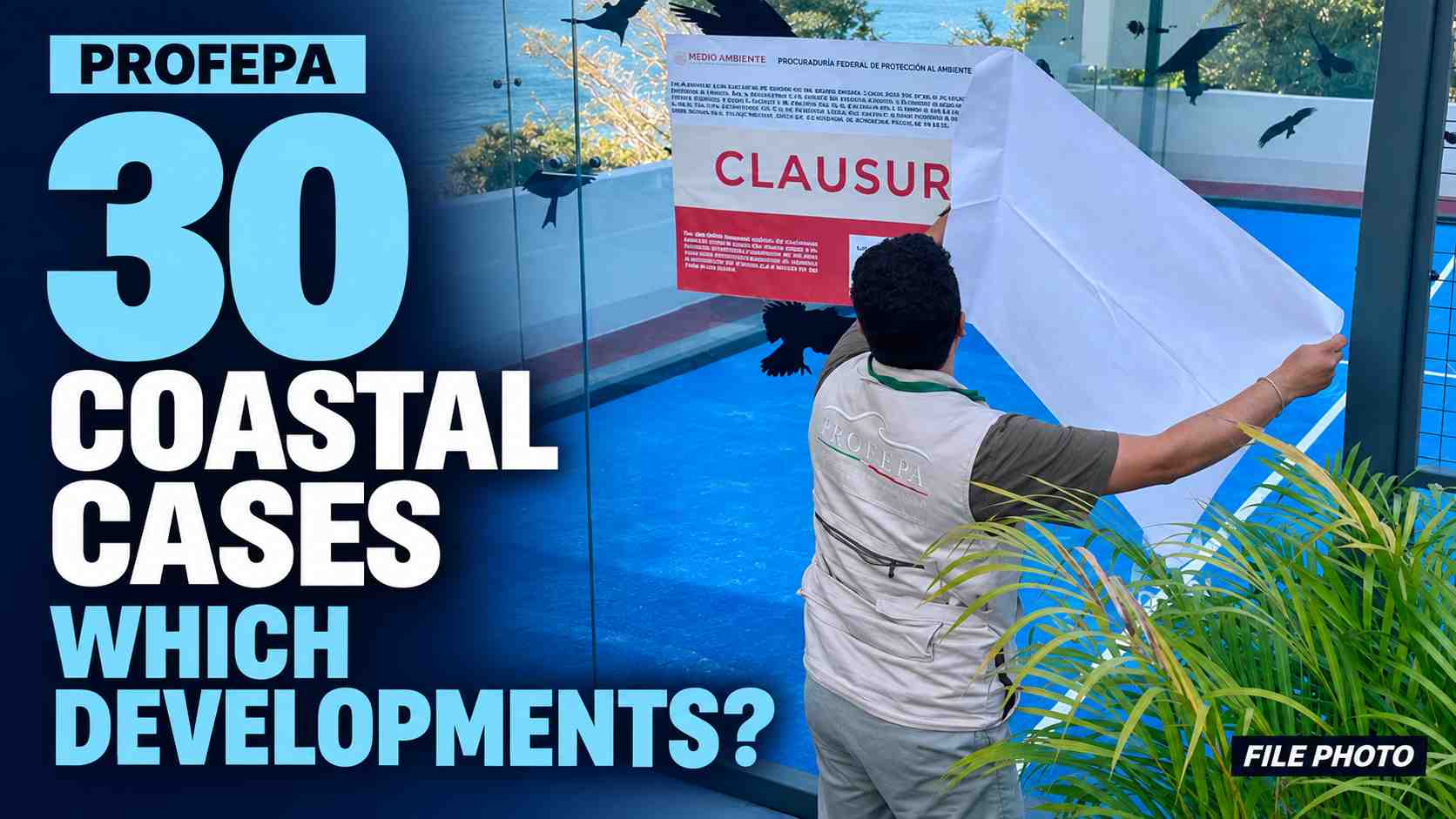

Federal authorities seize heavy machinery in Nuevo Nayarit over unauthorized beach work and discover an exposed sea turtle nest during inspections.
Nuevo Nayarit, Nayarit, November 24, 2026 – Federal environmental authorities have seized heavy machinery used to move sand along a stretch of beach in Nuevo Nayarit after those responsible for the work failed to demonstrate that they had the necessary permits.
The intervention followed a citizen complaint and was carried out by the Federal Attorney for Environmental Protection (PROFEPA) in coordination with the municipal government of Bahía de Banderas.
According to PROFEPA’s official statement issued November 18, the work was taking place on federally regulated coastal land adjacent to a hotel.
During the inspection, authorities also discovered a sea turtle nest that had been exposed by the movement of sand.
The machinery was seized as a precautionary measure, and an administrative proceeding was opened to determine responsibility and whether sanctions should be imposed.
The incident raises a question that deserves more attention as development continues along the shores of Bahía de Banderas.
Who actually has the right to modify our beaches?
An unexpected discovery beneath the sand
Moving sand around a beach might seem relatively harmless, particularly when compared with constructing buildings or dumping wastewater into the ocean.
But there’s a lot happening beneath the surface of our beaches that isn’t immediately visible.
When wildlife specialists examined the exposed turtle nest in Nuevo Nayarit, they found eggshell remains consistent with a previous hatching. Fortunately, inspectors did not establish that viable eggs had been damaged.
That distinction is important. There is currently no evidence in the official findings that developing turtles were killed during the work.
Nevertheless, the discovery illustrates why environmental regulations exist in the first place.
Heavy machinery can compact sand, damage incubating eggs and make it more difficult for nesting turtles to dig. Mexico’s federal sea turtle protection standard, NOM-162-SEMARNAT-2012, specifically addresses vehicle activity on nesting beaches.
And it’s been a particularly difficult year for sea turtle conservation efforts around Bahía de Banderas.
In October, we reported that storms destroyed approximately 137 nests at the Boca de Tomates turtle camp, while Puerto Vallarta was seeking volunteers to rebuild its damaged turtle nursery at Playa Holi.
Nature already presents considerable challenges for the survival of these animals. Human activity can introduce additional risks.
Having beachfront property doesn’t mean owning the beach
One of the more persistent misunderstandings among foreign property buyers and vacationers in Mexico involves beachfront ownership.
Buying an oceanfront condominium or operating a beachfront hotel doesn’t automatically give the property owner control over the beach in front of it.
Under Mexico’s General Law of National Assets, beaches and the adjoining federal maritime land zone are public national assets.
That federally regulated strip is known as the Zona Federal Marítimo Terrestre, or ZOFEMAT. Where the coastline meets the conditions established by law, it generally extends 20 meters inland from the beach.
Businesses can obtain concessions and authorizations allowing certain uses of federal coastal land. However, those permissions come with conditions and don’t amount to unrestricted private ownership.
A concession allowing a hotel to place beach furniture, for example, doesn’t automatically authorize the hotel to excavate sand or alter the coastline.
Earlier this year, Vallarta Daily examined ongoing beach access restrictions in Nuevo Nayarit, where questions about private property management collided with the public’s right to access the coast.
The latest PROFEPA intervention involves a different issue, but the underlying principle is much the same. Activities on federal coastal land remain subject to federal regulations, regardless of who owns the neighboring property.
Even storm damage doesn’t give businesses a free pass
Anyone who has spent a few rainy seasons around Bahía de Banderas knows how dramatically our beaches can change.
A stretch of beach that was wide and sandy one week can look considerably different the following week after powerful waves redistribute the sand.
For beachfront hotels, restaurants and condominiums, those changes can create considerable problems, particularly when the winter tourism season is approaching.
Restoring a damaged beach may seem like a reasonable response. But PROFEPA has made it clear that natural changes to the coastline do not exempt property operators from obtaining the appropriate authorizations.
That includes damage caused by mar de fondo, the long-period ocean swells that periodically affect Mexico’s Pacific coastline.
The agency announced that it would issue a formal warning to hotels, condominium developments, construction companies and other coastal businesses against undertaking unauthorized sand-moving operations.
There’s a difference between maintaining a beachfront property and modifying the natural environment surrounding it.
Determining where that line falls requires more than simply deciding that the beach needs a little work.
A growing challenge along the Riviera Nayarit
The Nuevo Nayarit incident isn’t happening in isolation.
Earlier this year, we reported on community opposition to coastal development at Playa Las Cocinas in Punta de Mita, where residents and environmental activists raised concerns about dunes, beach access and construction within the federal coastal zone.
Those disputes involve different properties and circumstances, and they shouldn’t be confused with the current investigation in Nuevo Nayarit.
However, they illustrate the challenges of managing a coastline where residential development, tourism, public recreation and environmental conservation all compete for space.
Beaches are among the most valuable assets of the regional tourism economy. They’re also natural ecosystems that are constantly changing.
For developers and tourism operators, maintaining an attractive beachfront makes economic sense. For environmental authorities, preserving the natural processes that sustain those beaches is an equally important consideration.
The two objectives aren’t necessarily incompatible, but achieving both requires proper planning, environmental assessments and compliance with regulations.
What residents can do if they witness unauthorized beach work
One of the most significant details about the Nuevo Nayarit intervention is that it began with a complaint from a member of the public.
Residents don’t need to be environmental experts to report potentially unauthorized activities.
According to PROFEPA’s official guidance on coastal complaints, the agency investigates suspected unauthorized construction, improper use of federal coastal land and restrictions on public beach access.
If you witness activity that concerns you, document the location, date and nature of the work. Photographs taken from a safe, publicly accessible location can also be helpful.
Complaints can be submitted through PROFEPA’s environmental reporting process, by emailing [email protected] or calling 800-776-3372. Telephone complaints must be formally ratified within three business days.
There’s no need to confront machinery operators, construction workers or hotel employees yourself.
Authorities are responsible for determining whether the work has the necessary permissions.
What happens next?
PROFEPA’s administrative investigation will determine whether environmental regulations were violated, who was responsible and what penalties, if any, should be imposed.
The federal agency has not publicly identified the hotel adjacent to the work site in its statement. No final sanctions or subsequent resolution have been independently confirmed.
PROFEPA says it will continue inspecting coastal areas, with particular attention to protecting wildlife during sea turtle nesting season.
For now, the seizure serves as a reminder that the beaches along Bahía de Banderas aren’t simply extensions of the hotels and condominiums built beside them.
They’re public spaces, natural habitats and an important part of the region’s environmental heritage. Protecting them begins with respecting the rules that govern what can happen on them.