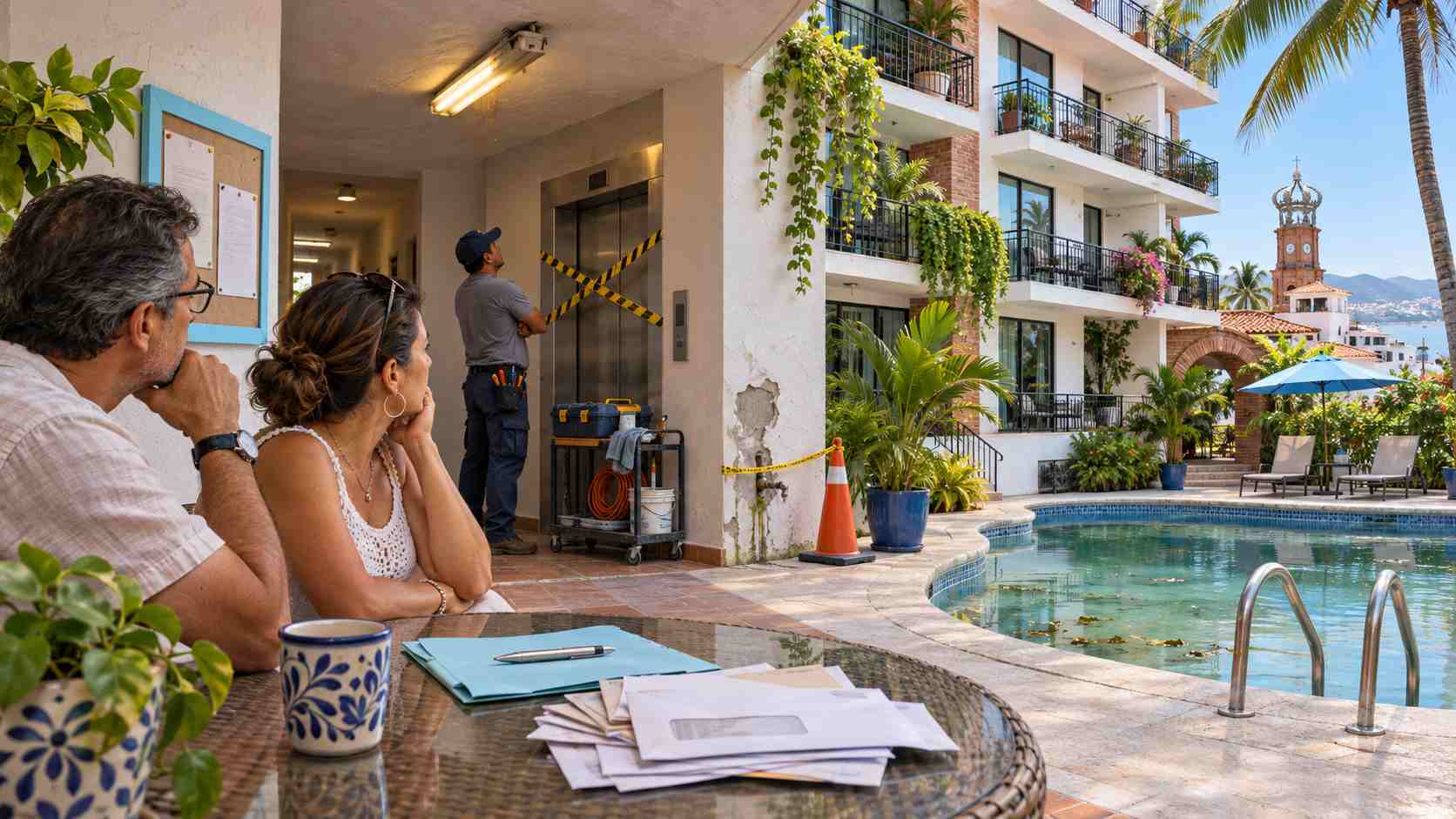

Buying property in Puerto Vallarta? Learn how unpaid developer debts can complicate ownership, utility services and resale, and how to protect yourself.
When buying a property in Puerto Vallarta, most people want to know whether the title is clean, the property taxes are paid and the monthly maintenance fees are reasonable. But there is another question worth asking before signing a purchase agreement: Has the developer paid its own bills?
It is possible to purchase a home, pay every bill on time and still find yourself dealing with financial or administrative problems that originated long before you moved in.
Outstanding developer obligations, unpaid communal utility bills and incomplete infrastructure agreements can create problems for homeowners years after construction has finished.
Some of those problems may only become apparent when you decide to sell.
A cautionary tale from Ecoterra
A situation reported this week involving homeowners in Puerto Madero, a private residential community within Puerto Vallarta’s Ecoterra development, illustrates why these questions deserve attention.
In a November 24 report, residents claimed they were experiencing difficulties obtaining water debt clearance certificates and completing property-related paperwork because of alleged outstanding debts associated with their developer and condominium association.
The homeowners said their individual water accounts were fully paid.
The reported debts and the reasons for the alleged administrative restrictions have not been independently established. The original report did not include responses from the developer, condominium association or municipal water authority.
Regardless of how that particular dispute is eventually resolved, it raises an important issue for anyone considering purchasing property in Puerto Vallarta.
Buying a property within a development means acquiring more than the space within your four walls. You are also buying into a community with its own financial obligations, infrastructure arrangements and administrative history.
And that history deserves just as much investigation as the property itself.
Not all developer debt is bad debt
Real estate development is an expensive business. Developers frequently borrow money to acquire land, finance construction and complete infrastructure before receiving the full proceeds from property sales.
The existence of developer debt is not, by itself, a warning that something is wrong.
What matters is the nature of that debt, whether it is being managed responsibly and whether it could affect your property.
There is a considerable difference between a construction loan with an established procedure for releasing individual units from a mortgage and an outstanding infrastructure obligation that nobody has agreed to settle.
The kinds of obligations worth investigating include construction financing, unpaid property taxes, utility connection charges, outstanding payments to contractors and financial commitments associated with common areas.
Some may be secured against the property. Others may belong exclusively to the developer. Still others may eventually become legitimate obligations of the condominium association.
An unpaid corporate debt does not automatically become your personal responsibility simply because you purchase a property from that company.
But even when you are not legally responsible for a debt, resolving the complications surrounding it can cost you time and money.
The difference between owning a home and owning a share of a development
When you purchase a condominium, you typically acquire rights to your individual unit along with a proportional interest in common property.
That common property can include swimming pools, elevators, gardens, access roads, water pumps, drainage infrastructure and other facilities.
Someone has to pay for maintaining and operating all of it.
Under Article 1030 of the Civil Code of the State of Jalisco, legitimate condominium obligations are covered through common funds. When those funds are insufficient, condominium owners may be required to contribute proportionally toward the outstanding amount.
That does not mean an association can simply assign any outstanding developer debt to homeowners. The origin of the obligation, applicable contracts and legal responsibility must first be established.
However, it does mean that the financial health of your development matters to your personal finances.
Imagine a hypothetical condominium community with 50 properties, equal ownership shares and a legitimate shared obligation of 500,000 pesos that its reserve fund cannot cover.
That could represent an additional assessment of 10,000 pesos per property.
The actual allocation would depend on the condominium’s ownership percentages, governing documents and applicable law.
It is one reason why we previously encouraged homeowners to understand what happens when their condominium neighbors fail to pay maintenance fees.
The same principle applies when investigating obligations left behind during the transition from developer management to homeowner management.
Why water infrastructure deserves special attention
Water is particularly important in Puerto Vallarta because residential developments depend on connections to municipal water and drainage infrastructure, along with whatever private systems serve the development.
A functioning kitchen faucet does not necessarily establish that every contractual and administrative obligation associated with the development’s water infrastructure has been fulfilled.
Developers may be responsible for obtaining service authorizations, installing infrastructure, paying connection charges and completing arrangements with SEAPAL, Puerto Vallarta’s municipal water authority.
Depending on how the development was established, there may be individual water accounts, communal accounts or a combination of both.
You need to understand which arrangement applies to your property.
According to SEAPAL’s published administrative requirements, outstanding debts must be cleared when requesting a water debt clearance certificate or changing the registered owner of a water account.
Those requirements do not clearly establish how disputes involving separate developer or communal accounts should be handled when an individual homeowner has paid their own bills.
That is precisely why buyers should seek clarification before completing a purchase rather than waiting until a problem arises.
Ask whether the development’s water infrastructure has been formally accepted where required, whether permanent service contracts are in place and whether outstanding obligations exist.
If the property has an individual water meter, establish whether it corresponds to a direct SEAPAL contract or simply measures consumption within a privately managed system.
They are not necessarily the same thing.
Problems can remain hidden until you sell
You might live comfortably in a condominium for ten years without encountering a serious administrative problem.
Your water works. The swimming pool is maintained. Your property taxes are paid. You have no outstanding maintenance fees.
Then you decide to sell.
During the transaction, the notary or prospective buyer requests documents that were never previously required from you. That is when outstanding obligations, incomplete registrations or unresolved infrastructure arrangements may come to light.
Puerto Vallarta’s published municipal property registration procedures identify water payment documentation and property tax clearance among the requirements for registering transactions involving developed properties.
The municipality lists a SEAPAL debt clearance certificate, the latest paid water receipt, or both, depending on the applicable documentation.
There is also a separate requirement under Article 1029 bis of Jalisco’s Civil Code for the seller of an individual condominium unit to provide the notary with a debt clearance certificate issued by the condominium administrator.
These are different documents serving different purposes.
Depending on the circumstances, unresolved obligations could delay a transaction, complicate a change of utility account ownership, discourage a prospective buyer or require additional legal work.
Even if the problem can eventually be resolved, a buyer may not be willing to wait several months for that to happen.
The documents you should request before buying
A developer’s sales office will usually provide plenty of information about floor plans, amenities, finishes and expected delivery dates.
You should be equally interested in the paperwork that explains the financial and legal condition of the development.
The following documents form a useful starting point for your independent attorney and notary.
| Document | What you need to establish |
|---|---|
| Certificado de libertad de gravamen | Whether registered liens, mortgages or other encumbrances affect the property |
| Constancia de no adeudo predial | Whether municipal property taxes are current |
| Constancia de no adeudo de SEAPAL | Whether the applicable water account has outstanding obligations |
| Constancia de no adeudo condominal | Whether the individual property owes condominium fees |
| Escritura constitutiva del régimen de condominio | How the condominium is legally established and ownership responsibilities are allocated |
| Acta de entrega-recepción | Which facilities and responsibilities have formally transferred from the developer, where applicable |
| Condominium financial statements | Whether the association has outstanding debts, sufficient reserves or unpaid supplier bills |
| Condominium meeting minutes | Whether owners have discussed financial disputes, extraordinary assessments or unresolved developer obligations |
| Utility authorizations and service contracts | Whether permanent services have been authorized and who is responsible for outstanding infrastructure commitments |
Obtaining a clean individual property certificate is important, but it is not a substitute for investigating the broader development.
A certificate showing that your future condominium has no registered mortgage will not necessarily reveal an unpaid communal water bill.
Similarly, a condominium administrator’s letter confirming that the seller has paid all maintenance fees will not necessarily establish that the association itself is free of debt.
You need to investigate both.
Our earlier guide to the real cost of buying property in Puerto Vallarta also explains the taxes, fees and administrative expenses that buyers should anticipate before closing.
Be especially careful when buying pre-construction property
Buying a condominium before construction is completed introduces another layer of uncertainty.
The developer may not yet have completed the permanent utility connections, established the final condominium ownership structure or transferred responsibility for common infrastructure.
That does not necessarily indicate a problem. Some of those steps naturally occur later in the development process.
The important thing is establishing who is contractually responsible for completing them, when they must be completed and what remedies you have if the developer fails to fulfill those obligations.
Mexico’s official residential property commercialization standard, NOM-247-SE-2021, establishes consumer protections for residential transactions covered by the standard, including requirements involving permits, basic utility infrastructure, disclosure and purchase contracts.
Buyers can also consult PROFECO’s Public Registry of Adhesion Contracts to locate registered contract models used by property developers and other commercial sellers.
Compare the registered model with the actual contract you are being asked to sign.
Registration does not prove that a developer has paid its debts, completed its infrastructure obligations or has sufficient financing to finish construction.
It is one part of your investigation, not the end of it.
Questions worth asking the developer
Before committing to a property purchase, ask the developer or condominium administrator the following questions and request written answers supported by documentation.
- Are there outstanding debts associated with the development’s water, drainage or electricity infrastructure?
- Is the land or development currently being used as security for construction financing?
- How will any registered encumbrance affecting my individual property be released before closing?
- Has the developer completed its financial and infrastructure obligations to the condominium association?
- Who is responsible for maintenance fees on properties that remain unsold?
- Are any special assessments anticipated to cover obligations originating during construction?
- Are there pending lawsuits, administrative disputes or unresolved municipal requirements that could affect ownership or resale?
- Can the relevant authorities issue the necessary debt clearance certificates for my property?
You can also search the developer’s legal business name through PROFECO’s Commercial Bureau for information about recorded consumer complaints.
A complaint history is not proof of wrongdoing, and an absence of complaints does not establish that a development is financially sound. It is simply another useful piece of information.
Protect yourself through the purchase agreement
One of the most important opportunities to protect yourself comes before you sign a purchase agreement or hand over a substantial deposit.
Ask your independent attorney to negotiate provisions establishing that the seller is responsible for resolving outstanding obligations attributable to the seller or developer that could interfere with the agreed transfer of ownership.
Depending on the transaction, your attorney might recommend conditions involving the delivery of debt clearance certificates, release of mortgages, completion of utility documentation or confirmation that the condominium is properly established.
It may also be appropriate to negotiate a payment holdback, professionally administered escrow arrangement or a contractual right to withdraw if specified conditions are not satisfied.
These protections are not automatic. They need to be negotiated and incorporated into an enforceable agreement.
A verbal assurance that everything will be taken care of before closing offers considerably less protection than a properly drafted contractual obligation.
And remember that the real estate agent, developer’s attorney, notary and your own independent attorney serve different roles.
Hiring someone specifically to protect your interests is worth considering when making what may be one of the largest financial commitments of your life.
What if you already own a property?
You do not need to wait until you are ready to sell before investigating the financial condition of your development.
Request an updated individual condominium account statement. Review the association’s financial reports and ask whether the developer has outstanding obligations.
If the development is relatively new, find out whether all necessary infrastructure and administrative responsibilities have been transferred.
Where a utility account or property transaction is already being held up, request a written explanation identifying the account involved, the amount allegedly owed, the legal basis for the refusal and the steps required to resolve it.
Do not assume that paying a disputed debt will automatically resolve the administrative problem or that you can easily recover the money afterward.
An independent local property attorney can help determine whether the obligation belongs to you, the developer, the condominium association or another party.
Addressing these questions while you are comfortably living in your home is considerably easier than trying to resolve them while a prospective buyer is waiting to close.
Buy the property with your eventual sale in mind
Most people buying a home in Puerto Vallarta are thinking about the beginning of their ownership experience.
They are imagining mornings on the terrace, afternoons by the pool and perhaps years of retirement in Mexico.
Few are thinking about what might happen when they eventually need to sell.
But the ability to sell your property without unnecessary complications is an important part of its value.
A beautiful condominium in an attractive development can still become a difficult asset to sell if its legal or administrative history is complicated.
Before purchasing property, investigate the financial obligations attached to the individual home, the condominium association and the development itself.
You do not need a developer that has never borrowed money. You need a clear understanding of its outstanding obligations and reliable documentation showing that those obligations will not interfere with your ownership.
The best time to discover a developer’s unpaid bills is before your money becomes part of the development.