
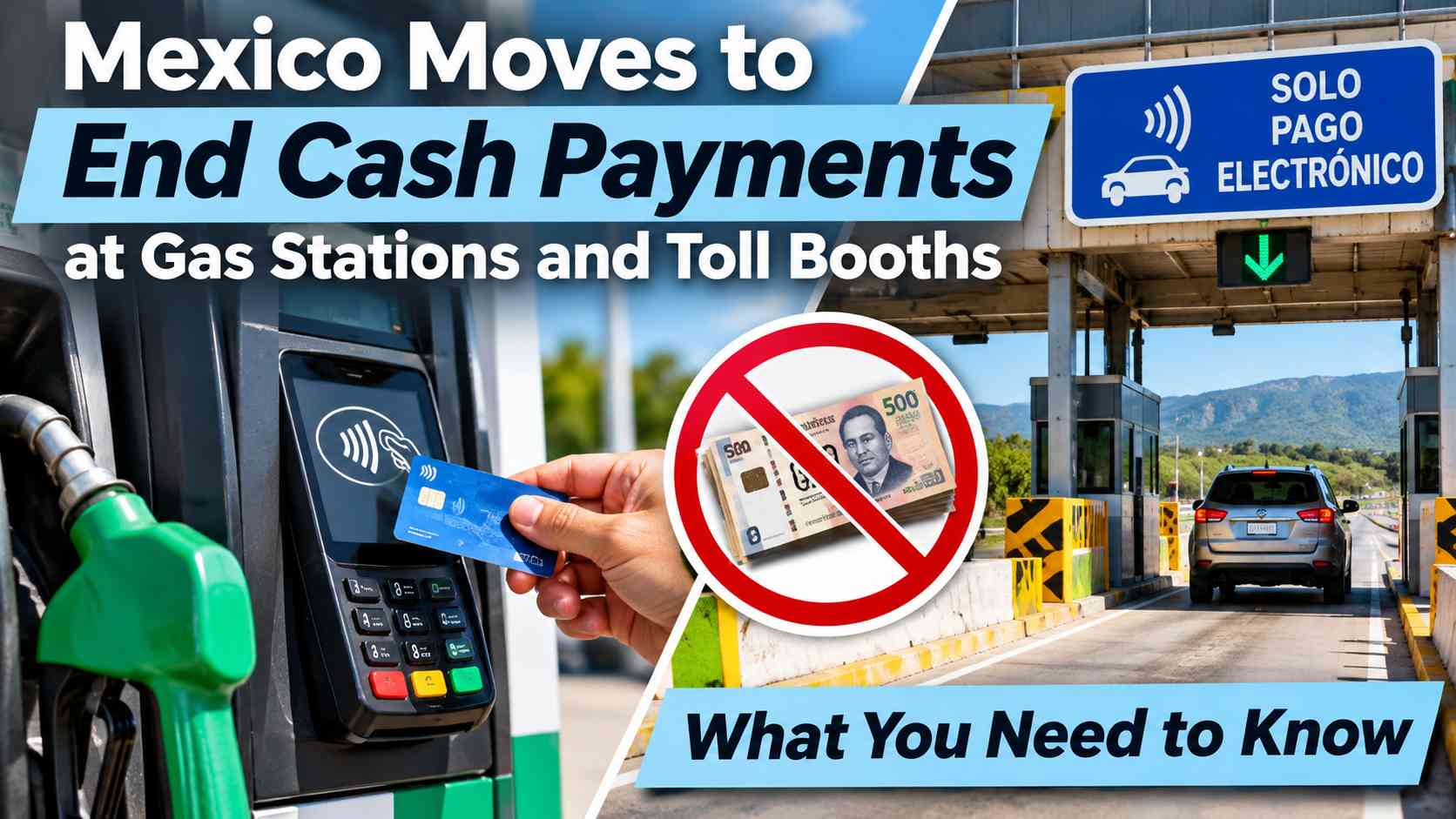
Mexico begins phasing out cash payments at gas stations and highway toll booths, with authorities given 15 business days to establish new rules.
Mexico City, Mexico, November 27, 2026 – If you’re accustomed to keeping a few hundred pesos in your car to pay for gasoline or highway tolls, that may soon become a thing of the past.
Mexico’s Ministry of Finance and Public Credit (SHCP) published an agreement Friday officially designating gasoline and diesel retailers and highway toll booths as the first two activities where electronic payments will become the exclusive method of payment.
The agreement published in the Official Gazette of the Federation gives the authorities responsible for each sector 15 business days to establish the rules, requirements and transition periods for moving away from cash.
For millions of Mexican motorists, foreign residents and tourists who drive in Mexico, the decision could fundamentally change something as routine as filling up the car or taking a toll road.
However, you don’t need to empty your glove compartment of pesos just yet.
When will Mexico stop accepting cash at gas stations?
Although the Hacienda agreement took effect Friday, that does not mean gas stations and toll booths must immediately stop accepting cash.
The transition will be gradual, with implementation deadlines established separately for each activity.
As El Economista explains in its coverage of the new agreement, authorities are expected to publish those regulations by December 18.
That is the expected deadline for publishing the rules, not necessarily the date when cash payments will end.
The measure follows the publication of Mexico’s new Digital Economy Law for Digital and Electronic Payments on November 4, which established the legal framework for introducing exclusively electronic payments in designated sectors.
Vallarta Daily previously reported on Mexico’s plans to reduce its dependence on cash transactions in February.
Friday’s announcement moves that initiative from a broader government policy into specific activities that affect people’s daily lives.
Why gas stations and toll booths were chosen first
The government has different reasons for targeting these two activities.
At gas stations, the primary objective is to increase financial transparency and combat the illegal sale of fuel, a longstanding problem in Mexico commonly associated with the practice known as huachicol.
Electronic payments create financial records that authorities can use alongside fuel inventory and sales records to identify possible irregularities.
Hacienda also argues that reducing the amount of cash handled by gas stations could lower operating costs and security risks.
In April, the federal government reached an agreement with banking industry representatives to temporarily reduce certain transaction fees associated with electronic payments at gas stations, helping prepare the industry for the transition.
At highway toll booths, the objective is more practical. The government wants to get vehicles through toll plazas faster and reduce the long lines that frequently develop during holiday weekends and busy travel periods.
According to transportation standards referenced in the Hacienda agreement, lanes accepting both manual and electronic payments can accommodate approximately 600 to 700 passenger vehicles per hour. Lanes dedicated exclusively to electronic toll collection can handle between 900 and 1,200.
Whether those improvements materialize nationwide will depend on the infrastructure installed and how easily motorists can use it.
Will everyone need a credit card?
Not necessarily.
The new law recognizes several forms of electronic payment, including:
- Credit and debit cards.
- QR code payments.
- Contactless payments using compatible smartphones and smartwatches.
- Electronic bank transfers.
- Other electronic payment systems recognized by the relevant authorities.
Electronic toll collection devices, commonly referred to as TAGs in Mexico, are also expected to play an important role in the transition.
However, recognizing several payment methods under the law does not necessarily mean every gas station and toll booth will be required to accept all of them.
That is one of the details the forthcoming regulations will need to address.
Ideally, motorists would have several ways to pay rather than finding themselves dependent on a single payment system or financial institution.
What happens when the internet goes down?
Anyone who has spent much time traveling around Mexico probably recognizes the potential problem here.
Payment terminals occasionally stop working. Internet connections disappear. Power outages happen, particularly in smaller communities and more remote areas of the country.
The legislation does anticipate those situations.
Article 15 of the Digital Economy Law permits payments in cash or by check when extraordinary circumstances prevent an establishment from processing electronic transactions.
Businesses will not, however, be allowed to routinely use equipment failures as an excuse to avoid complying with the electronic payment requirements.
The practical question is how those exceptions will work.
If a gas station loses its internet connection, will employees immediately be authorized to accept cash? If an electronic toll system stops functioning during a holiday weekend, how will motorists continue their journey?
The sector-specific regulations are expected to establish procedures for dealing with those situations.
Mexico is still a country that relies heavily on cash
Perhaps the biggest challenge facing the government is that electronic payments have not yet become part of everyone’s daily routine.
According to the 2024 National Financial Inclusion Survey conducted by INEGI, 85.2% of Mexicans between the ages of 18 and 70 reported cash as their most frequently used payment method for purchases of 500 pesos or less.
Even for purchases exceeding 500 pesos, 73.5% reported primarily using cash.
Those percentages have declined since 2021 as electronic payments have become more common, but they illustrate just how deeply cash remains embedded in Mexico’s economy.
There is also a considerable difference between choosing to pay in cash and having no practical alternative.
Some people do not have bank accounts. Others live in communities with limited access to banking services or reliable internet connections.
For those individuals, purchasing gasoline could become considerably more complicated unless affordable and accessible payment alternatives are introduced alongside the new requirements.
Simply not having a bank card is not among the extraordinary circumstances currently defined by the law for accepting cash payments.
What does this mean for foreigners and tourists in Mexico?
For Americans, Canadians and other international visitors who drive in Mexico, one of the biggest unanswered questions is whether foreign-issued credit and debit cards will be accepted consistently.
Friday’s agreement does not establish specific requirements concerning internationally issued cards, foreign bank accounts or electronic payment applications that may require a Mexican telephone number or bank account.
These are important details for a country that welcomes millions of international visitors.
Consider a Canadian couple driving their vehicle to Puerto Vallarta for the winter, or an American tourist renting a car for a week. Neither should reasonably be expected to open a Mexican bank account simply to purchase gasoline or travel on a toll road.
Rental car companies may also need to adjust how they handle electronic toll payments, including whether vehicles come equipped with toll devices and how customers are subsequently charged.
For residents traveling between Puerto Vallarta and Guadalajara, where highway tolls have already become a significant travel expense, knowing which payment methods are accepted along the route will become another consideration when planning a trip.
Until the new regulations are published, motorists should continue carrying sufficient cash and, when possible, an alternative electronic payment method.
Will cash eventually disappear from other Mexican businesses?
Friday’s agreement applies specifically to the retail sale of gasoline and diesel and the collection of highway tolls.
It does not prohibit cash payments at restaurants, supermarkets, hotels, neighborhood stores or other businesses across Mexico.
However, the legislation gives Hacienda the authority to designate additional economic activities for similar payment requirements in the future.
That makes the experience at gas stations and toll booths particularly important. How smoothly the transition works, how consumers respond and whether financial accessibility improves could influence future government decisions about cash payments elsewhere.
For now, Mexican pesos remain legal tender, and Friday’s announcement should not be interpreted as a nationwide prohibition on cash transactions.
What motorists should expect next
The next important development will be the publication of the implementation rules, expected by December 18.
Those regulations should provide greater clarity about when gas stations and toll booths must stop routinely accepting cash, which electronic payment methods will be available and how businesses must respond when payment systems fail.
They may also answer questions about foreign-issued bank cards, transition periods and accommodations for people without access to conventional banking services.
The potential benefits are understandable. Shorter lines at toll booths, improved financial transparency and fewer cash-related security risks are worthwhile objectives.
The challenge will be achieving those benefits without making essential services less accessible to the people who depend on them.
Mexico has officially decided where its transition away from cash will begin. Now comes the considerably more complicated task of making it work.