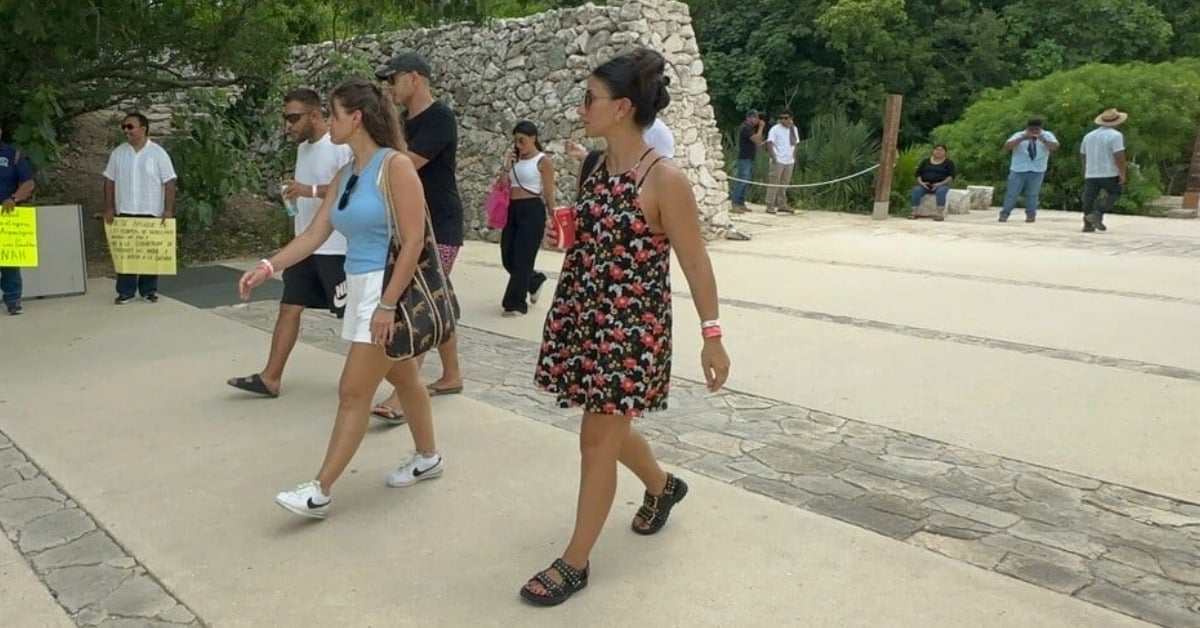
Residents and small business owners in Tulum say something is broken at Jaguar Park. They describe a place where rules shift at the gate, fees feel punitive, and decision-makers don’t answer basic questions. Their anger intensified after a local report accused park administrators of internal theft, nepotism, and irregular charges—claims that stemmed from months of frustration over access and prices. The operator, Grupo Mundo Maya, rejects the broader narrative, stating that locals get in free, with a new Sunday-free entry policy for Mexicans.
Alleged military abuses
A piece in Sol Quintana Roo alleged a string of abuses inside Parque del Jaguar—among them a 200,000-peso theft attributed to outsiders, favoritism in hiring, and staff pocketing currency-exchange spreads by underreporting dollars received at the gate. The story also described ignored agreements with the Tulum municipal government and “cobros indebidos” that left visitors and workers feeling squeezed. The outlet attributed the problems to the park’s current military-led administration.
The specific allegations of theft and nepotism have not been detailed by authorities in public statements. Still, they sit within a broader conflict that is on the record: a high-profile fight over who pays, who enters, and under what conditions. On August 26, Tulum’s mayor publicly accused Grupo Mundo Maya—an Army-run state company that operates the park—of breaking a deal to guarantee free access for locals and easy access to the beach.
Who runs the park—and what residents say
Jaguar Park is managed by Grupo Mundo Maya (the state firm born from the Olmeca-Maya-Mexica holding), which the federal government placed under the Army’s umbrella. The company’s own site lists Jaguar Park among the assets it operates.
Locals say that structure has come with opacity. Complaints have spread in recent weeks over what residents call “triple charges” to access the beach and ruins now located inside the park. La Jornada Maya and other regional outlets have documented pushback from tourists and merchants, citing fee levels and the practical obstacles to free entry.
Fees, access rules, and the law
Multiple outlets have reported posted prices that top 415 pesos for foreigners and around 255 pesos for Mexican visitors, with discounts for Quintana Roo residents and free entry for documented Tulum residents. Those figures match rate snapshots published by Luces del Siglo during the dispute.
At the core is a fundamental legal point: Mexican beaches are public. The 2020 reform to the Ley General de Bienes Nacionales guarantees free access and transit on the nation’s beaches and empowers authorities to sanction those who obstruct it. In practice, access can still hinge on gatekeepers, pathways, and overlapping fees—especially when protected areas, archaeological sites, or concessions are involved.
What Grupo Mundo Maya says
Grupo Mundo Maya says the promise stands: locals enter free with proof of residence. After days of pressure, the operator also announced that all Mexicans will have free access on Sundays starting August 31, and noted that INAH already waives its charge for nationals on Sundays. That leaves CONANP’s component as the last piece to align for an entirely free Sunday inside the park.
The company and its affiliated outlets have reiterated that message across statements this week, emphasizing that the project aims for conservation and “ordenamiento” in a fragile area that has been plagued for years by disorderly tourism and informal commerce. Critics counter that “order” without clear rules and community buy-in appears to be exclusion.
Why the allegations matter
Even if only parts of the local exposé prove out, they hit sensitive terrain: public trust in the Army’s growing role in civilian tourism assets, from airports to parks. Jaguar Park is a new, high-profile development tied politically to the broader Maya Train project. It was also sold locally as a conservation-first reset for Tulum’s coast. If residents experience it as a paywall—and vendors as a closed shop—the social license erodes fast.
Look for paper trails. If an internal theft happened, there should be a complaint number. If currency irregularities occurred, the audits—whether internal or from the Treasury—should surface. And if Sunday is now the free day for Mexicans, watch whether CONANP harmonizes its charge so that “free” means free all the way from the parking lot to the shoreline and ruins. Meanwhile, the mayor is still pressing, and residents continue to watch the gate.