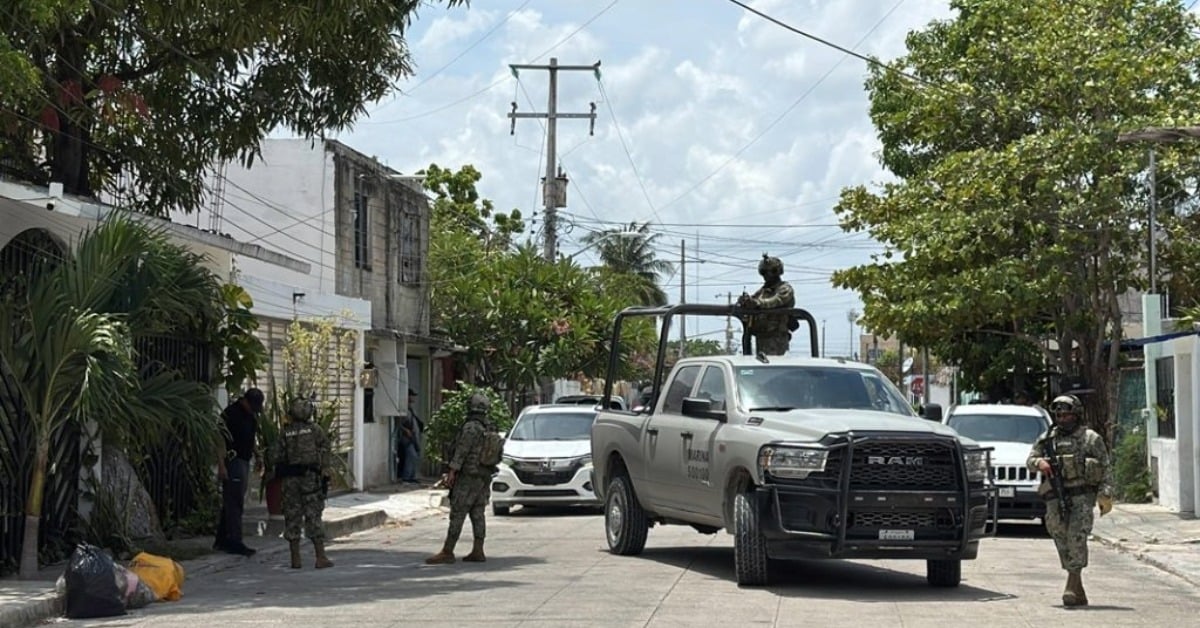
Shortly after 1 p.m. On Thursday, authorities from all three levels of government raided two addresses in Cancún, arriving almost back-to-back with search warrants. The first team entered a home behind the municipal fire station in Region 100, near the intersection of streets 24 and 123. About an hour later, a second team hit a property along Avenida Francisco I. Madero—better known locally as Ruta 4—near the corner with Bonampak in Region 68. Homes were sealed once agents cleared them. Officials had not detailed seizures or arrests at press time.
The operations drew a heavy security perimeter. State investigative police led the entry, while the National Guard, Army, Navy, and state police maintained the cordon. That multi-agency footprint has become standard in Benito Juárez municipality as officers serve court-authorized “cateos” focused on street-level dealing. Local outlets that monitored both scenes reported the exact timetable and locations, with matching descriptions of how the searches unfolded.
Anti-drug raids in Cancún
In Mexico, a cateo is a judge-approved search. It allows prosecutors to enter and secure a property tied to an ongoing investigation. When cateos target narcomenudeo—small-scale drug sales—the legal aim is to preserve evidence and, when possible, take suspects before a control judge within constitutional time limits. Thursday’s actions fit that model: the sites were secured and sealed while prosecutors prepared to disclose results. At least one outlet noted that the Region 100 warrant may be tied to a separate homicide investigation; however, authorities have not confirmed this linkage.
What officials have confirmed—and what remains pending
By early Friday, the Quintana Roo Attorney General’s Office had publicized other narcomenudeo milestones this week, including judges linking several defendants to trial in Benito Juárez on unrelated cases. That shows the broader enforcement backdrop, though prosecutors had not yet issued a results bulletin specific to Thursday’s two searches. We will update when they do.
A pattern of warrant work across August
The two Cancún cateos follow a month of stepped-up search activity. On August 20, authorities executed three simultaneous warrants in different parts of the city, seizing drugs and equipment and detaining three people, according to contemporaneous reports. Two days later, separate cateos in the Jardines del Sur and La Joya areas led to drug seizures but no arrests. Earlier in August, the state prosecutor highlighted 12 cases across four municipalities in a weekly enforcement recap. Together, those actions frame Thursday’s raids as part of a sustained push rather than a one-off event.
Why these two locations matter
Region 100 sits along the Chac Mool corridor and backs onto the fire station complex—terrain with quick highway access and dense housing stock. Region 68 abuts central arteries; Avenida Madero funnels to Bonampak and the hotel zone via López Portillo and Tulum Avenue. For street-level sellers, that geography offers foot traffic and escape routes. For the police, this argues for coordinated entries, quick site control, and layered outer rings—exactly what witnesses described as federal and state forces holding the perimeter.
What readers should watch next
Expect an official bulletin detailing any seizures, detentions, and case numbers once chain-of-custody work is complete. If suspects were detained, prosecutors typically have 48 hours—extendable in some cases—to seek charges before a control judge. If no one was inside, the case can still advance on the strength of the evidence collected during the warrant. Either way, Thursday’s operations continue the state’s August pattern: frequent cateos, swift sealing of properties, and steady movement of narcomenudeo cases into the courts.