An accident at Residencial Aqua has moved beyond the first emergency reports. AMPI Cancún is defending the development’s permits while pointing to an outside contractor chosen by condominium owners. Fiscalía investigators are now reviewing the collapse, and the questions are getting bigger than one gate. In Cancún’s fast-growing Huayacán corridor, where real estate confidence leans heavily on paperwork, supervision, and trust, the case has landed at a sensitive moment for the property market.
Aqua Accident Tests Confidence in Cancún Real Estate
An accident at Residencial Aqua in Cancún has pushed a construction-site tragedy into the property sector, where confidence often depends on permits, supervision, and the belief that someone checked the work before concrete went up.
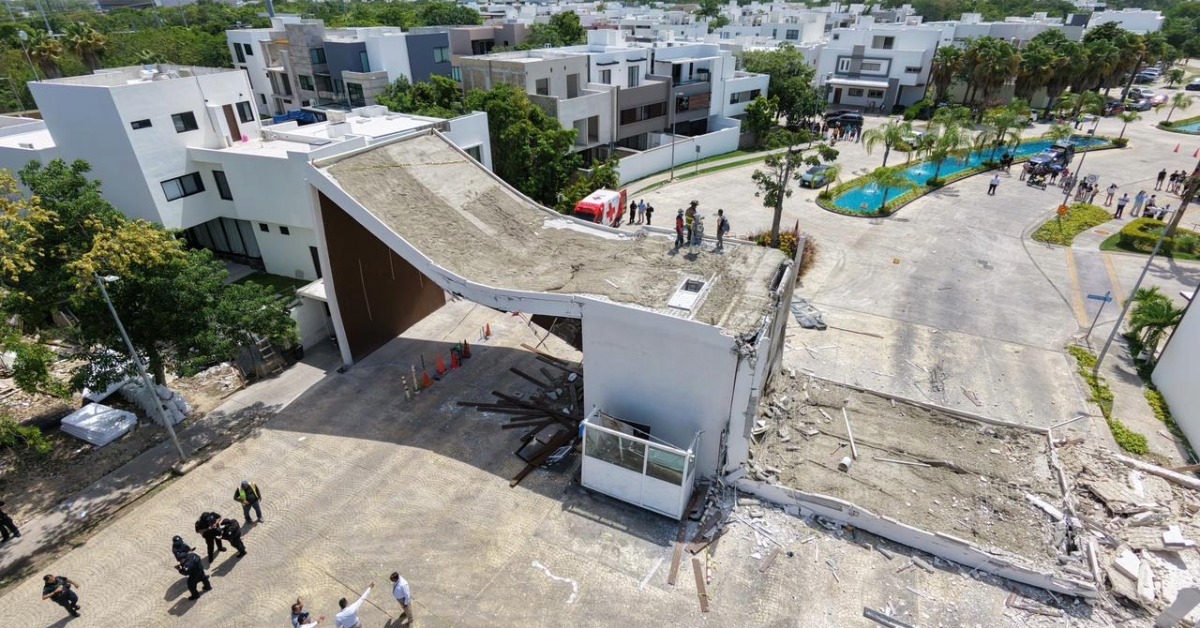
The collapse happened Friday, June 5, at the access area of the residential complex on Avenida Huayacán, one of Cancún’s fastest-growing corridors. Municipal authorities said the first 911 report came at 2:03 p.m. for the collapse of an access-booth structure. Protección Civil, firefighters, municipal police, transit officers, ERUM, and the Red Cross worked at the site during the first rescue and debris-removal response.
The first public update confirmed one death while rescue work continued. A later Fiscalía update put the toll at two deaths and seven people injured, with the state agency opening an investigation for culpable homicide, injuries, and property damage. The injured were receiving care in different hospitals, and authorities said none of those injuries were life-threatening.
Fiscalía officials said civil engineering and structural experts were assigned to determine the cause of the collapse at the complex, which the agency located in Supermanzana 330 of Benito Juárez. That finding will shape the legal file. It will also shape the extent of the damage the case does to Cancún’s real estate confidence.
AMPI points to an outside contractor
AMPI Cancún president Dafnee Fuentes Trujillo said the development itself had the required paperwork and should not be treated as an irregular project solely because of the accident.
“The development itself complies. It has its permits and licenses. This is the first project not carried out through the developer group, but by an outside group,” Fuentes said in Spanish.
She said Aqua has operated since 2007 and 2008 with the required documentation and without a similar accident history. According to AMPI Cancún’s account of the case, the work involved in the accident was not handled by the original development group. It was carried out by a company contracted after a vote in a condominium owners’ assembly.
That distinction is central to AMPI’s position. The group is trying to separate Residencial Aqua’s permits from the execution of a specific job inside the development. Fuentes said the Fiscalía must determine the cause and establish responsibility.
She also acknowledged the wider damage. “It affects the plusvalía of any development and mainly of the state,” Fuentes said in Spanish. “People talk about builders without quality, when really it was an accident that could have been avoided, and there is a responsible party who must answer.”
Fuentes warned that permits do not remove every risk. A project can have authorizations in order and still face problems if a contractor fails to follow technical or structural specifications during the work. She called for stronger supervision, background checks on builders, and close review of executive plans before work begins.
Owners ask for documents and answers
A written message attributed to owners and neighbors asked for “a clear and documented explanation” from the administration, the board, the company responsible for the work, and the developer group related to Aqua.
The same message said owners had raised concerns for weeks about the execution, supervision, and safety of the access-portico work. It also referred to an investment of about 4 million pesos and recent talks over possible extra maintenance fees.
“Residents deserve transparency, safety, and answers,” the message said.
Owners asked who supervised the work, what technical opinions were available, and who would assume responsibility so that the financial cost would not fall back on condominium owners.
Huayacán growth is now part of the story
Avenida Huayacán has become a major real estate corridor in southern Cancún, with residential and commercial expansion spreading along the road.
Weeks before the Aqua collapse, AMPI Cancún described Huayacán as one of the areas drawing strong interest from investors and developers because of that expansion. Fuentes also said the Polígono Sur had gained weight because of the planned financial and technology district, while warning that fast growth requires stronger roads and public services.
In the same market comments, Fuentes said Cancún was seeing annual plusvalía increases of 8 to 12 percent. She also warned that some projects face legal, administrative, or planning problems and urged buyers to review carefully before purchasing.
The Aqua case is not being presented by AMPI as a permit problem. It is being presented as a problem between supervision and the contractor. Still, confidence tends to flatten those distinctions. Buyers see a collapsed access structure. Investors ask who approved the work. Owners ask who was watching.
Cancún officials have spent the last year trying to link real estate growth with order. At an AMPI forum in 2025, Mayor Ana Paty Peralta said the city had taken action against irregular developments and property sales lacking permits.
That same tension has appeared across Quintana Roo. Recent coverage of the Quintana Roo property boom has highlighted warnings about projects outside the rules, and Cancún has previously closed developments lacking permits. The Aqua accident now raises a different question. A project can have documents, but the work still has to be completed.