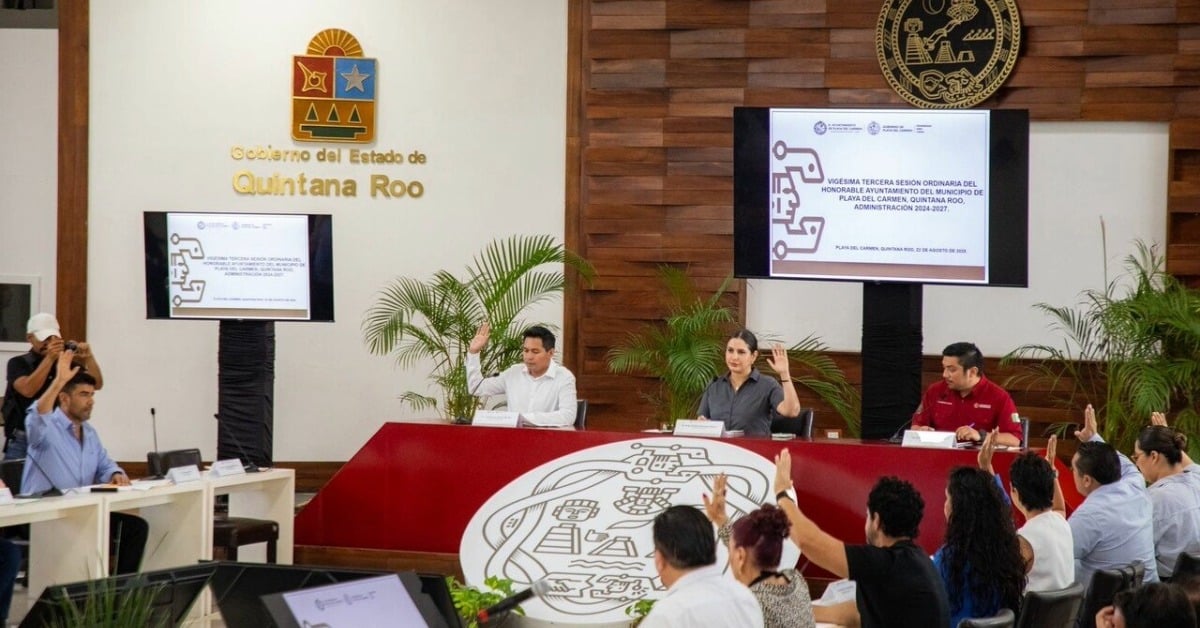
Playa del Carmen gave itself a unifying shade. The city council voted to make “Arena Playa” (Beach Sand) the permanent civic color across public works and facilities. The mayor framed the move as a nonpartisan identity decision that leaves partisan palettes behind. The vote came in the 23rd regular session and passed unanimously.
Arena Playa official color of Playa del Carmen
Under the agreement, the color becomes mandatory on municipal infrastructure used by the public. That includes parks, sports units, and cultural venues. A technical manual will standardize applications across departments.
City officials said the rollout will be gradual and tied to budget availability. Oversight will fall to Infrastructure and Public Services, while the Institutional Image office writes and enforces the manual.
Why the city chose a neutral tone
For years, municipal projects across Mexico often reflected the colors of the ruling party. The new standard bars any color tied directly or indirectly to political parties. The goal is a stable identity that survives election cycles and helps residents recognize city assets without partisan cues.
This approach aligns with long-standing neutrality rules in Mexican law. Article 134 of the Constitution requires impartial use of public resources and restricts propaganda that favors any party or person. Municipal identity systems are one way local governments operationalize that principle in day-to-day work.
Changing or replacing “Arena Playa” will require a two-thirds vote of the council with justification. The city also emphasized enforcement. Departments that build or maintain facilities must apply the standard, and the image office will monitor compliance. The plan avoids overnight repainting; the city will transition as projects and budgets allow.
Identity manuals are standard tools in Mexico. Major municipalities issue them to regulate everything from color swatches to sign dimensions. Puebla and Mexico City publish such guides to keep public-facing materials consistent and nonpartisan. Playa del Carmen’s forthcoming manual follows that pattern.
A city with a new legal name
The identity shift dovetails with a larger change. Earlier this year, the state congress approved “Municipio de Playa del Carmen” as the official name, replacing “Solidaridad.” The decree took effect on March 20, 2025. City messaging and manuals now reflect that legal update.
Residents may overlook immediate repaints, but the standard should show up on new benches, shade structures, and wayfinding as projects move forward. Over time, the city’s physical footprint should present a single, clear visual identity rather than shifting with politics.
Standards are only as strong as enforcement. By tasking specific departments with oversight and publishing a manual, the city creates a paper trail for compliance. Residents and watchdogs can request the manual and monitor whether new works follow the rules. That transparency matters when aesthetic choices meet public money.
The policy also signals a broader push to detach city identity from election cycles. A color might seem minor, but it shapes how people read ownership of public space. Neutral design lowers the temperature and promotes continuity. In a fast-growing beach city, that consistency is part of service delivery.