You feel San Miguel de Allende before you see it. The bell towers, the cobblestones, the pink stone of the parish church, catching late afternoon light. It is a city where strict rules and stories guard the façades, which are told through color and texture as much as through words. Building something new here is never neutral. It is an intervention in a place that many residents consider almost sacred.
That tension sits at the heart of Artesanto, a housing development rising in Distrito Corazón, just beyond the historic core. On paper, it is a mixed-use project with homes, green areas, and commercial spaces. In practice, its ambition is bigger. Artesanto is trying to answer a question that has haunted San Miguel since it became a UNESCO World Heritage Site in 2008: how do you add new housing without turning the city into a generic postcard backdrop?
The stakes are real. Since the UNESCO designation, San Miguel has experienced a sharp rise in real estate development along its edges, often on former agricultural or artisan land. A local real-estate association estimates that the supply of new residential projects around the city jumped by more than 40 percent between 2019 and 2024, much of it in gated complexes that could sit almost anywhere in Mexico’s booming Bajío region.
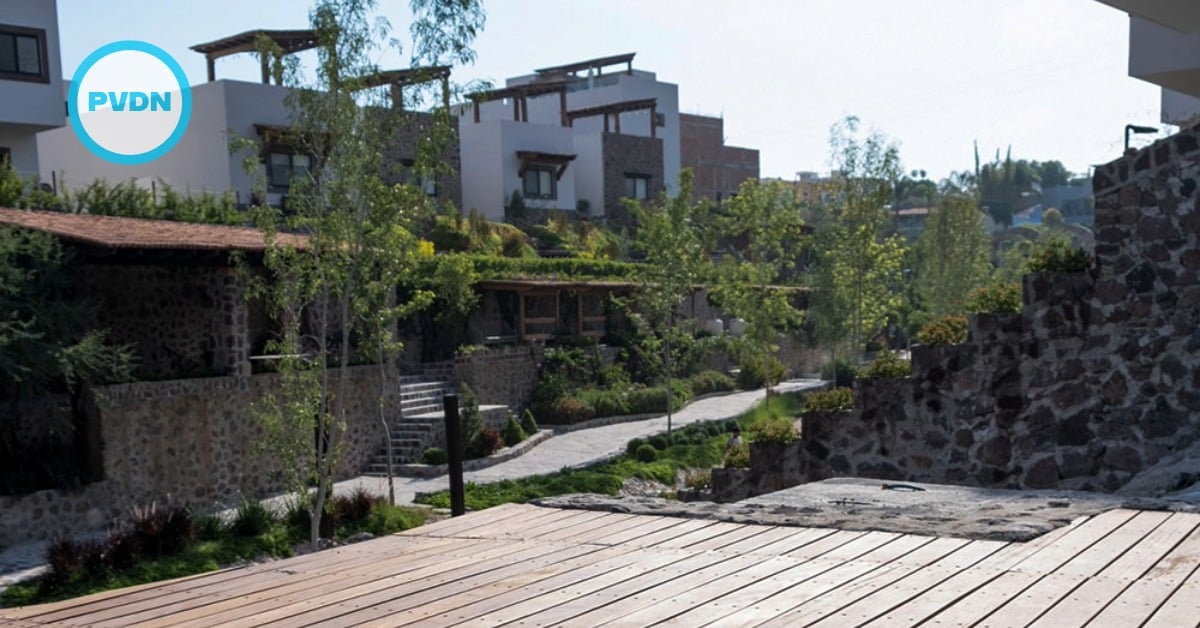
Against that backdrop, Artesanto presents itself as a counter-proposal. Instead of borrowing a global style and dropping it on local soil, its architects start from the visual language people already know: earthy colors, human-scale streets, recessed doorways, ironwork, clay tile, and stone. The aim is not to copy an 18th-century alley but to let those references shape contemporary forms.
Building memory into new walls
Walk through the first courtyards, and that approach becomes clear. Volumes are broken down into smaller fragments so that no single block overwhelms the view. Passageways bend rather than run in straight, exposed lines. Patios open suddenly, catching light the way old colonial homes do when a heavy wooden door swings inward and a hidden garden reveals itself.
Materials do much of the narrative work. Instead of uniform concrete and imported finishes, Artesanto leans into clay, stone, and wood sourced from the region. Walls are designed to feel textured to the hand, not sealed behind high-gloss coatings. Floors and stair treads echo the tones of San Miguel’s streets, tying private spaces back to the city outside.
Those choices are not only aesthetic. Thick walls and breathable finishes help regulate temperature in a high-altitude climate that swings from hot afternoons to cool nights. Deep windows reveal and wooden lattices shade interiors, letting light through. Interior patios pull in air and sky, creating cross-ventilation that reduces the need for mechanical cooling. In a country where architects and activists are reviving earth-based construction to cut cement use and carbon emissions, these passive strategies place Artesanto into a broader movement to rethink how homes breathe and age.
The layout also tries to keep life at eye level. Instead of turning its back on the surroundings, the project creates pedestrian routes, plazas, and small commercial spaces intended to stitch into the everyday city. Cafés, coworking rooms, and neighborhood services are planned within walking distance of homes, reflecting the idea that a good house is not only four walls but also the routes people take to get coffee, buy tortillas, or meet a friend after work.
This ambition to “build with memory” is not nostalgic. The developers speak openly about San Miguel’s role as an economic magnet, drawing investors, remote workers, and executives from the nearby industrial corridor that stretches through Guanajuato. The promise is that new residents can plug into that regional economy without retreating into sealed-off enclaves or forcing the historic center to carry all the weight of growth.
Artesanto San Miguel living
What does that look like on an ordinary day for someone who actually lives there? Imagine waking up to a courtyard instead of a parking lot. Morning light filters through wooden screens, not reflective glass towers. You walk downstairs, and the air moving through the patio is cool enough that you do not reach for an air conditioner. Cross-ventilation and shaded circulation spaces do their quiet work in the background.
From your front door, you can choose to wander toward the historic center on foot, following established streets into the 64-block core that UNESCO recognized for its colonial architecture, or stay within the district and still find a café, a small gym, or a coworking space without getting in a car. For a city struggling with traffic from tourism and commuting, that kind of “walking distance” living is not just a lifestyle perk. It is part of a strategy to reduce pressure on roads and parking in the old town.
Inside the homes, comfort is framed less around spectacle and more around how rooms feel over time. Large windows are placed to catch views of the landscape and church towers without exposing interiors to the harsh western sun. Terraces and roof gardens extend living space outdoors, picking up on a regional tradition of spending evenings on flat roofs and balconies once the heat has faded. Water management systems, including rainwater capture, are built into the infrastructure, acknowledging both the semi-arid climate and the growing conversation about scarcity in central Mexico.
There is also an economic and social layer to this design story. Project information highlights the deliberate hiring of local craftspeople and suppliers, including stone masons, ironworkers, and carpenters. In a market where many developments import standardized components, that decision keeps part of the construction budget circulating in San Miguel and nearby towns. Advocates for bioconstruction and green housing in Mexico argue that this kind of local value chain is as important as any solar panel for long-term sustainability.
None of this erases the hard questions that hang over any high-end project in a popular, already pressured city. Artesanto is clearly aimed at buyers with significant resources, including foreigners and executives connected to the Bajío’s industrial boom. Housing activists in San Miguel point out that rising land values and luxury developments have pushed many workers to outlying areas with weaker services and longer commutes.
But the way a project is conceived still matters. If new housing is inevitable, the choice is between anonymous blocks that could belong to any city and places that actually extend San Miguel’s character rather than strip-mining it. By insisting on local materials, human-scale streets, and passive design, Artesanto plants its flag firmly in the second camp. It treats comfort as something that grows out of climate, craft, and memory, not just imported finishes.
For long-time residents, the objective measure will be how this development feels in a decade. Will it age gracefully, the way old cantera does in the center, or will it date as quickly as the trends of 2025? Will its plazas and walkways become real public meeting points, or stay semi-empty backdrops for marketing photos? The answers will depend on maintenance, management, and who actually moves in.
What is clear already is that San Miguel de Allende is at a crossroads. Tourism, nearshoring, and the city’s cultural cachet are pulling powerful forces into a small valley with finite space and water. Projects like Artesanto will not solve those structural pressures on their own. But they do suggest a path in which new walls still remember where they are built. In a place where architecture has become a kind of shared language, that memory may be the difference between a city that keeps its soul and one that slowly forgets it.