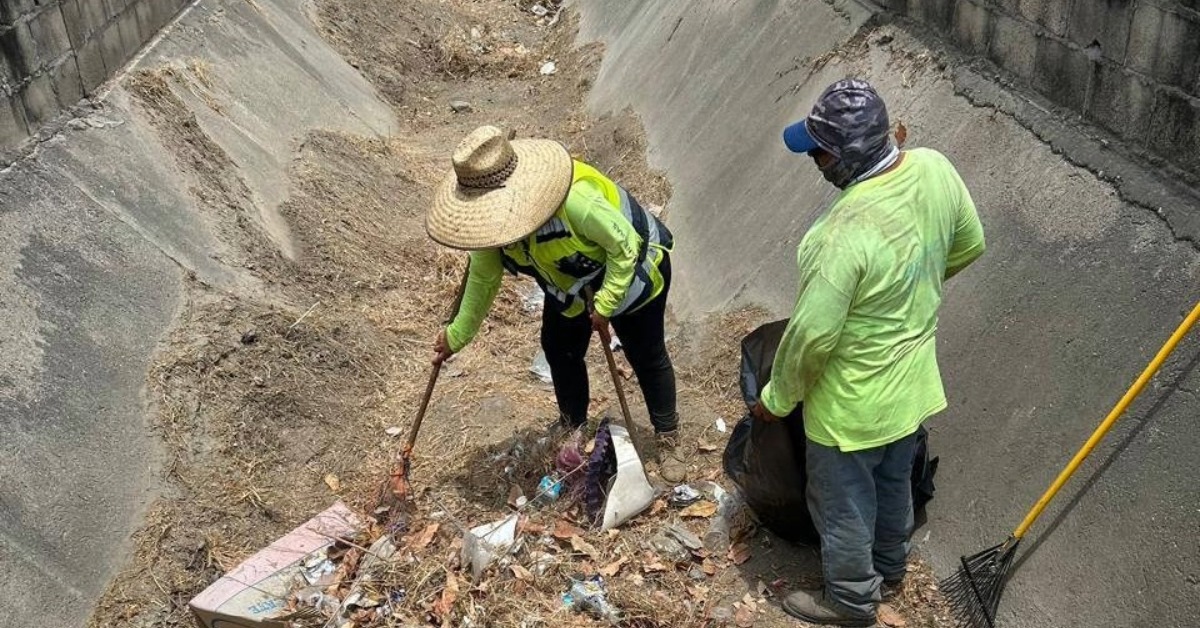
Bahía de Banderas is trying to finish the canal and drainage clearing before the first heavier June rains expose the weak spots. Officials say the work is moving fast, but not every channel is done. The more difficult test may come after the first storms arrive, when trash and loose debris begin moving through streets, arroyos, and canals. The full story looks at the remaining work list, the areas still pending, and the early-season risks.
Drainage work is still racing the calendar
Bahía de Banderas public services crews are still working through canal desilting and drainage clearing before the first heavier rains of June test the system.
José Ramón Álvarez, director of the Sistema Integral de Servicios Públicos, said the work was 72 to 73 percent complete as of Friday, May 29, according to a public-services update. He described the schedule as “contra reloj,” with the first rains expected around June 10.
That leaves the municipality in a narrow window. Álvarez said crews expected to reach 80 to 85 percent before the first rains if work advanced by 8 to 10 percent each week.
The work is part of a broader rainy-season preparation push by SISEP. A municipal announcement about canal desilting described the program as an effort to prevent flooding and improve stormwater flow through pluvial channels.
The unfinished points are specific
The remaining work list includes San Vicente del Mar, Mezcales, a drain behind Santa Fe, and the Sayulita arroyo. Those points matter because Bahía de Banderas mixes fast-growing urban zones, low-lying streets, and natural runoff from hillsides and arroyos.
Álvarez said the municipality expects to reach 100 percent in June. That does not mean the risk ends when the machinery leaves. He said crews would still need constant monitoring once rain begins, because the early storms move the loose material that has been sitting through the dry season.
His warning was blunt. The first rains are “las más peligrosas” because they drag trash and objects that can block channels.
That is the weakness in any pre-season cleanup. A channel can be cleared in late May and still be tested hard by one storm that pulls plastic, branches, soil, and household waste from streets, lots, and slopes.
The first storms are the messy ones
Early-season rain is rarely clean water falling into an empty system. It often carries the dry-season leftovers first. Trash that sat unnoticed along roadsides moves toward drains. Loose vegetation drops into channels. Mud collects around crossings and canal mouths.
That first flush can slow runoff before crews even know which points are blocked. It can also turn minor road problems into traffic hazards when water begins to move across streets.
The municipal risk work points in the same direction. In April, Bahía de Banderas said its 2026 risk atlas update included mitigation actions, such as cleaning and desilting canals in several cases.
That gives the current work a larger frame. This is not only routine maintenance. It is part of how the municipality is trying to reduce weak points before storms expose them.
Across the bay, the same pressure is showing up
Puerto Vallarta is dealing with a similar pre-rainy-season push. Vallarta Daily previously reported that Puerto Vallarta had reached 45 percent progress in its own river, arroyo, and canal clearing as crews worked toward a June 30 target in flood-prone areas.
The two municipalities do not share the same drainage system, but they share the same seasonal pressure. Heat builds. Clouds gather over the mountains. Then the first serious storms find the streets, canals, riverbeds, and low points that were neglected, blocked, or simply overloaded.
That is why drainage work before the rains is being watched more closely this year. Crews can remove sediment and vegetation. They cannot control what the first storms pull into the system.
Drivers should treat moving water as a hazard, not an inconvenience. A shallow-looking crossing can hide a drop, an open drain, or a faster current than it appears to have from the road. Local notices and storm warnings can change quickly once the first heavy storms settle over the bay.