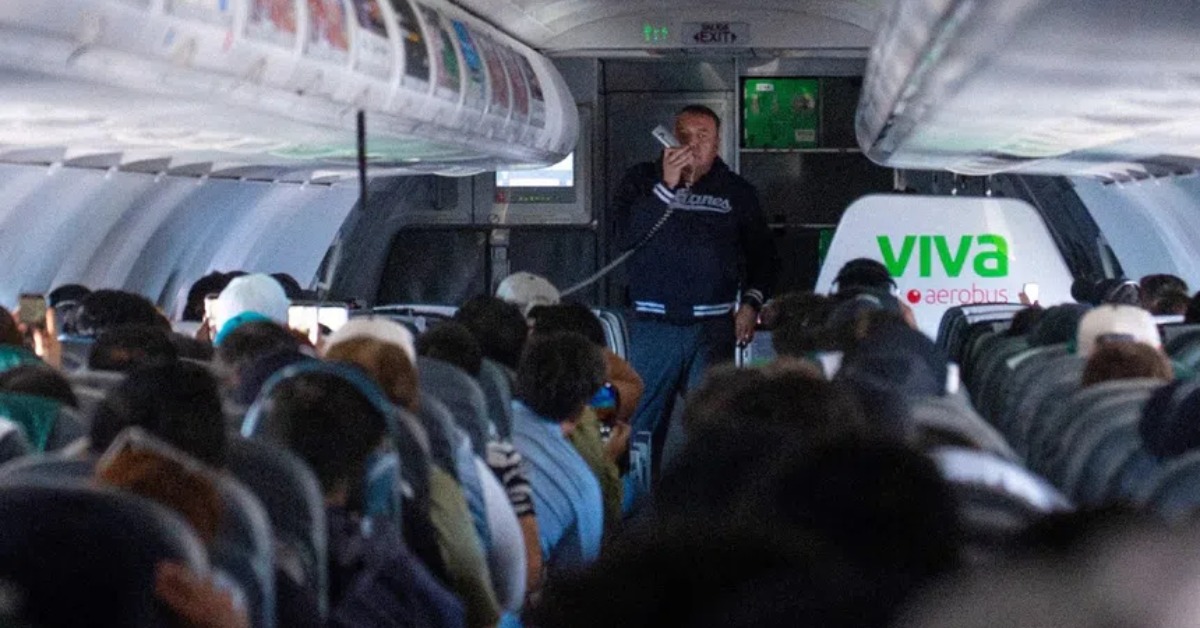
Passengers on a Viva Aerobus aircraft headed for Mérida faced a security delay at Mexico City’s main airport after a possible bomb threat triggered emergency protocols. The aircraft and luggage were inspected by airport security and specialized Navy personnel before authorities cleared the plane to continue its route. The incident ended without an explosive device being found, but it raised questions about how Mexico’s airports respond when a threat is reported.
Bomb threat protocol activated at Mexico City airport
A possible bomb threat involving a Viva Aerobus aircraft briefly disrupted operations Saturday at Mexico City International Airport before authorities cleared the plane to continue to Mérida.
The alert involved aircraft XA-VBM, which had arrived from Cancún as flight VB1029. The same aircraft was scheduled to continue as flight VB1104 to Mérida. It was parked at position 13 in Terminal 1 when the security report was made.
Airport security teams activated established protocols after the airline reported the possible threat. The aircraft and luggage were inspected, but authorities found no evidence of an explosive device.
The plane later resumed operations and departed for Mérida. The incident caused a delay but did not result in a confirmed security risk to passengers or crew.
What authorities inspected before clearing the flight
The response involved AVSEC airport security, the Unidad Naval de Protección Aeroportuaria, and members of the BLONAE explosive-device search-and-neutralization team.
Those teams inspected the aircraft and baggage in accordance with authorized airport procedures. The review was coordinated with AICM command officials.
After the inspection, authorities reported that no explosive artifact was found. The operation was then cleared to continue, and boarding resumed for the Mérida-bound flight.
For passengers, this kind of response can feel sudden and confusing. In aviation security, however, even an unconfirmed report can trigger a full inspection. Authorities do not need proof of a device before taking preventive action.
Why even unconfirmed threats lead to delays
Aviation security works on prevention. A report involving a possible explosive device is treated as a safety issue until it is ruled out.
That often means delays, extra inspections, and restricted movement around the aircraft. Luggage may be checked again. Security teams may also inspect cabin areas, cargo holds, and nearby airport zones.
For travelers, the result can look like a serious emergency. In many cases, the final finding is that no device existed. Still, the purpose of the protocol is to remove doubt before passengers and crew are allowed to continue.
Mexico City’s airport is one of the country’s busiest aviation hubs. A small security alert there can affect more than one route because aircraft often operate multiple legs on the same day. In this case, the same plane had arrived from Cancún and was scheduled to continue to Mérida.
What travelers should know if this happens
Passengers affected by a security delay should follow the crew and airport instructions first. Airline staff usually cannot give full details while the inspection is underway.
Travelers should keep identification, boarding passes, and medication with them. They should also wait for official instructions before leaving the gate area or attempting to rebook.
In Mexico, airport security incidents are handled by a mix of airport, aviation, and federal authorities. At AICM, the Navy also has a role in airport protection. That is why passengers may see uniformed personnel beyond airline staff and private security.
The safest approach is to avoid spreading unverified claims during an active alert. Posts on social media can move faster than confirmed information, especially when passengers are nervous or flights are delayed.
AICM has been testing emergency response procedures
The incident comes as Mexico’s aviation system prepares for heavier security and passenger loads ahead of the 2026 World Cup.
AICM recently carried out emergency-response exercises involving airport operations teams, rescue and fire personnel, the Navy airport protection unit, BLONAE specialists, aviation authorities, customs personnel, and a World Cup task-force group.
Those exercises are designed to test response times, coordination, and procedures. They also allow airport teams to identify gaps before a real emergency occurs.
The Viva Aerobus incident did not involve a confirmed device. Still, it showed how quickly airport protocols can affect a domestic flight when a threat is reported.
Mérida flight continued after security clearance
The aircraft was eventually allowed to continue its route to Mérida after authorities completed the inspection. No injuries were reported, and no explosive device was found.
For travelers flying through Mexico City, the case is a reminder that airport delays are not always caused by weather, staffing, or mechanical issues. Security alerts can also cause a flight to be paused with little warning.
The main takeaway for passengers is simple. A delay caused by a bomb threat protocol does not mean a device has been found. It means authorities are treating the report seriously until they can safely clear the aircraft.