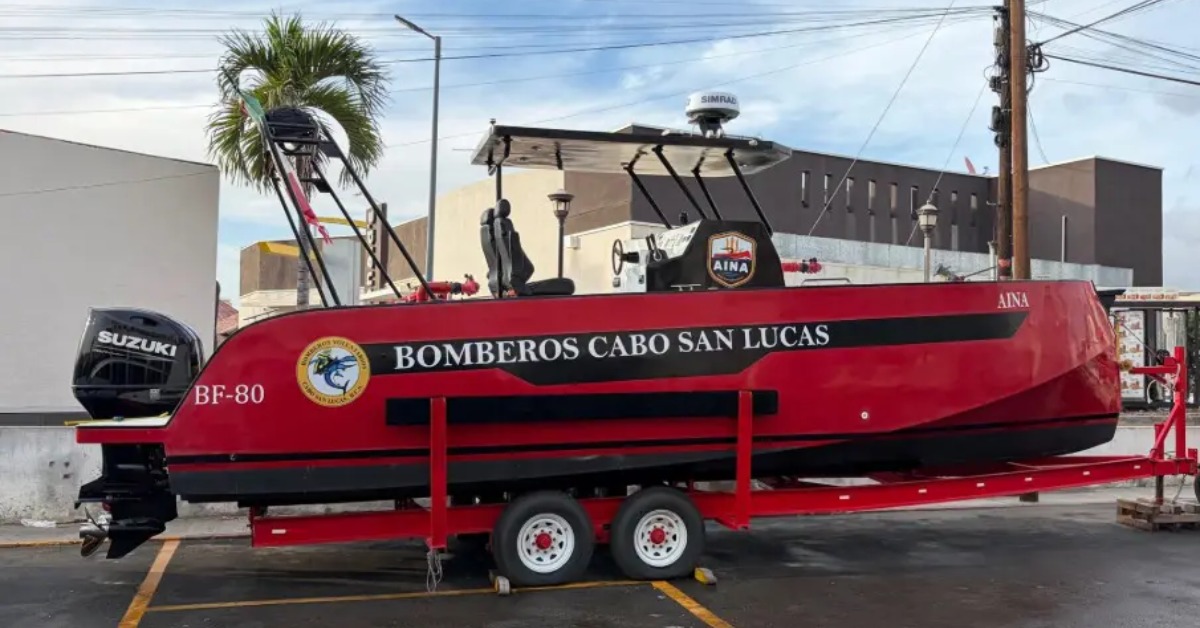
Cabo San Lucas has received AINA, described as Mexico’s first firefighting vessel operated by a local fire department. The boat is intended to improve response in a coastal area where tourism, sportfishing, private yachts, and marine services all operate in close quarters.
The arrival of AINA matters because fires at sea are different from fires on land. Access is harder. Waterfront congestion can slow response. In a marina or crowded bay, a fire can also spread fast from one vessel to another. A specialized unit gives firefighters a way to address that problem closer to the source, rather than waiting to respond from shore.
Local officials say six firefighters certified as mariners will operate the vessel. That detail is important. A boat like this is not only a piece of equipment. It also requires trained personnel who can handle marine navigation, onboard safety rules, and fire suppression in unstable conditions.
Why Cabo San Lucas says it needs a fireboat
Cabo San Lucas is not just a beach destination. It is also one of Mexico’s busiest marine tourism hubs. Its bay and marina handle constant traffic from fishing charters, sightseeing boats, luxury yachts, tenders, and service craft. That concentration creates economic activity, but it also raises the stakes when something goes wrong.
A fire in a marina can become a public safety problem in minutes. Fuel, fiberglass, electrical systems, and tightly packed vessels pose risks that are harder to manage than those of a normal structure fire. If a blaze breaks out near docks, hotels, or commercial areas along the waterfront, response time becomes critical.
That is part of the larger context behind AINA. The boat is meant to close a gap between land-based firefighting and marine emergencies. It gives Cabo San Lucas a unit built for the exact conditions that define the port: heavy vessel traffic, tourism density, and a waterfront where fire could threaten both boats and nearby businesses.
What the boat is designed to do
AINA was built specifically as a firefighting boat, not as a general patrol craft that was later adapted. Reports on the project say it includes pumping systems for saltwater and freshwater firefighting, as well as specialized equipment for marine fire response.
That design matters because marine emergencies need flexibility. A vessel may need to fight a fire on another boat, support an operation near the dock, or serve as a mobile water source during an emergency close to shore. In practical terms, the fireboat can bring firefighting capacity directly to where land units have the least reach.
Earlier reporting on the project also described AINA as a kind of mobile hydrant for the bay. That helps explain why the boat is relevant even beyond vessel fires. In a coastal emergency, it can expand the options available to first responders working in an area where access and water supply can shape the outcome.
The training behind the launch
The boat’s arrival also reflects a longer process than the public handoff suggests. Earlier reports said the project required maritime approvals, navigation tests, and operational certification before the vessel could enter service.
Training the crew appears to have taken close to a year. Firefighters involved in the program reportedly completed theoretical and practical preparation, including work at sea under authorized supervision. That is a major part of the story because a marine firefighting unit only works if the crew can operate safely under real conditions.
For readers outside Mexico, this point offers useful context. Municipal fire departments in the country do not usually have specialized marine units. In many places, water rescues or maritime emergencies depend on a mix of Navy, port, and civil protection resources. Cabo San Lucas is trying to add a local firefighting layer to that system rather than rely only on broader agencies.
How the project was funded
Reports on the project say the fireboat cost more than 5 million pesos. Funding was described as coming through private initiative and organized civil society in Los Cabos, with support tied in part to the local maritime community.
That funding model is also part of the story. In many Mexican cities, fire departments operate under financial pressure and often depend on a mix of public support, donations, and community backing. AINA is not only a new emergency asset. It is also an example of how local businesses and civic groups can push a public safety project forward when they see a direct need.
In a tourism economy like Los Cabos, the reasoning is easy to follow. Marine safety protects residents, workers, visitors, boats, marina operations, and waterfront businesses. A serious fire in the bay would not stay limited to one vessel for long. It could quickly become an economic and public safety event.
What AINA means for residents and foreign readers
For expats and foreign residents in Los Cabos, the new fireboat may sound like a niche story. It is not. It connects directly to how a fast-growing tourism city manages infrastructure and risk.
Many international residents live near the coast, use marina services, host visitors, book boat tours, or spend time in waterfront commercial areas. A stronger marine emergency response system affects daily life more than it may first appear. It can shape evacuation readiness, business continuity, and confidence in local emergency capacity.
AINA will not eliminate risk in Cabo San Lucas. But it does give the city a tool tailored to one of its most exposed spaces. In that sense, the boat represents more than a local milestone. It is a sign that the demands of modern coastal tourism are forcing more specialized responses in places that depend on the sea.