The visual scars are hard to miss. Boarded-up hotels near busy avenues, restaurants frozen in time, weed-choked empty lots wedged between apartment buildings. Now, Cancún’s city government says it wants to put names, numbers, and street addresses to those scars.
Local outlet Luces del Siglo reported that the Benito Juárez municipality is preparing a formal catalogue of abandoned buildings and lots in Cancún, with the goal of recovering or repurposing them to improve the city’s urban image and tackle safety concerns around long-neglected sites. Mayor Ana Paty Peralta has framed the effort as a way to “recover spaces” and respond to citizen complaints about derelict corners that feel forgotten by city hall.
According to officials, the catalogue will pull together information that today is scattered across departments: citizen complaints, property-tax and land-registry data, inspections by Civil Protection and Ecology, and reports from police and social-services teams. The idea is to identify which properties are truly abandoned, which are simply underused, and which pose an urgent risk to neighbors because of fires, crime, or health issues.
The catalogue will not, by itself, fix crumbling walls or clean out trash-filled patios. But it could give the municipality a much clearer map of where pressure on owners is needed, where legal action might be possible, and where the city should step in directly, whether to close unsafe buildings, negotiate new uses, or, in extreme cases, consider expropriation under existing regulations.
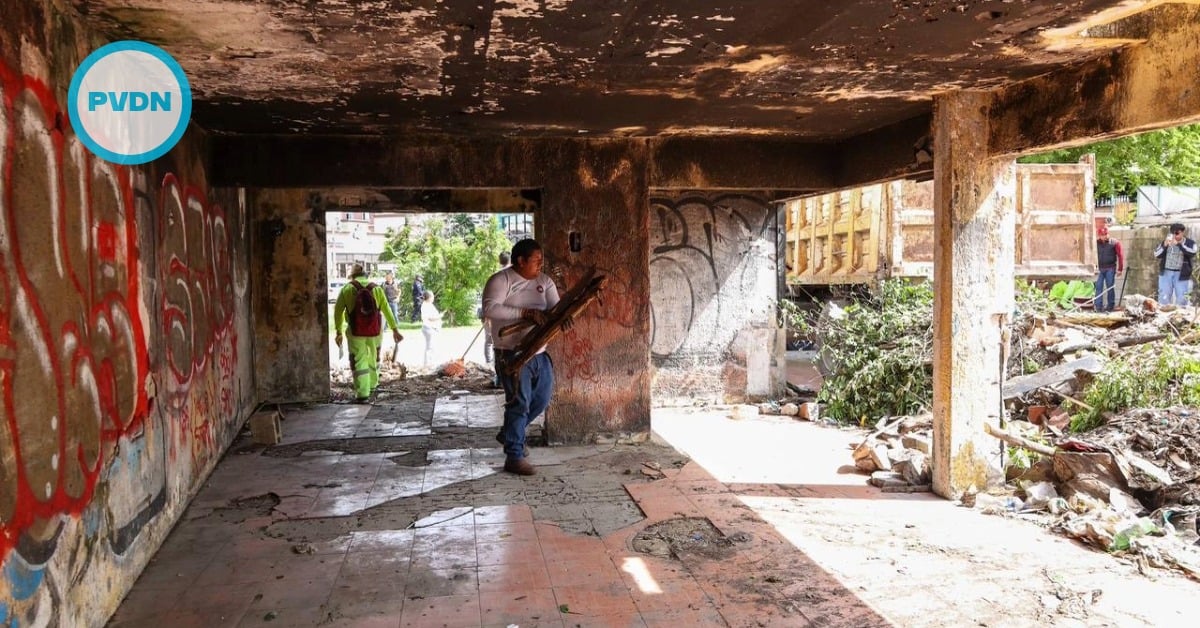
Recent operations show how far the city is already willing to go. In November, municipal crews moved at dawn to clean and secure a restaurant that had sat abandoned for five years on Yaxchilán Avenue in Supermanzana 24, described by authorities as a focus point for trash, pests, and risky activity. The action, documented in a municipal press release, combined public works staff, firefighters, police, and an addiction-treatment team, which removed at least one person from a street situation for rehabilitation.
Why Cancun abandoned properties are now a priority
Cancun abandoned properties are not just an aesthetic problem. They sit at the intersection of public safety, health, housing, and the city’s image as a tourist capital. Back in 2019, then-mayor Mara Lezama created a program specifically to pressure owners of vacant lots to keep them clean, warning that the city would step in to clear them and later charge the cost when owners ignored repeated notices.
Residents’ complaints have been consistent for years. Empty lots become informal dumps that attract rats and mosquitoes. Tall grass and broken fences turn into hiding spots and improvised housing, with neighbors speaking of “malvivientes” using abandoned corners as a base for thefts and assaults. The fear is not theoretical. City officials acknowledge that neglected properties can quickly become linked to drug use, gender violence, or extortion, even if most never make the news.
In October, another joint operation in Supermanzana 69 targeted two derelict properties along José López Portillo Avenue, in a site once known as “Hotel-Posada Acapulco.” Authorities found four men in a street situation with addictions, who agreed to enter rehabilitation, and rescued three dogs that had been left on the property. The city stressed that these actions are part of a wider push to “rebuild the social fabric,” not just to wall off uncomfortable problems from the tourist gaze.
Human-rights advocates watching these interventions say the new catalogue could be a turning point. On the one hand, it could help the city prioritize where social services, addiction support, and homeless outreach are most needed, rather than treating abandoned properties solely as nuisances. On the other hand, it risks becoming a blunt instrument if used solely to punish owners or push vulnerable people out of central areas without a plan for where they will go.
In parallel with the catalogue, Cancún is updating its Urban Development Plan with technical support from ONU-Hábitat. Peralta and her urban-planning team say that process is meant to steer growth toward a “sustainable and orderly” city that balances investment, mobility, and environmental protection. In a recent local report, the Ecology and Urban Development department confirmed that seven abandoned or underused properties have already been intervened along key arteries like Tulum, Yaxchilán, José López Portillo, and Sayil, and that the municipality is also assembling a catalogue of properties for sale in “strategic areas” to encourage responsible renewal.
The abandoned-properties list now on the table would sit alongside that economic catalogue, but with a sharper focus on safety and quality of life. Officials argue that once each derelict site is formally identified, the city can work case by case: some lots might be cleaned and returned to private use, others could be steered toward housing or mixed-use projects, and a few might lend themselves to public spaces in densely built neighborhoods that lack parks.
From catalogue to real change on the street
Cancún’s move is unfolding against a much larger national backdrop. Mexico has around 600,000 abandoned houses built under past federal housing models, and more than six million vacant homes in total, according to census data and a detailed fact-check by Verificado. Those figures show how policies that treated housing mainly as a financial product left behind entire ghost subdivisions, especially in border and metropolitan cities.
President Claudia Sheinbaum has promised a national program to recover some of those 600,000 abandoned homes, starting with a registry to clarify who owns each property, who lives there now, and in what condition. Her team has linked that effort to a broader housing plan that includes building a million new homes, regularizing titles, and improving existing housing over the next six years, with Infonavit expected to play a central role again.
Cancún’s catalogue may sound smaller in comparison, but for people living next to these derelict sites, the stakes are immediate. A single abandoned corner can define whether a block feels safe after dark, whether children can walk to school without crossing the street to avoid a crumbling wall, or whether a mosquito outbreak starts in the empty lot next door. The city’s challenge will be turning an inventory on paper into visible change: cleaner sidewalks, lit-up facades, and perhaps new public or community uses in spaces that have been locked or fenced off for years.
Property owners will be watching closely, too. Many argue that they are trapped between economic downturns, legal disputes, and high renovation costs. City hall insists it wants to work “hand in hand” with them, using persuasion and technical support before any sanctions. But the new catalogue will make invisibility harder. Once a building appears on a public list of abandoned properties, neighbors will expect a timeline, not indefinite promises.
For now, Cancún’s government is asking residents to keep calling in reports of derelict properties and promising that those complaints will be added to the catalogue. If the project works, the city could chip away at some of its most stubborn urban voids and show that a tourist powerhouse can also tidy up the spaces it usually keeps out of the postcard frame. If it stalls, Cancun abandoned properties will remain what they are today: everyday reminders, for those who live beside them, of a city still learning how to care for the pieces it left behind.