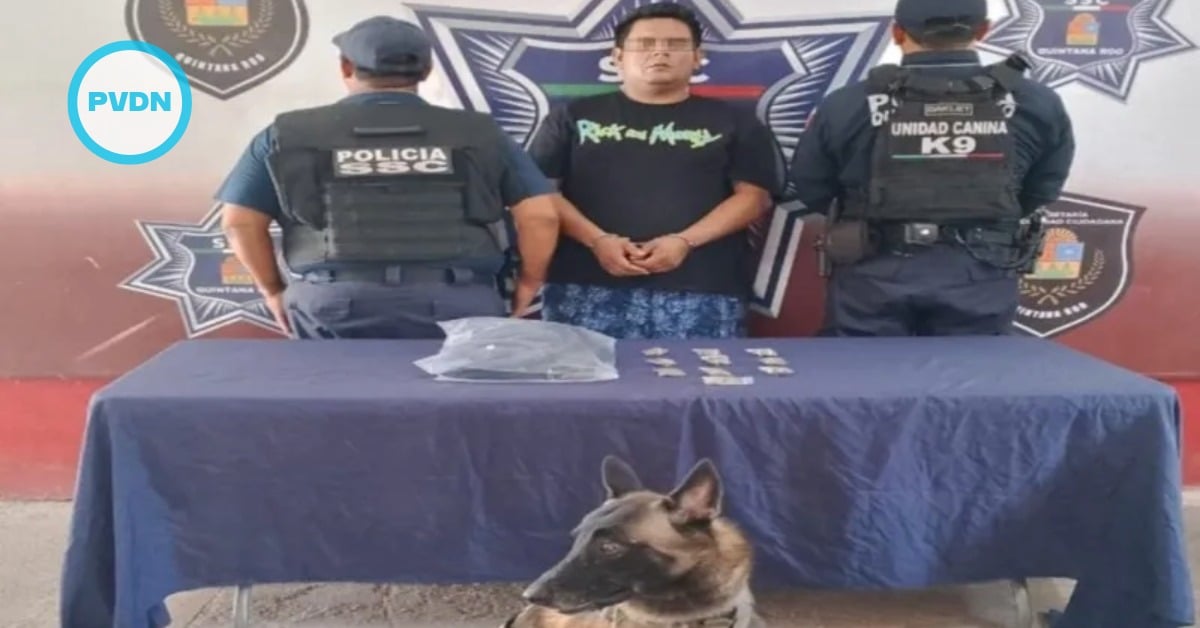
A police dog named Logan changed the pace of an ordinary afternoon at Cancún’s ADO bus terminal. Officers say the K9 alerted to a man who appeared nervous, and a search turned up small baggies of marijuana. The detainee was handed to the state narcomenudeo unit. It’s a short encounter with significant implications for the city’s busiest ground-transport hub, where K9 patrols have become common. Here’s what happened, what we know from officials, and why these checks are showing up more often at bus stations.
Cancún ADO K9 bust
A routine sweep by Quintana Roo’s K9 unit turned into an arrest at the ADO bus terminal in downtown Cancún. Local outlet Turquesa News reports officers noticed a man acting nervously before the dog, “Logan,” signaled the presence of narcotics. Police say they seized several small baggies of marijuana and turned the detainee over to the state unit that handles street-level drug cases. The report identifies the suspect only as Fernando de Jesús “N,” in line with Mexico’s presumption-of-innocence rules.
Authorities have increasingly relied on dogs like Logan at high-traffic transit nodes. State communications this year emphasized K9 patrols at bus terminals in Benito Juárez (Cancún) and Tulum as part of a broader tourist-area security push. Those deployments focus on detecting drugs, firearms, and explosives in places where locals and visitors converge.
The ADO terminal sits at the heart of downtown, near Avenida Tulum and Avenida Uxmal—an easy transfer point for travelers headed to the hotel zone, Playa del Carmen, or the airport. That constant churn of people and luggage makes it a logical checkpoint. Public directories and mapping entries list the terminal at Supermanzana 23, confirming the well-known location and steady foot traffic.
This is not the first time a narcotics dog has made a case at an ADO station in the state. Earlier this year, local media detailed similar inspections that ended with arrests after K9s marked bags or boxes inside the waiting area. Those incidents, like this one, were handled as possible street-level dealing and routed to the specialized narcomenudeo unit. While each case is separate, the pattern shows a clear focus on bus hubs.
What we know—and what we don’t
Police accounts say Logan indicated a scent consistent with drugs, prompting an inspection that turned up baggies of marijuana in a backpack. The man was detained and transferred to prosecutors who handle small-quantity drug offenses. That’s the official version released to the media. As of now, authorities have not publicly detailed lab results, final charges, or a hearing outcome. In Mexico, suspects are identified with initials or first names plus an “N” until a judge rules otherwise; it’s a reminder that an arrest is not a conviction.
Readers inquiring about the presence of dogs at the terminal should be aware that K9 patrols are part of a long-standing security strategy for tourist infrastructure. The state government highlighted canine units at terminals and ferry ports last year, saying the goal is to deter contraband and reassure riders. Independent local coverage across Quintana Roo has documented multiple bus-station finds since 2023, from Cancún to Tulum, underscoring how common these sweeps have become.
Why this bus station matters
ADO is the region’s ground-transport backbone. On any given day, thousands of workers commute through the downtown Cancún terminal, and visitors use it to hop the coast. That density makes the building both a community space and a security challenge. K9s provide officers with a quick, non-intrusive method to triage luggage and individuals without disrupting service. When a dog marks, it creates probable cause for a closer look and, sometimes, a bust like today’s. The flip side is civil-liberties concern: riders want safety without feeling hassled. That tension will accompany every patrol in the weeks ahead.