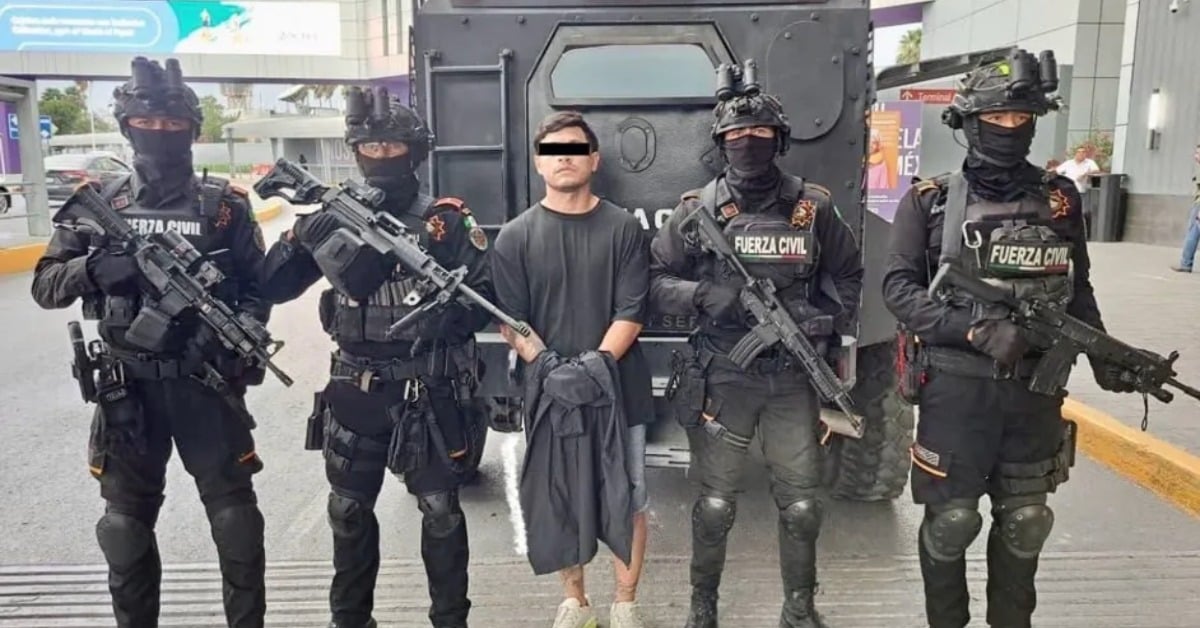
A 35-year-old man identified as Francisco “N” was arrested in Cancún early Sunday, September 7, after a coordinated operation by federal and Nuevo León authorities. Officials describe him as the alleged leader of an independent criminal cell that operated from the southeast while directing crimes in the Monterrey metro area. He was flown to Monterrey on Sunday afternoon to face court orders.
Leader of Monterrey criminal cell arrested
The arrest happened before dawn in the municipality of Benito Juárez (Cancún). Agencies involved included Mexico’s Secretariat of Security and Citizen Protection, the National Intelligence Center, the Nuevo León Attorney General’s Office, the State Investigation Agency, and Fuerza Civil. Authorities say geolocation work led teams to the suspect’s hideout.
In brief statements reported by several Monterrey outlets, investigators linked Francisco “N” to schemes that pressured local merchants for protection payments, along with drug distribution and homicides in the metro area. He is also wanted on an outstanding warrant for attempted aggravated homicide, according to coverage citing state sources.
Why the case matters in Monterrey
Extortion has been a persistent concern for businesses across Nuevo León in 2025. Official data reported by local media show complaints filed in 30 of the state’s 51 municipalities during the first half of the year, with Monterrey logging the highest number of cases. Those reports reflect totals provided by the state prosecutor’s office.
Nationally, the federal government has elevated extortion as a priority. In July, the president announced plans to send a General Law against Extortion to Congress to harmonize investigations across states and allow authorities to pursue cases without requiring a victim’s direct complaint—an approach meant to protect small shopkeepers and market vendors who fear retaliation.
What authorities say they disrupted
Local reports describe the detainee as a “priority target” for Nuevo León due to his alleged role in generating violence and running collection networks that hit neighborhood commerce. Coverage in Milenio, POSTA, and El Porvenir is consistent on the core details: the pre-dawn arrest in Cancún; the multi-agency tasking; the extortion nexus in Monterrey; and his afternoon transfer to the state capital.
ABC Noticias in Monterrey likewise attributes the arrest to a joint intelligence operation and notes the line of investigation into crimes against merchants, narcotics distribution, and homicides.
What’s next
As of Monday morning, authorities had not publicly disclosed the suspect’s full name, consistent with Mexican due-process rules limiting identification before trial. He is expected to appear before a Nuevo León judge on the attempted aggravated homicide case while investigators continue to build the broader extortion and narco-distribution files.
The arrest does not end the threat to small businesses in the Monterrey metro, but it removes a figure whom investigators say coordinated from afar. Whether this translates into fewer collection calls and street-level pressure will depend on follow-through, both prosecutorial and on the preventive side, where merchants often need protection to report.