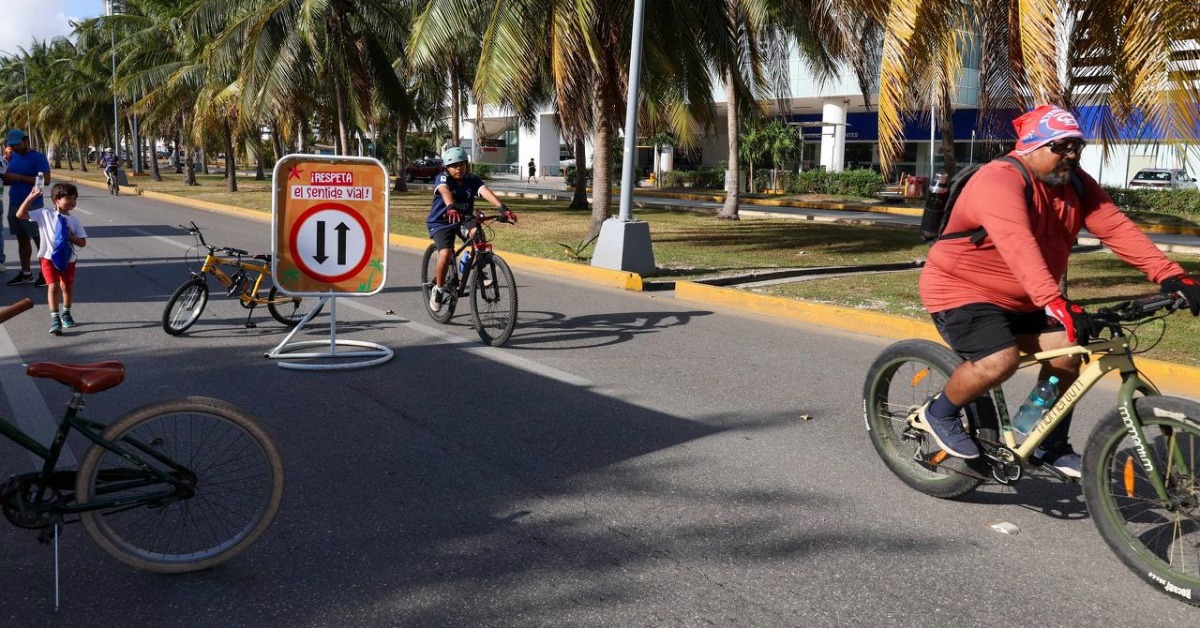
Not every local story in Cancún comes from tourism, crime or development. On Sunday morning, a different picture of the city took shape along Bonampak and Malecón Tajamar, where families, runners, cyclists and small vendors took over the road for several hours. The turnout mattered on its own. But the larger story is what this weekly event says about how Cancún is trying to use public space, support local commerce and build routines that serve residents as well as visitors.
A Sunday route built for people, not cars
Hundreds of people turned out Sunday for the latest edition of Paseo Cancunense, a city-backed event that temporarily gives part of Avenida Bonampak and the Malecón Tajamar area over to pedestrians, cyclists, skaters and families. The March 15 edition ran from 7 a.m. to noon and marked the program’s 16th outing this year. Along the route, people walked, rode bikes, pushed strollers, brought pets and joined exercise activities in a setting usually defined by vehicle traffic.
That is the immediate appeal of the event. It offers a few car-free hours in one of Cancún’s best-known urban corridors. But the story goes beyond a good Sunday turnout. The city has been using Paseo Cancunense to test a broader idea about mobility and community life: that a major road can function, even briefly, as shared civic space instead of serving only as a corridor for cars.
What Paseo Cancunense is trying to do
For readers unfamiliar with the concept, Paseo Cancunense is Cancún’s version of an open-streets program. In simple terms, that means a temporary closure of selected roads to private vehicles so people can walk, run, cycle, skate and spend time outdoors. Municipal officials present it as a tool for active mobility, healthier routines, safer public interaction and stronger neighborhood life.
The program began in 2025 and held 10 editions during its first year, drawing more than 5,000 attendees in total. Earlier this year, city officials said the initiative would move into a weekly format, with Sunday editions scheduled throughout 2026. That shift matters because it turns the event from an occasional attraction into a recurring part of city life. It also makes it easier for residents to treat the route as a habit rather than a one-off celebration.
A mix of exercise, vendors and city outreach
Sunday’s edition was more than a road closure. Officials and local coverage described a program that mixed recreation, road-safety education, small-scale commerce and family activities. There were fitness sessions, local talent, informational stands and food options along the route. Municipal traffic staff also used the event to promote safe driving rules and public awareness around road risks.
That mix helps explain why the event keeps drawing attention. It is not only for cyclists or serious runners. It is designed to be broad enough for families, older adults, casual walkers, pet owners and people who simply want a calmer Sunday morning outdoors. At the same time, the inclusion of food stalls and small vendors gives the route a neighborhood-fair atmosphere without turning it into a formal festival.
Why this matters in Cancún
For many international readers, Cancún is still understood mainly through the Hotel Zone, airport arrivals and beach tourism. Stories like this one show a different side of the city. Paseo Cancunense is rooted in everyday urban life, not in the resort economy. It reflects how local government wants residents to use the city, and how a fast-growing destination is trying to carve out more space for daily recreation and non-motorized movement.
Officials have also framed the program as part of a larger conversation about who gets priority in public space. That is important in a city where growth, traffic and tourism pressure often shape urban decisions. A recurring car-free route does not solve those pressures. But it does create a visible counterpoint. It signals that walking, cycling and simply spending time outdoors with family are worth planning for, not just accommodating on the margins.
More than a soft community story
This is a lighter city story than a major development filing or a public-security headline. Even so, it is still useful for understanding local priorities. Recurring programs like Paseo Cancunense can reveal how city officials want to build public trust, how they support small businesses and how they present the idea of quality of life. The March 15 turnout suggests there is public appetite for that approach.
For expats living in Cancún or considering a move, the event also offers a practical glimpse of the city beyond the usual headlines. It is free, predictable and public-facing. It brings together exercise, local commerce and family recreation in a space many residents already know. That may sound modest, but those routine civic habits often say as much about a city as its biggest announcements do.