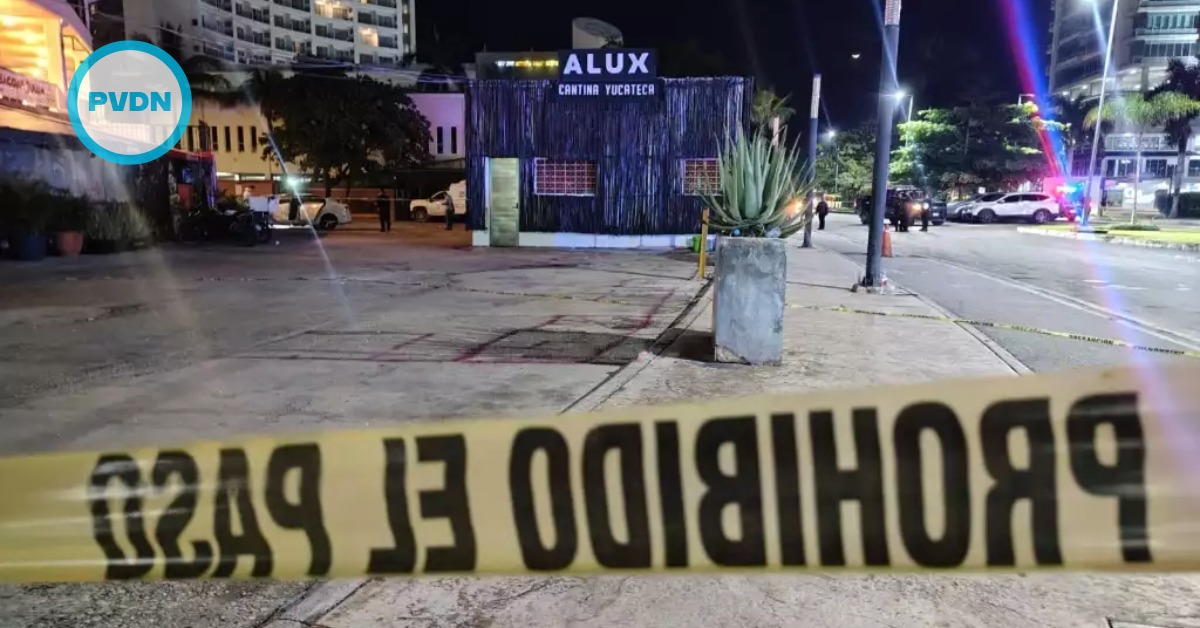
A ministerial police agent was gunned down in the parking lot of Cancún’s Plaza de Toros after a night out, yet days later, the public still knows very little about why he was targeted or who pulled the trigger. Witnesses describe a direct attack carried out in seconds. Prosecutors have confirmed an investigation but have withheld key details, fueling concern about how the state handles violence that reaches its own ranks. For many in Cancún, that silence is as unsettling as the crime itself.
The gunfire that ended Altamirano Olarte’s life came in the early hours of Sunday, in one of Cancún’s best-known entertainment spots. The ministerial police agent, assigned to the state’s narcomenudeo, or street-level drug unit, had spent several hours inside a bar at the Plaza de Toros complex, according to early investigative reports. It was supposed to be a day off. He walked out toward his white car in the parking lot. Before he could get in, two men approached him and opened fire.
Witnesses describe a swift, direct attack. The shooters, who arrived on foot after getting out of nearby vehicles, went straight to the officer and fired several times, apparently from behind. The officer collapsed beside his car, in a pool of blood, as people inside the plaza ducked for cover. Bystanders called the emergency line while others rushed away from the scene, afraid the attackers might return.
Paramedics from a private company arrived within minutes but could only confirm that the officer was already dead. Municipal police, National Guard troops, and state investigators quickly surrounded the parking lot, sealing off the area well into the morning. Among the officer’s belongings, investigators found an official credential confirming he worked for the Quintana Roo State Attorney General’s Office, known as the FGE. Only then did many on scene realize the victim was one of their own.
Cancun ministerial police killing
Shortly after the killing, the FGE reported on social networks that it had opened a homicide investigation and activated coordination with a multi-agency security group. The statement used familiar language about zero tolerance and a commitment to justice, but it did not name the victim, specify a motive or mention any suspects.
Internally, the officer was identified as Altamirano Olarte, a ministerial agent for the specialized narcomenudeo unit. Investigative reports indicate that he was off duty when he went to the bar at Plaza de Toros, located between the Sayil and Bonampak avenues in Cancún’s central area. People who were there that night say he spent hours inside before walking out to his car, planning to leave, when he was ambushed.
Accounts gathered by investigators point to at least two attackers who escaped immediately after the shooting and have not been located. Security personnel collected shell casings and other evidence around the vehicle while crime scene technicians photographed the body and the parking lot. The plaza remained partially closed as they worked, an unusual sight in a zone better known for concerts, bullfights, and late-night parties.
Despite the high-profile nature of the case, state officials shared almost nothing in public the following day. During the regular Monday security briefing, attended by state and federal authorities, the killing was not discussed in detail. Officials confirmed that the case was under investigation but declined to answer questions about possible motives, lines of inquiry, or whether there were any leads on the gunmen.
People close to the investigation say analysts are now reviewing video from cameras in nearby businesses and from the state’s C5 surveillance system, trying to trace the route of the vehicles linked to the attack. They are also reconstructing the officer’s final hours, including who he met inside the bar and whether he had reported threats in recent days. Investigators have not publicly ruled out any scenario, from a dispute inside the establishment to retaliation related to his work in the narcomenudeo unit.
The killing came just hours after security forces in Cancún announced a major operation against an alleged cell of the Jalisco New Generation Cartel, seizing an arsenal of more than forty weapons and tactical equipment and arresting two suspects. So far, authorities have not said whether they see any connection between that operation and the attack on the ministerial officer, leaving residents to draw their own conclusions in the absence of clear information.
Witness accounts and unanswered questions
For many people in Cancún, the setting of the attack is almost as shocking as the crime itself. The Plaza de Toros sits near busy roads, surrounded by offices, restaurants, and nightlife venues. A killing in its parking lot, targeting a state investigator on his day off, reinforces the sense that violence can erupt anywhere, even in heavily frequented areas of the city.
Witnesses who have spoken with investigators describe a scene of confusion and fear. Some said they heard a burst of gunfire and then saw people running from the parking lot toward the street. Others stayed low inside nearby businesses until police arrived. Those details help investigators piece together the sequence of events, but they have not answered the central questions of who ordered the attack and why.
The FGE has stressed that the investigation remains open and that it is working to identify and arrest those responsible. Yet the tight control on information has also fueled frustration. The office has not clarified whether the officer had reported threats, whether he was involved in any recent high-impact cases, or whether colleagues in the narcomenudeo unit have received extra protection.
The lack of detail stands out in a state where attacks on security forces have become more frequent. Local counts indicate that since 2018, dozens of municipal, state, and ministerial officers have been killed in armed attacks across Quintana Roo, many of them in Cancún. In several of those cases, authorities also kept a low profile, citing the need to protect investigations even as families and colleagues demanded answers.
In this case, the body of Altamirano Olarte is expected to be handed over to his relatives once the forensic examination is complete. Colleagues in the Fiscalía describe the institution as “on alert,” although that concern has not translated into detailed public briefings. Residents, meanwhile, are left with brief official statements, fragments of witness testimony, and a crime scene in a familiar parking lot to remind them of the risks that persist.
Until prosecutors break their silence with concrete information on suspects, motives, and progress in the case, the Cancun ministerial police killing will remain emblematic of a wider problem: when violence reaches the state’s own institutions, the public often learns very little about what happens next.