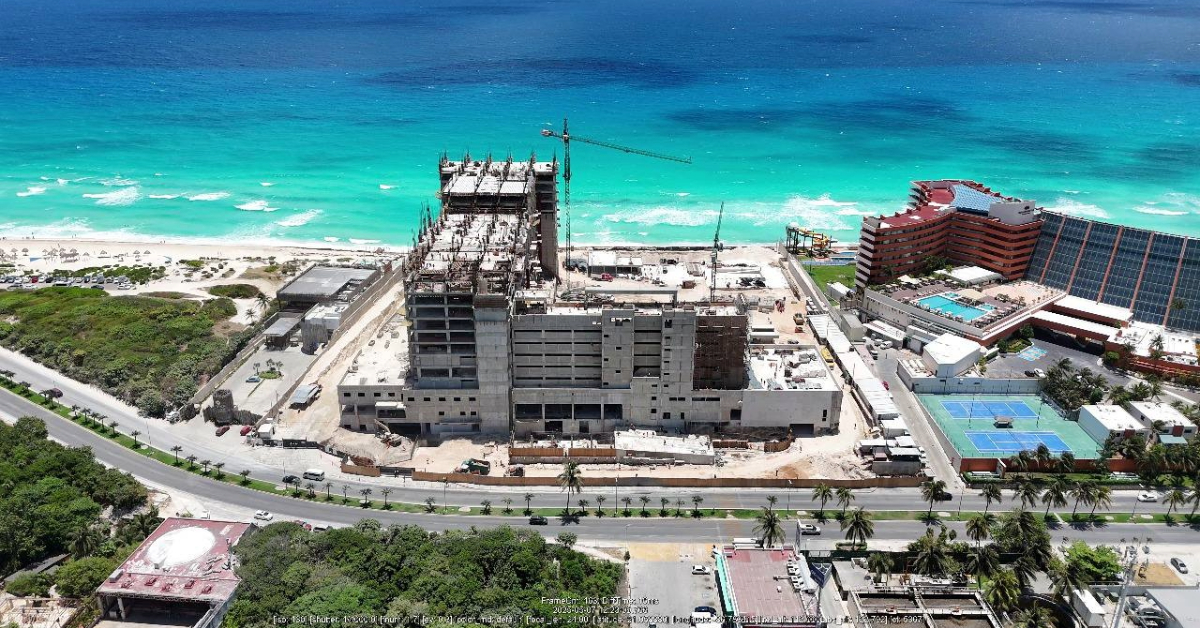
Cancun and the Riviera Maya account for 91% of new hotel rooms opened in Mexico in early 2025, with over 25,000 more planned in Isla Mujeres. Experts predict the region could soon rival Las Vegas.
Between January and May 2025, Mexico saw the addition of 2,280 new hotel rooms. An overwhelming 91% of that growth occurred in just two destinations: Cancun and the Riviera Maya. According to real estate consultancy CBRE, 1,715 new rooms were opened in Cancun alone, while the Riviera Maya added another 355. In comparison, the Riviera Nayarit, another coastal hotspot, accounted for only 140 new rooms during the same period.
This sharp geographic concentration underscores the Mexican Caribbean’s dominance in the national tourism and investment landscape. CBRE’s “Hotel Investor Intentions 2025” report highlights that resort-style properties remain the most attractive category for hospitality investors, a trend that continues to drive large-scale developments along Mexico’s eastern coastline.
Nearly 4,000 More Rooms Coming This Year
CBRE estimates that more than 3,900 additional hotel rooms will come online across Mexico in the second half of 2025. Cancun, the Riviera Maya, and Los Cabos are expected to capture a significant share of that growth, with over 5,000 rooms currently under construction across the three destinations.
In particular, the continental area of Isla Mujeres—just north of Cancun—is emerging as one of the country’s most ambitious hotel development zones. Officials confirm that 11,000 rooms have already opened there, with another 14,000 planned. If fully realized, the area alone will offer 25,000 rooms, firmly cementing its status as a tourism mega-project.
Quintana Roo Aims to Rival Las Vegas
Bernardo Cueto Riestra, head of the Quintana Roo Tourism Secretariat (Sedetur), has stated that the state’s trajectory puts it on track to rival Las Vegas in total hotel capacity within the next five years.
“It’s not just about quantity—it’s about being a global benchmark in hospitality,” Cueto said. “We are building an infrastructure that can compete with the most iconic tourism destinations in the world.”
As of June 2025, Sedetur reports that Quintana Roo has a total of 135,961 hotel rooms spread across 1,478 hotels. That’s a 9.2% increase from June 2022, when the state counted 124,463 rooms. In just three years, 11,468 new rooms have been added, with most of the growth centered in the northern part of the state—Cancun, Isla Mujeres, Playa del Carmen, and Tulum.
At this pace, the state is projected to surpass 150,000 rooms by 2030.
Investment Momentum Builds Despite Global Challenges
Despite global economic uncertainty, major hotel chains and institutional investors remain bullish on Mexico’s resort sector. CBRE’s report reveals sustained optimism across the industry, driven by Mexico’s strong post-pandemic tourism recovery, favorable exchange rates, and consistent demand from U.S., Canadian, and European travelers.
Hotel brands see the Mexican Caribbean as a stable environment for growth, especially with ongoing infrastructure projects such as the Maya Train and airport expansions in Tulum and Cancun further improving access to the region.
What It Means for Tourists and Locals
For tourists, the boom means more accommodation choices, including new all-inclusive resorts, boutique hotels, and luxury offerings. But for local communities, the rapid expansion brings mixed outcomes.
While job creation and economic activity increase, concerns around overdevelopment, environmental impact, and housing affordability are mounting—especially in areas like Tulum and Isla Mujeres where infrastructure has struggled to keep up with tourism-driven growth.
Planners are now under pressure to ensure that the boom doesn’t come at the cost of long-term sustainability. Cueto has emphasized the need for “intelligent growth” that protects natural resources while continuing to elevate the region’s global tourism profile.
Looking Ahead
With thousands of rooms under construction and tens of thousands more in planning, the Mexican Caribbean’s dominance in Mexico’s hotel industry is unlikely to slow down any time soon. If projections hold, Quintana Roo could soon stand shoulder to shoulder with global giants like Las Vegas and Dubai—not just in hotel capacity, but in international reputation.
But as the state grows, so does the challenge of balancing progress with preservation. The next five years will test whether Cancun and the Riviera Maya can remain competitive without compromising what made them desirable in the first place.