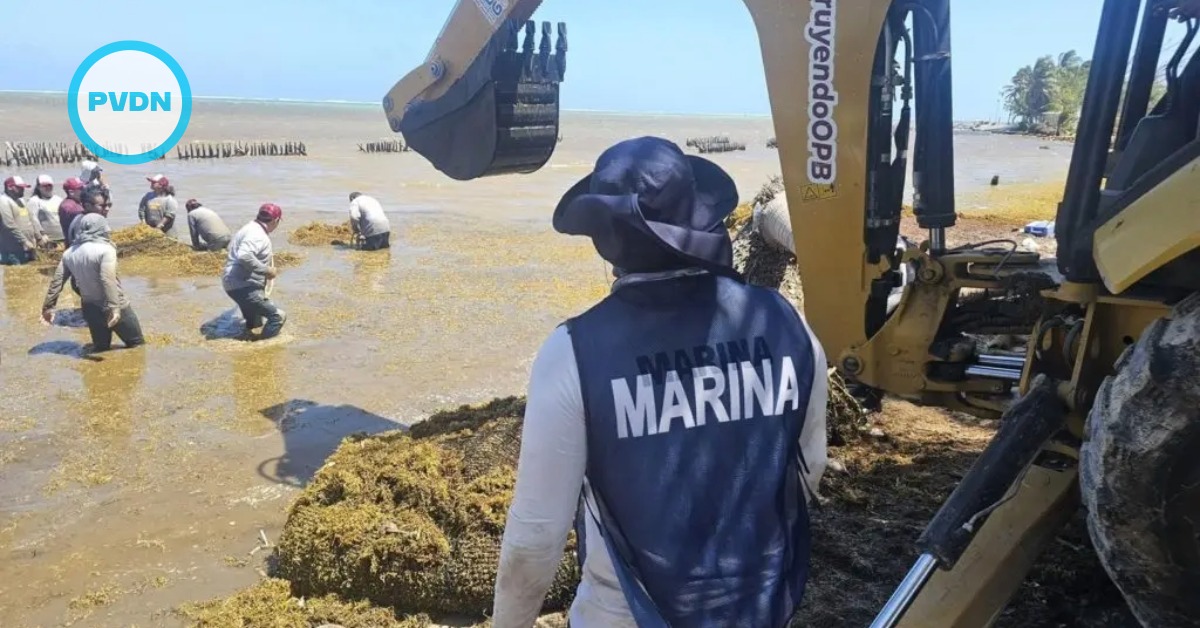
More than 91,000 tons of seaweed have been cleared from Mexican Caribbean beaches in 2025, keeping key resorts clean and testing new biogas uses.
The 2025 sargassum season in Quintana Roo ran from early April to the end of October and closed with more than 91,000 tons of the macroalgae collected along the state’s coastline. State monitoring reports compiled by environmental authorities, coastal municipalities and the Navy show a final figure of just over 91,500 tons removed from beaches and near-shore waters, the highest volume in at least seven years and roughly 147 percent more than in 2024.
Most of that effort took place at the height of summer. June, July and August were the hardest months, each bringing well over 15,000 tons of sargassum to shore, with a peak in July. September also stayed heavy before arrivals dropped sharply in October and early November, when barely a few hundred tons were recorded. By then, clean-up brigades were no longer racing the tide every morning and could focus on restoring beaches for the coming winter high season.
The workload was not spread evenly. Playa del Carmen alone accounted for more than 33,000 tons, followed by Cancún and Costa Mujeres, Puerto Morelos, Othón P. Blanco and Tulum. Coastal municipalities together handled around two-thirds of the total seaweed, with Navy crews and a private collection network lifting the rest from the water and the shoreline.
Behind the scenes, the state government had quietly moved before the worst of the season hit. A dedicated 2025 Sargassum Strategy Table brought together state and municipal officials, the federal government and private operators to coordinate daily decisions such as where to deploy barriers, where to send extra crews and how to manage final disposal sites. The Navy operated a fleet of specialized vessels, amphibious beach cleaners and support boats, backed by more than nine kilometers of floating barriers installed from Isla Mujeres down to Mahahual.
By November, visitors flying into Cancún and other gateways were again stepping onto white sand and turquoise water, a stark contrast with the brown, algae-choked scenes many locals had endured just weeks earlier. Hoteliers describe this winter as a test of whether robust early-season planning can keep the tourism engine running even in years when the Atlantic sends record sargassum volumes toward the Caribbean. Global satellite monitoring has already identified 2025 as one of the most intense bloom years on record across the wider Atlantic basin.
Mexican Caribbean sargassum as a new resource
Authorities insist that reacting on the beach is no longer enough. The state has begun to treat Mexican Caribbean sargassum not just as waste to be removed, but as a raw material with economic potential. The federal government recently updated the National Fisheries Chart to list holopelagic sargassum in the region as a resource with development potential. That bureaucratic step opens the door to regulated harvesting and industrial use, rather than treating the algae only as a nuisance.
The centerpiece of this shift sits far from the hotel zone, in the south of Quintana Roo. There, a pilot biogas plant backed by an investment of about 40 million pesos is already processing a mix of sargassum and sludge from wastewater plants. After more than a year of testing, project engineers report that the blend can be digested efficiently to produce biogas, heat and by-products such as organic fertilizers. State officials say researchers and partner companies have identified scores of potential derivatives, from soil improvers to construction inputs, that could eventually be produced at scale.
The idea is simple but ambitious. Instead of paying ever-higher costs to move seaweed from beach to landfill, the state wants to close the loop by using it inside a broader circular-economy hub. European investors and Mexican authorities have already discussed expanding to at least two industrial-scale plants capable of processing hundreds of tons a day, which would cover a significant share of the volumes collected in heavy years like 2025.
Technology is also reshaping how crews know where to work. A new state monitoring center uses satellite imagery, ocean-current models and local observations to anticipate where the largest sargassum patches will make landfall. The system feeds a color-coded “traffic light” for beaches. It guides daily decisions on whether to reinforce offshore barriers, increase boat patrols or send more workers to specific stretches of sand. Officials argue that catching seaweed while it is still at sea prevents the worst smell and visual impact once it reaches shore.
For residents, the stakes go beyond tourism revenue. Fishing communities and small coastal businesses suffered through thick seaweed mats that smothered near-shore habitats and pushed visitors away during the worst weeks of 2025. In places like Tulum, Playa del Carmen and Mahahual, local operators reported losses as beaches vanished under brown algae and waters turned murky. Many will be watching closely next year to see whether new technology and the emerging biogas industry can reduce those impacts or whether they will again spend the summer shoveling seaweed before dawn.
A cleaner winter, but no easy fix
For now, the visual result is clear. As the winter high season gets underway, beaches from Cancún to the southern Costa Maya are largely free of sargassum, even after a year that pushed local collection records to new highs. Visitors arriving in December are unlikely to guess how many tons of seaweed lay on those same shores just a few months earlier.
Scientists and policymakers, however, are under no illusion that the problem has been solved. Researchers at Mexican universities warned as early as June that warming seas and changing currents were setting up 2025 to rival some of the worst sargassum years of the past decade. International satellite data showed massive algae belts stretching across the tropical Atlantic, confirming that the phenomenon is tied to broader ocean and climate shifts rather than local pollution alone.
That context explains why officials now talk about sargassum as a “permanent challenge” rather than a seasonal inconvenience. Even as this year’s figures are tallied and the last trucks leave temporary stockpiles, planning has already shifted to 2026. The state aims to expand offshore collection capacity, improve early-warning systems and secure long-term financing for treatment plants so that seaweed arriving next year is seen less as an emergency and more as feedstock.
For the millions of people who live and work along the Mexican Caribbean, success will be measured in simple, everyday ways. Clean water where children play, clear horizons for hotel workers whose income depends on full rooms, predictable fishing seasons for coastal communities and fewer dawn patrols shoveling stranded algae. This winter’s pristine beaches are a welcome sign after a record-breaking season. The real test will be whether the same view can still greet tourists and locals in the years to come.