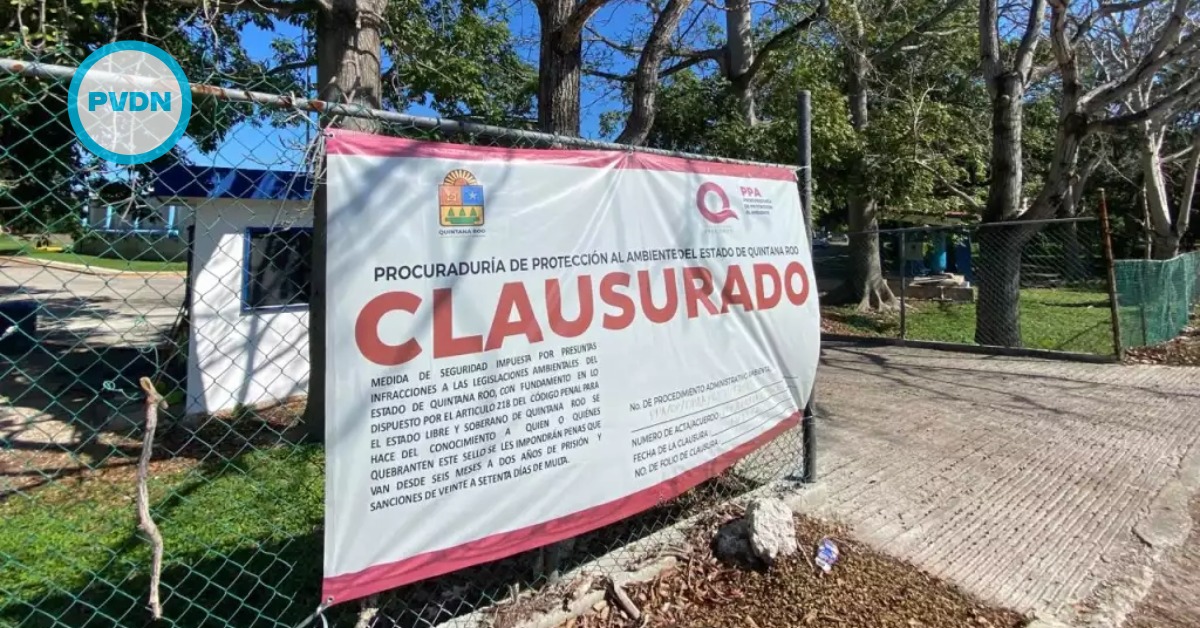
A closure notice went up at what officials describe as Cancún’s largest wastewater treatment plant, but the pumps didn’t go silent. Inspectors allege the facility released roughly 300 liters per second of effluent around its perimeter, prompting a partial shutdown designed to stop the leakage without triggering a citywide sanitation emergency. For residents in northern Cancún, the episode raises the same uncomfortable questions that surface every time the city’s infrastructure strains: where does the wastewater go, who is accountable, and what happens next?
A partial closure in a fast-growing city
State environmental inspectors in Quintana Roo have sealed what officials describe as Cancún’s largest wastewater treatment plant, after allegations that treated or partially treated effluent was discharging around the facility at a rate of roughly 300 liters per second. The action amounts to a formal closure measure on paper, but not a full operational stop in practice.
Authorities say the plant is too critical to shut down completely without risking a wider sanitation contingency. Instead, the facility has remained in partial operation while regulators pursue an administrative process to compel repairs and prevent repeat overflows. That balancing act—enforcement on one hand, continuity of service on the other—reflects a reality in Cancún that many residents know well: the city’s population and development have outpaced parts of the infrastructure meant to keep daily life invisible and sanitary.
What investigators allege happened
The plant sits in northern Cancún, in the Arco Norte area of Region 237, serving a densely populated swath of the city and handling additional volume when the system is under stress. Inspectors allege that wastewater effluent was escaping around the facility—enough to create pooled water and odors in the surrounding area and to contribute to disruptions beyond the plant’s perimeter.
Three hundred liters per second is not a minor seep. Over a full day, that flow rate would equal about 25.9 million liters. Even when the immediate impact looks like “just” standing water and foul smell, persistent leakage can become a broader problem in a city built over porous limestone, where what hits the ground doesn’t simply stay put.
A related concern for residents is that these incidents don’t always announce themselves with official alerts. People often learn about them through what they can smell, what they can’t avoid driving through, or the sudden appearance of a closure banner and crews working behind a gate.
Why it matters for northern Cancún and the hotel zone
The immediate consequences tend to land closest to home: unpleasant odors, uncomfortable commutes, and the sense that something is failing in plain sight. But the larger stakes are environmental and public-health related. Cancún relies on a fragile groundwater system, and wastewater management is a frontline defense for both neighborhoods and the tourism economy that underwrites much of the region’s work.
For expat residents, the relevance is both practical and civic. Many live in the growing north and northwest, where new housing has expanded rapidly, and where service interruptions or sanitation problems can ripple quickly through daily routines. Even for those farther south, the city’s wastewater network is interconnected; when one major node is compromised, the workaround is rarely seamless.
This isn’t the first time the plant has drawn scrutiny. In 2023, municipal ecology officials inspected the same facility after a complaint and noted occasional overflow at points tied to discharge processes, opening an administrative procedure while keeping the site accessible so service could continue. The new closure action suggests regulators believe the underlying issues have not been resolved—or have resurfaced under heavier demand.
What happens next
The environmental authority has initiated a legal-administrative process that can compel corrective work and, depending on findings, lead to financial penalties. The short-term priority is to stop the discharge and repair damaged sections so the plant can operate without leaking beyond its footprint. The longer-term test will be whether enforcement translates into measurable improvements, or whether the city cycles back into the familiar pattern of incident, cleanup, and uneasy normalization.
For residents, the most immediate signals to watch are operational: whether odors persist, whether overflow reports continue, and whether authorities provide clear timelines for repairs. In a city where infrastructure failures can become background noise, sustained public attention often determines whether a closure notice becomes a turning point—or just another banner flapping in the wind.