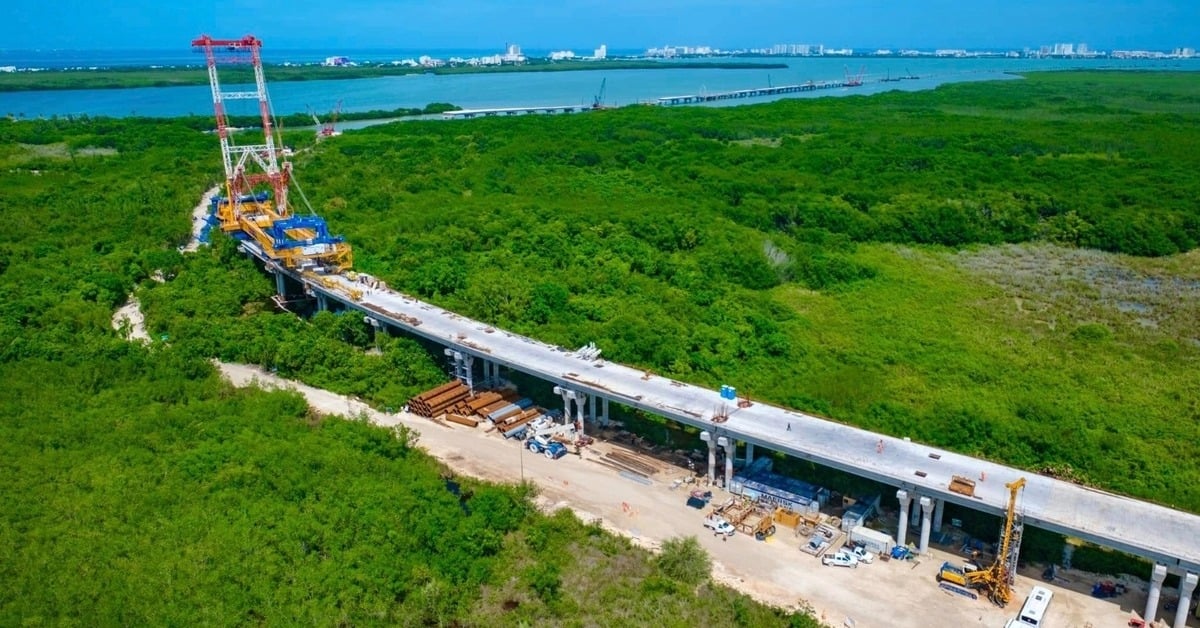
With the Nichupté bridge reported at more than 90% complete, many Cancún drivers expected a late-January opening. But crews working on the lagoon crossing say the schedule is slipping again. A stubborn stretch near the bridge’s highest point is being reinforced after signs of movement in a few supports. Officials insist the structure is safe, yet the extra work is not quick. That leaves a simple question hanging over the Hotel Zone: how close is “almost finished,” really?
A bridge that’s nearly finished, but not ready
The Nichupté vehicular bridge was built to give Cancún a second entrance to the Hotel Zone. It is meant to ease pressure on the single corridor that regularly locks up at rush hour. The route runs about 11.2 kilometers end to end, with an 8.8-kilometer lagoon crossing. Design plans call for three traffic lanes, including one reversible lane. A bike path and pedestrian space are also part of the project. Officials have recently put overall progress in the low-90% range, around 93%. That helped fuel expectations of a late-January 2026 opening and a free crossing. Now, engineers and on-site workers say the finish line has moved again. They expect added structural reinforcement to delay the opening by at least three months. That would push any launch into late April 2026 at the earliest. The new work follows inspections and viral videos showing cracking and minor movement at a few supports. Authorities say the bridge remains safe, but they want more margin for long-term stability.
The lagoon floor and the problem called La Joroba
The most delicate work is clustered around “La Joroba,” the bridge’s highest section over the lagoon. Here, the deck sits about 15 meters above the water. It is also the point designed to clear the lagoon’s navigation channel. That clearance forces longer spans and higher stresses on the supports. At this height, wind, loads, and tiny alignment errors become less forgiving. But the real headache is below the surface. The floor of the Nichupté Lagoon is limestone, riddled with pores and occasional voids. Those hidden cavities can weaken a footing or alter its settlement. In karst terrain, small shifts often show up first where the structure is tallest. Crews have focused monitoring on supports roughly numbered 213 through 223. In that stretch, inspectors observed slight settling and cracking in at least one support. The response has been to redesign the foundation locally and go deeper. Officials have described moving from about 35 meters to roughly 42 meters of foundation depth there. That is why crews treat this zone as the project’s true bottleneck.
Reinforcing a bridge mid-build is straightforward in concept, but slow in practice. The plan adds at least four new piles at the weakest point, two on each side. It also calls for steel beams at several supports to stiffen the structure. Think of the steel as a brace that spreads loads and limits flex. Each pile has to be drilled and poured with tight tolerances while working over water. Bad weather can halt the floating equipment and erase a whole day’s schedule. Crews also have to monitor movement as new elements are added. New piles must connect cleanly to existing concrete and rebar. Otherwise, the fix can create new stress points instead of removing them. Workers say a roughly 100-meter stretch in the La Joroba zone remains unfinished. That segment must be completed while reinforcement is underway. Visible fissures draw attention, but engineers care more about what they mean over the decades. The current choice is to add capacity now, before the bridge carries daily traffic.
What still needs to happen before opening day
Even once reinforcement is finished, the bridge still needs formal proofing before opening. Officials say it will undergo load tests in both dynamic and static conditions. That means vehicles in motion and vehicles parked to stress the structure. It is routine for major projects, and vital after design changes. There is also the less visible work that turns a structure into a usable corridor. Crews still have to complete lighting, markings, and safety barriers. Authorities also cite pending installation of cameras and license-plate readers. Those tools feed traffic management and security systems tied to public safety. The reversible lane will also need clear rules and operational controls. A late stage can look like small tasks, yet each one needs inspection and commissioning. Until that is done, a 93% figure does not equal an open bridge. That gap is why officials now avoid naming an exact inauguration day. For drivers, the trade-off is more waiting now and fewer surprises later.
Why the delay hits close to home
For residents and expats, the Nichupté bridge is less a mega-project and more a daily wager. It promises a faster commute into the Hotel Zone and an escape from Kukulcán gridlock. For workers on shift changes, the minutes saved add up to real time at home. Tour operators and delivery drivers are watching closely, too. The bridge is also pitched as a route for resilience during hurricanes, floods, or major crashes. That is why each delay feels personal, not bureaucratic. There is a financial sting as well. Public figures say costs have climbed from about 5.58 billion pesos to around 10 billion. Part of that increase came from redesigns needed to deal with the lagoon’s karst terrain. Still, the region has learned that rushed openings can be more expensive than late ones. If this reinforcement buys decades of stability, most drivers will trade patience for certainty. What they want now is a date that holds.
With information from Por Esto!, Noticaribe, El Economista, La Crónica de Hoy, Proyectos México, Agencia de Proyectos Estratégicos de Quintana Roo, Municipio de Benito Juárez (Cancún), Canal 10 Quintana Roo