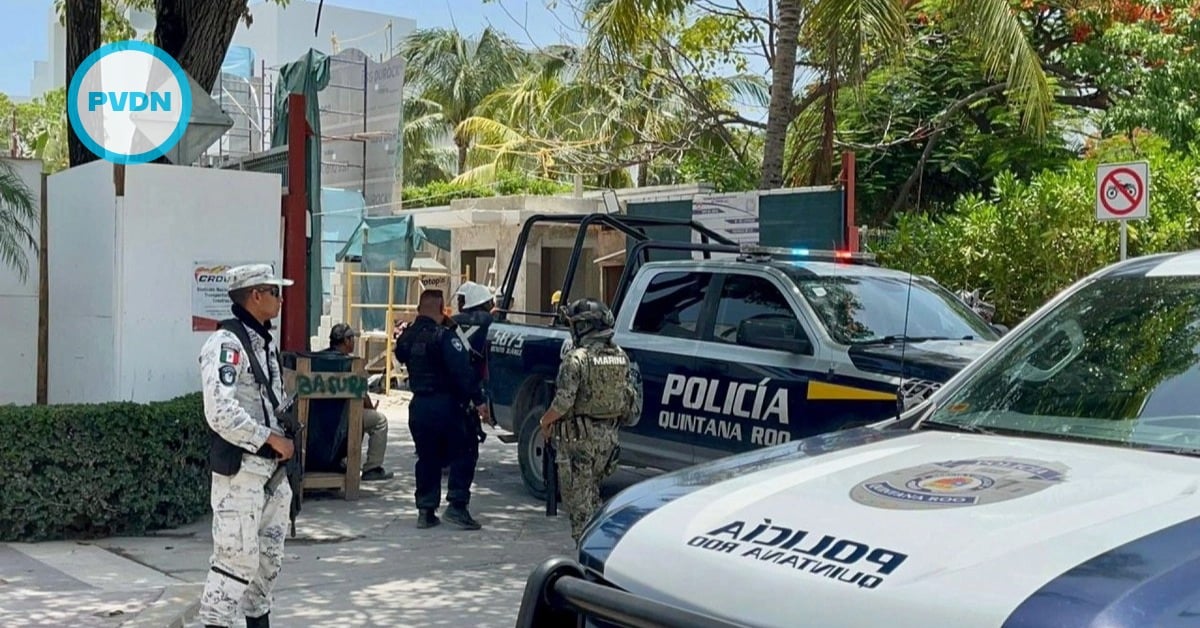
Quintana Roo’s prosecutor says a CJNG cell murdered investigator Adalberto Altamirano in Cancún as revenge for recent arrests and drug seizures.
In Cancún, the killing of a state investigator in a busy commercial area is now officially being treated as a cartel message. Quintana Roo’s attorney general, Raciel López Salazar, confirmed that a cell of the Cártel Jalisco Nueva Generación ordered the murder of police investigator Adalberto Altamirano Olarte as an act of revenge against recent operations targeting the group.
Altamirano, assigned to the state’s anti–drug dealing unit, was shot dead in the early hours of Sunday, 16 November, in the parking lot of the Plaza de Toros, just off Avenida Bonampak in central Cancún. He had just left a bar and was heading toward his car when a group of gunmen approached and opened fire at close range.
Investigators later counted at least seventeen spent shell casings at the scene. Ten bullets struck the officer, killing him almost instantly beside his vehicle. Witnesses called the emergency line and paramedics confirmed he had no vital signs by the time medical help reached the parking lot.
From the start, authorities described the shooting as a direct, targeted attack on an officer who worked against street-level drug dealing. At the time, they did not publicly explain a motive. That changed a week later, when the state’s top prosecutor laid out a narrative that ties the murder to a broader confrontation with one of Mexico’s most aggressive criminal organizations.
A planned ambush tied to cartel retaliation
According to López Salazar’s version, the attack was not spontaneous. The group that killed Altamirano had been watching him for at least two hours around the Plaza de Toros before receiving the order to move in. The prosecutor described the assailants as part of a commando trained in weapons and survival tactics and brought in from Jalisco and Michoacán to reinforce CJNG operations in Cancún and nearby resort cities.
The gunmen allegedly followed a standing instruction: send a message to the state prosecutor’s office in response to recent raids on safe houses, drug seizures and arrests of local operators. Days earlier, authorities in northern Quintana Roo had detained suspected CJNG members and seized weapons and drugs, including an alleged logistics operator for the organization. The timeline, investigators argue, suggests the homicide was organized as a backlash for those blows.
Ballistics work after the attack added another layer. One of the weapons recovered from the suspects later tested positive in a separate shooting on 10 November, when a man was killed and a pregnant woman was wounded; doctors later reported that the baby she was expecting had died. For prosecutors, that overlap places the same armed group behind at least two high-impact attacks in Cancún within days.
Altamirano’s murder also exposed how little separates routine nightlife from cartel violence in the city. The Plaza de Toros area is surrounded by bars, restaurants and shops. On that night, patrons and employees became sudden witnesses to a professional-style hit carried out in seconds in a place where families and tourists often pass through.
In the hours after the killing, the state opened a homicide investigation and launched a manhunt using both field work and technology. What followed was a rapid series of arrests that officials now say dismantled the cell responsible.
CJNG Cancun police killing and the wider crackdown
Within twenty-four hours of the attack, the Quintana Roo prosecutor’s office announced the detention of seven suspects on the highway between Playa del Carmen and Tulum. All are men, including one minor identified by his nickname. Authorities say they were traveling in three Playa del Carmen taxis when they were intercepted.
During the operation, officers seized two long guns, three handguns, magazines, ammunition and packages of what appeared to be marijuana. Ballistics tests later linked at least three of those weapons to the Plaza de Toros crime scene, where seventeen shell casings were recovered and ten bullet wounds were documented on Altamirano’s body. The same arsenal, prosecutors say, also tied the group to the earlier attack against the couple on 10 November.
Officials have publicly identified several of the detainees only by their first names and aliases, in keeping with Mexican legal practice. According to the prosecutor’s office, the suspects arrived in Cancún from Jalisco and Michoacán after receiving firearms and survival training, with instructions to bolster the CJNG structure already operating in tourist corridors such as Cancún, Playa del Carmen, Tulum and Cozumel.
The investigation has since expanded to urban neighborhoods linked to the case. Authorities have carried out searches in residential areas such as Jardines de Bonampak, described as possible safe-house locations for the commando. Those searches are part of what officials call a broader effort to map out the group’s logistics, including vehicles, weapons storage and communication routes.
A control judge has now ordered pretrial detention for the seven detainees while prosecutors complete their case. The measure can last up to two years or the time needed to conclude complementary investigations. The suspects are also under investigation for drug-dealing offenses, given the weapons and narcotics found at the time of their arrest.
For López Salazar, the case illustrates both the reach of CJNG in Quintana Roo and the level of confrontation between the group and the state. In the same security briefing where he described Altamirano’s killing as an act of revenge, he reported that 138 alleged members of the CJNG have been arrested in the state so far this year in coordination with federal forces. Authorities say they have seized seventy-four firearms from the organization, including fifty-two long rifles and twenty-two pistols, as well as grenades, drones, tactical vests and large quantities of drugs.
Those figures suggest a criminal structure that is both heavily armed and under sustained pressure. For residents of Cancún, they also underscore the risks when organized crime responds to law enforcement actions by striking directly at investigators in public spaces. The murder of Adalberto Altamirano has now become a test case of whether the justice system can protect its own while sustaining an offensive against a powerful cartel.
The prosecutor insists the investigation remains open and that more people linked to the CJNG cell could face charges in the coming months. For now, the official version is clear: the CJNG Cancun police killing was not a random attack in a parking lot, but a deliberate message from a cartel that feels the state is closing in. How the courts handle the case, and whether that message is met with impunity or accountability, will shape public trust in Quintana Roo’s security institutions long after this news cycle fades.