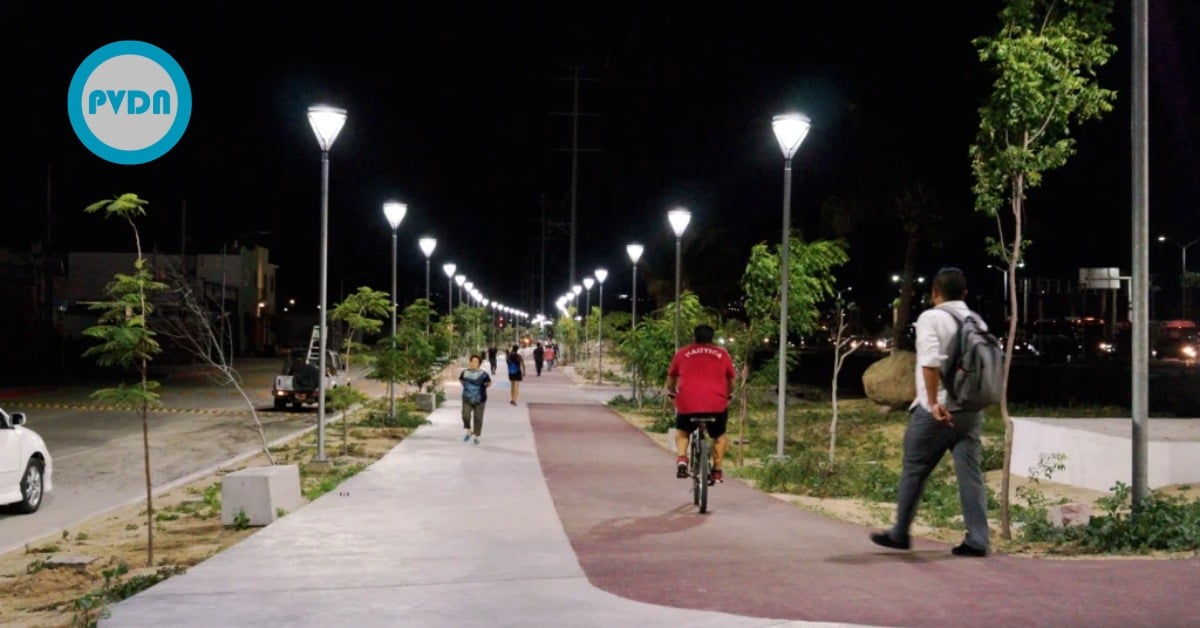
A 650-meter stretch of the Constituyentes linear park is now underway in Cabo San Lucas, after federal water authorities cleared work in the arroyo. The plan is to push the path and lighting toward the Yenekamu courts, creating what officials bill as the city’s largest linear park. Residents near Boulevard Constituyentes may start seeing heavy crews and closures as the second stage takes shape. We verified the permits, mapped the route, and checked what’s next for timelines, budgets, and access points—here’s what matters now.
FOIS crews have reopened the project along the Salto Seco arroyo in Cabo San Lucas, building a new 650-meter segment with the green light from Mexico’s water authority. The second stage is designed to carry the pathway toward the Yenekamu sports area, stitching together a continuous public space parallel to Boulevard Constituyentes. Officials frame the build as the city’s largest linear park when complete, a long-planned spine of shade, lighting, and safe movement through one of CSL’s busiest corridors.
What stage two covers
This phase picks up inside the arroyo right-of-way and extends the track, lighting, and basic urban furniture. The work sits in the federal water zone, so Conagua’s authorization was a prerequisite. With that sign-off in hand, FOIS is moving equipment to lengthen the path and prepare for later connections. Residents should expect intermittent closures around work fronts and some detours for trucks hauling material. The goal is continuity: a single, readable route that families can use without gaps or road crossings that kill momentum.
The park is not starting from scratch. A first segment already brought a jog track and lighting to part of the corridor, giving proof of concept that people actually use. Building out from that nucleus matters. A park is only as good as its links—dead ends invite cars back in, while continuous tracks invite people to walk.
Constituyentes linear park
The Constituyentes linear park has existed on paper for years, partly due to the arroyo’s sensitive nature and the challenges of land control. This year’s momentum follows federal recovery of right-of-way inside the Salto Seco channel and a municipal push to treat natural corridors as public space, not leftovers. That planning approach is spelled out in local urban policy, which calls arroyos the backbone of open-space networks rather than obstacles to be fenced off.
Context helps here. Early cost talk in 2023 pegged the whole corridor in the hundreds of millions of pesos, which signals a multi-year, multi-segment build that will arrive in pieces. That’s normal for linear parks. What matters for users is seeing segments connect: more lighting, longer runs without crossings, and safe approaches to busy streets like Constituyentes.
The target toward Yenekamu is not arbitrary. The sports fields and community facilities already attract families; integrating them into a safe path increases usage. Think kids walking to practice on a lit track instead of hugging traffic. Think seniors getting morning steps without dodging curb cuts. This is the quiet math of small public-works wins.
So what should neighbors watch for next? In the near term, tasks include grading and compacting in the arroyo, setting poles for lights, and performing concrete work on edges where the path meets streets. In the medium term, planners have talked about more shade, rest areas, and a cycle-safe alignment. The endgame is a stitched corridor that feels obvious: you step onto it, and you keep going.
The promise is simple but ambitious. If FOIS and Conagua keep this sequence unblocked, Cabo San Lucas gets a continuous park that treats its natural channel like a civic asset. If segments stall again, it risks becoming another pretty rendering. For now, shovels are down, lights are planned, and a 650-meter bet on everyday use is being poured.