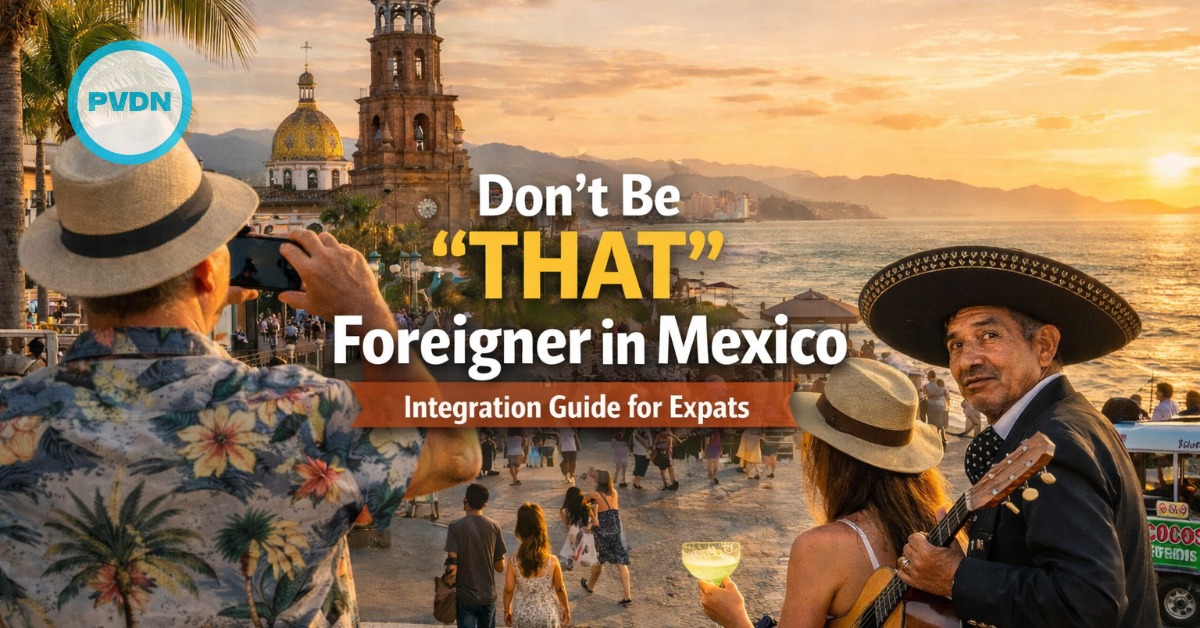
A practical integration guide for expats who want a good life here (and want to be good neighbors, too).
Most people don’t move to Mexico planning to be “that foreigner.”
You know the one: loudly confused in public, constantly comparing, offended by normal life sounds, treating service workers like props, insisting they “love the culture” while doing everything possible to avoid participating in it.
The thing is, becoming that person is rarely about bad intentions. It’s usually about a handful of tiny habits—almost invisible to you—that add up quickly for everyone else.
So this isn’t a scolding. It’s a shortcut.
If you’re new: save this and come back to it when you have your first “wait… how does this work?” moment.
If you’ve been here a while, you’ll recognize a few of these with a painful little laugh.
And if you’re the person who’s thinking, “This doesn’t apply to me,” congrats—you’re exactly the target audience.
Start with humility, not hot takes
There’s a specific kind of newcomer energy that makes locals (and longtime expats) tired: you’ve been here three weeks, and you’re already diagnosing the country.
- “In the USA, we would never—”
- “Why don’t they just—”
- “Mexico should—”
Maybe your observation is correct. Maybe you’re even trying to be helpful. But you don’t have enough context yet to know whether something is cultural, municipal, regional, seasonal, political, economic, or just… Tuesday.
Here’s the move that changes everything: swap complaints for questions.
Instead of: “This is so disorganized.”
Try: “Is there a reason it works this way?” or “Who would know the official rule?”
Instead of: “People don’t respect lines here.”
Try: “Is there an unspoken system I’m missing?”
Because often, there is a system. It’s just not your system. Did you move to Mexico and expect it to function exactly like the USA? Are you closed to accepting that things work differently in other countries? Maybe you were not realistic in your decision to move to Mexico.
And if you’re in Puerto Vallarta, Cabo, San Miguel, Mexico City, or Playa—your neighbors have seen waves of newcomers arrive with the same criticisms. They’re not offended by your confusion. They’re exhausted by your certainty.
Learn survival Spanish first (even if you’re “bad at languages”)
You don’t need to become fluent to integrate. You do need to show effort.
In expat-heavy places, it’s easy to outsource language forever. You’ll find bilingual friends. Staff will help you. Your phone will translate. You’ll “get by.”
But integration lives in tiny moments: saying hello properly, using “con permiso” when you pass, asking a question without assuming someone owes you a full explanation.
Here’s a practical reality: Spanish isn’t just communication here—it’s respect. The effort matters more than the accuracy.
Start with phrases that reduce friction:
- Buenos días / buenas tardes / buenas noches (use them—always)
- Con permiso (for passing through, squeezing by, entering)
- Disculpe (for getting attention; softer than barking “hey”)
- ¿Me puede ayudar, por favor?
- ¿Cuánto cuesta?
- ¿Tiene cambio? (you’ll use this more than you think)
- ¿Cómo se dice…?
- ¿Está bien así? (when you’re not sure you did it right)
And here’s the golden rule: don’t turn the nearest bilingual person into your unpaid assistant.
If someone helps you translate, thank them. If they keep helping you, offer to buy them a coffee. And if you’re living here long-term, take a class. Not because you “should.” Because it will change your daily life.
Housing: the biggest impact you’ll have (even if you don’t mean to)
Housing is where the temperature rises in every expat city right now. It’s not because Mexico suddenly got less welcoming. It’s because housing is the one thing you can’t “just build more of” overnight without consequences.
If you’re renting, buying, or running a short-term rental, you’re not just choosing a home—you’re shaping a neighborhood.
A few ways newcomers accidentally cause real harm:
1) Treating rent like a flex
When you brag, “I got this place for only…” you’re telling your neighbors what their city is turning into. Even if you didn’t mean it. Especially if you’re saying it in front of people who will never earn remotely what you earn.
2) Bidding up casually because “it’s still cheaper than back home”
That logic feels innocent. It’s also how a market shifts fast. In PV, PDC, and parts of CDMX, you can watch the ripple effect in real time.
Pay fair rent. Don’t inflate “just to win.” Don’t treat a landlord like a personal concierge. And for the love of everyone’s sanity, get everything in writing.
3) Acting like the neighborhood is an amenity
If you moved into a lively area—near the malecón, a plaza, a market, a nightlife strip—then you moved into the sound of Mexico. You can manage your comfort (windows, fans, white noise, building choice). But trying to silence a neighborhood is the fastest way to become unwelcome.
If you need quiet, choose quiet. Don’t move into the drum circle and complain about drums.
4) Short-term rentals: don’t pretend they don’t affect people
I’m not here to moralize your business model. I’m here to tell you reality: when a building becomes a revolving door, the social fabric changes. Security changes. Noise changes. Maintenance changes. People stop learning each other’s names.
If you run an Airbnb, be the one who doesn’t ruin a building:
- strict quiet hours
- real guest screening
- a local point person
- immediate response to neighbors
- no “party” vibe, ever
And if you’re choosing a place to live, respect buildings that prioritize residents. They’re not being “uptight.” They’re protecting their home.
Service work isn’t “Mexican hospitality.” It’s labor.
One of the most common newcomer mistakes is confusing warmth for “I can ask for anything.”
Mexico is friendly. That’s real. But friendliness isn’t an invitation to treat people like your staff.
This shows up everywhere:
- snapping fingers at servers
- calling adults “sweetie” or “buddy”
- assuming a worker has to solve your personal problems
- venting about your day to someone who can’t walk away
- acting offended when someone sets a boundary
Be friendly. Learn names. Say good morning. Ask how someone is. Tip consistently. But don’t demand emotional labor.
Tipping: be consistent, not performative
Don’t turn tipping into a morality show. Just be fair and steady.
Also: if you can afford imported groceries, rooftop cocktails, weekly massages, and beach clubs… you can afford to tip without acting like it’s a tragic burden.
People notice.
Noise, space, and the public realm
Every expat destination has its “sound wars.”
- PV: construction, nightlife, banda, fireworks
- Cabo: corridor development, tourist traffic, resort noise
- San Miguel: church bells, fireworks, festivals
- CDMX: everything—plus the city itself vibrating
- Playa: scooters, construction, weekend parties, humidity-fueled arguments at 2 a.m.
Here’s the distinction you need to learn quickly:
Some noise is cultural. Some noise is enforceable.
Cultural noise is part of living here: festivals, celebrations, parades, holiday fireworks, music drifting down a street.
Enforceable noise is things like:
- a neighbor hosting a loud party every night
- construction outside permitted hours
- a bar ignoring regulations
- a building breaking its own rules
If your first reflex is “call the police,” pause. Mexico runs on relationships as much as rules. The gentlest path often works best:
- Ask your building admin or security what the normal process is.
- If it’s a neighbor, try one polite conversation (with a smile).
- If it’s a business, ask who handles complaints—often there’s a municipal route.
- Escalate only when needed.
Also: don’t assume you’re the only one annoyed. Often, your Mexican neighbors are annoyed, too. They just have a different strategy for handling it.
Side note: If you go to bed at 8 PM, do not expect silence anywhere in Mexico. The acceptable time in Mexico to turn down the noise is midnight. You will not change that by complaining too much. It is the culture of the country you choose to live in.
Money talk: stop narrating Mexico as a bargain
This might be the single easiest way to avoid becoming “that foreigner”: stop calling Mexico cheap.
You can say:
- “The value is better for me here.”
- “I can afford a lifestyle I couldn’t afford back home.”
- “I’m grateful this works for my budget.”
But “It’s so cheap!” hits differently when you’re saying it in a country where many people are hustling hard just to cover basics.
And yes, I know the counterargument: you’re not responsible for wage structures or government policy. True. But you are responsible for how you talk about money in front of people who can hear you.
And you’re responsible for one more thing: not turning your currency advantage into entitlement.
Online behavior that quietly wrecks your reputation
If you want to integrate, your online life matters—because expat communities are small and the internet leaks into real life fast.
A few patterns that make people dislike newcomers immediately:
1) Treating Facebook groups like your personal staff
“Need a dentist, a driver, an immigration lawyer, a maid, a cheap apartment, and a private chef. Go.”
You might not mean it that way. But it reads like you’re shopping for humans.
Try this:
- explain your situation briefly
- ask for recommendations with respect
- say thank you
- report back with what worked
Better yet. Unfollow all expat groups. They are useless and normally filled with complainers. If you want to know about living in your area, make local friends, ask real people in your community, not expats in a Facebook group seeking likes and controversy. Expat Facebook groups are the most toxic places and are full of misinformation.
2) Spreading rumors as “public safety”
You see a post: “My friend’s cousin said there were kidnappings at the mall.”
Stop. Verify. Don’t amplify fear. Fear spreads faster than truth, harming real people’s businesses and lives.
3) Naming and shaming individuals
If a business wronged you, there are ways to address it without turning a worker into a target. Be careful. Mexico isn’t a comment section. People have families. So do you.
Build real community (not just an expat bubble)
You can live in Mexico for 10 years and never really live in Mexico. You can also feel at home in six months if you build the right habits.
Integration is less about “becoming Mexican” and more about belonging without taking over.
The simplest strategy is what I call your “third place.”
Not your home. Not your work. The third place you show up regularly:
- your market
- a café
- a park
- a gym
- a volunteer role
- a neighborhood tienda
- a dog-walking route where you learn people’s names
That’s where community happens. Not at the expat brunch where everyone complains about the same three things.
Also, if you want to give back, ask what’s needed instead of inventing a project. Donating money is often more helpful than creating a “thing” that makes you feel good.
Integrate without cosplay
This one’s subtle.
There’s a version of “loving Mexico” that treats the country like an aesthetic: a costume party of traditions, a backdrop for your content, a curated vibe you consume.
People can feel that. And it doesn’t build a real connection.
Enjoy the culture. Participate when invited. Learn the context. Tip the musicians. Pay the artisans. Ask questions. Listen to the answers. Respect what’s not for you.
The difference between appreciation and appropriation is often:
- credit
- context
- consent
- who benefits
If you keep those four in mind, you’ll be fine.
City reality check callouts (because these places are not the same)
Puerto Vallarta
PV runs on friendliness—until you act entitled. Learn your building culture fast. Don’t pick a lively zone and then wage war on music. Treat beach access and public space with respect. And remember: PV is a working city, not just a resort.
Los Cabos
Cabo can fool newcomers because the luxury layer is so thick. Don’t let it distort your idea of Mexico. Service charges and tips get confusing—read receipts, tip fairly, don’t fight staff over systems. And if you live in an HOA-heavy area, learn the rules before you become the person who wants to “change everything.”
San Miguel de Allende
San Miguel is charming, artistic, and… loud in very specific ways. Bells, fireworks, festivals—these aren’t “noise problems,” they’re the town’s heartbeat. Also: altitude is real. Give your body time. And be mindful of the “foreign town within a Mexican town” dynamic. It’s sensitive for a reason.
Mexico City
CDMX is the best city in the hemisphere for a lot of reasons—and also the easiest place to accidentally live inside a bubble. Neighborhood tensions are real. Don’t treat Roma/Condesa like a theme park. Learn transit etiquette. Learn how the city flows on Sundays. And please: don’t talk about the city like you discovered it.
Playa del Carmen
PDC is where humidity humbles everyone. Mold is real. AC bills shock people. The churn in short-term rentals can be intense, so be a stable neighbor if you’re living there. Also: don’t build your whole impression of the Riviera Maya around a week of online sargassum discourse.
A simple 30-day plan to feel more at home
You don’t need a personality transplant. You need a few new routines.
Week 1: Language + respect defaults
- greet everyone (yes, even strangers in small settings)
- learn survival Spanish phrases
- ask “what’s normal here?” more than “why is it like this?”
Week 2: Neighborhood competence
- find your market, pharmacy, and reliable coffee spot
- learn trash pickup norms in your area
- learn building rules before you break them
Week 3: Civic basics
- figure out where to verify local announcements (water, road closures, storms)
- learn emergency basics relevant to your city (storms, earthquakes, etc.)
- stop amplifying rumors online
Week 4: Community and consistency
- pick a third place and become a regular
- make one Mexican friend without making them your guide
- volunteer or donate in a way that’s locally led
The actual secret: don’t be perfect. Be teachable.
You’re going to mess up. Everyone does. Integration isn’t about never offending anyone. It’s about how you recover.
The move is simple:
- apologize without defensiveness
- learn the lesson
- adjust
- move on
Mexico can be incredibly generous to people who show effort and respect. Not because you’re foreign, but because that’s how relationships work here: people meet you where you meet them.
If you’re new, welcome.
If you’ve been here a while, thanks for sticking around long enough to care.
And if you’re reading this thinking of a specific person to send it to… send it. Kindly.