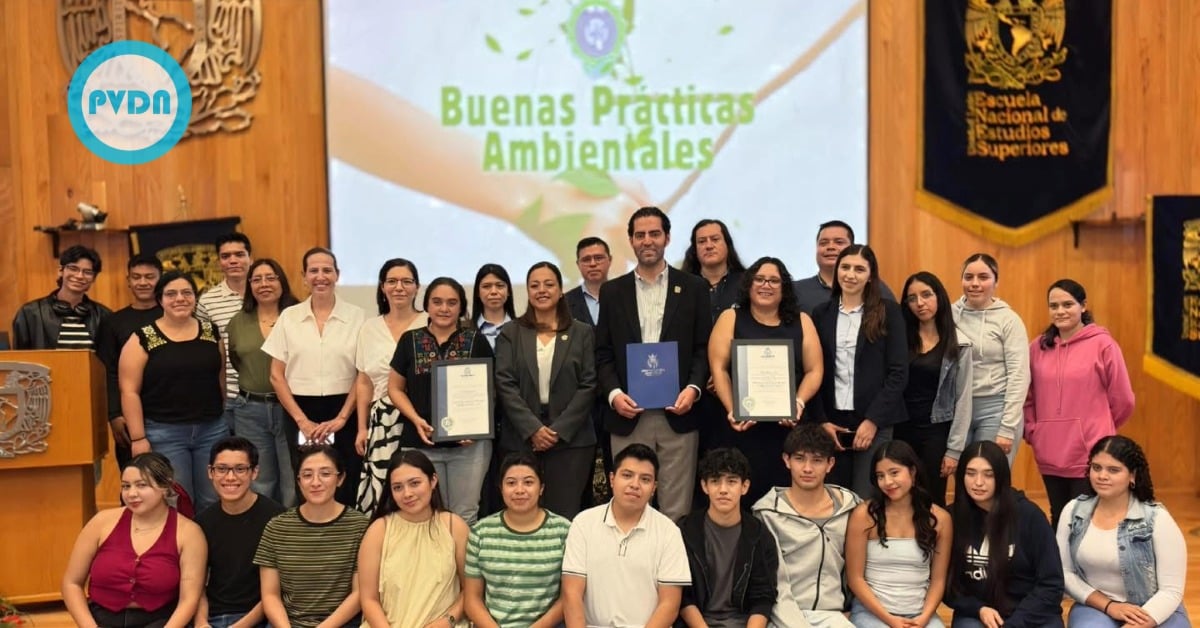
UNAM’s ENES León and its San Miguel de Allende Extension didn’t just pledge to be greener—they proved it. Over the course of six months, both sites reduced electricity use, diverted tons of waste from landfills, and expanded care for campus green spaces. Guanajuato’s environmental watchdog took note, issuing the state’s environmental good practices distinction for measurable gains rather than promises. It’s a small story with significant ripple effects for how universities in Mexico approach sustainability—and how results, not slogans, are starting to move the needle.
Environmental good practices
Guanajuato’s environmental authority (PAOT) awarded the environmental good practices distinction to UNAM’s ENES León campus and its San Miguel de Allende Extension after a six-month push that delivered complex numbers: a reduction of 11,592 kWh in electricity consumption, 9,578 kilograms of waste kept out of the landfill, and stewardship over 3,902 square meters of green space supporting 258 individual plants and trees. PAOT chief Karina Padilla Ávila presented the recognition.
The program behind the award isn’t a public-relations plaque. PAOT’s “Buenas Prácticas Ambientales” framework outlines actions to reduce resource use—such as electricity, water, and raw materials—mitigate environmental risks, and enhance waste management. Institutions that meet the targets earn the distinction, a model aimed at pushing organizations to show progress over a defined period rather than signing broad commitments with no follow-through.
Local outlets first reported the distinction for ENES León and San Miguel de Allende on October 6, lining up with a government bulletin detailing the specific outcomes. That matters for credibility: the state’s own numbers match third-party coverage and the campuses’ social confirmations, reducing the chance of inflated claims.
Why these numbers matter beyond campus
Universities punch above their weight in the sustainability conversation because they operate like small cities—mixing classrooms, labs, offices, and public spaces—so operational wins can be scaled up. Prior efforts in Guanajuato demonstrate the program’s reach: in 2023, 34 university facilities elsewhere in the state received the same distinction, indicating that sectors far beyond industry are being drawn into verifiable climate action.
Guanajuato’s PAOT has spent three decades tightening the link between policy and everyday practice. That history is essential context: an agency with longevity can sustain programs across political cycles, keeping long-horizon work, such as waste diversion and energy efficiency, on track. The “Buenas Prácticas” model is one of the agency’s tools for transforming citizen and institutional participation into measurable reductions in environmental impact.
For UNAM’s Bajío campuses, the timing also aligns with a broader trend among Mexican higher-education institutions to treat sustainability as an operational requirement, rather than an elective. Scholarly work on “macro-universities” underscores both the scale and the challenge of embedding sustainability into sprawling public systems; recognitions tied to data, like this one, help keep those systems honest.
What it signals for students and the region
For students, the award serves as a reminder that sustainability isn’t limited to lectures. It’s baked into the way facilities run—lights, waste streams, and the care of green areas they use every day. For the region, it suggests an emerging baseline: if two public campuses can demonstrate six-month reductions backed by numbers, local governments and private actors will lose excuses for inaction. Coverage across state and regional channels—and confirmations from the campuses themselves—suggests the expectation is spreading.
The win is modest in the global emissions picture, but that’s the point. Climate progress will hinge on thousands of these small, verified steps. Guanajuato’s distinction leans into that reality by rewarding results, not rhetoric, and by making the metrics public. For UNAM’s ENES León and its San Miguel extension, the next test is persistence—keeping the kWh down, keeping waste out of landfills, and letting students see that sustainability is something you measure, not just something you say.