The Mexican Caribbean is bringing ocean conservation into public spaces with music, murals, student art, film, beach cleanups, and community events. The 14th Festival of the Oceans will run from May 30 to June 7, with free activities across Puerto Morelos, Benito Juárez, and Solidaridad. This year’s program arrives as Quintana Roo faces renewed pressure from sargassum, coastal development, and the need to protect the reefs and marine life that support daily life and tourism in the region.
Festival of the Oceans returns with free events across the Mexican Caribbean
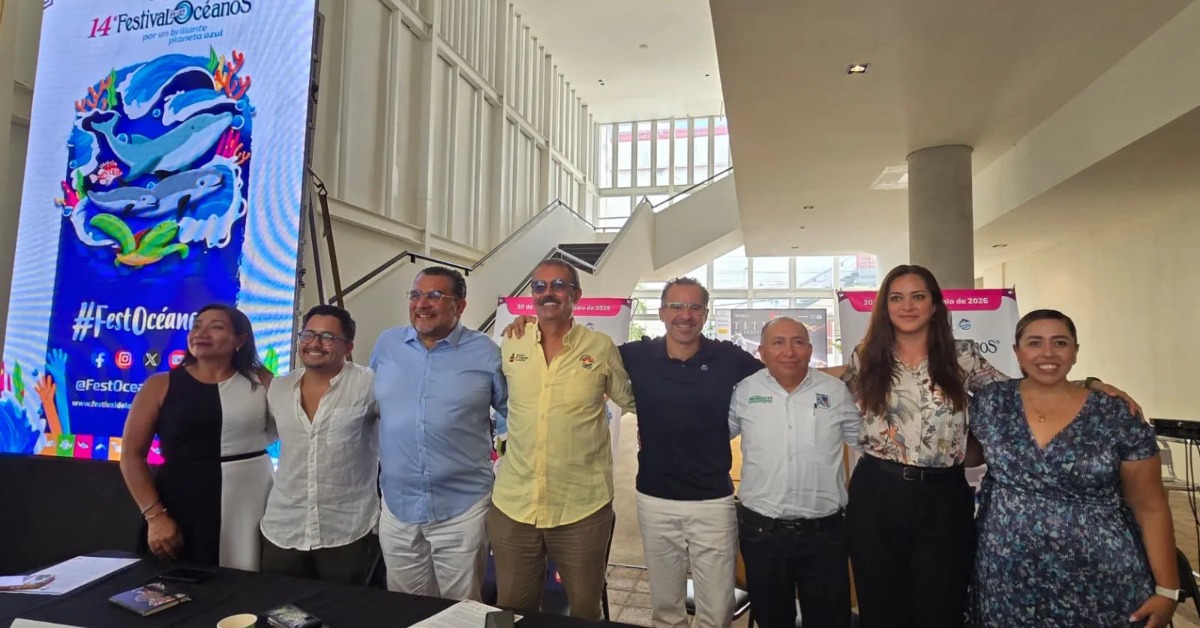
The 14th Festival de los Océanos del Caribe Mexicano will return from May 30 to June 7 with free cultural, environmental, and community events in Puerto Morelos, Benito Juárez, and Solidaridad.
The annual festival uses art, music, film, education, and volunteer action to raise awareness of the ocean and coastal ecosystems of Quintana Roo. Organizers describe the event as a public platform for building awareness around marine conservation in one of Mexico’s most visited coastal regions.
This year’s program includes a mural in Puerto Morelos, a beach and mangrove cleanup, an airport exhibition in Cancún, a concert at the Teatro de la Ciudad, a sustainable fashion presentation, and a closing event in Playa del Carmen.
The festival is organized by Delphinus with support from public institutions, universities, cultural groups, and private partners. Activities are free and designed for residents, students, families, and visitors.
The program opens in Puerto Morelos
The festival begins Saturday, May 30, in Puerto Morelos, a town whose local identity is closely tied to the sea, fishing, reef tourism, and coastal conservation.
The opening activity will include the presentation of the festival’s commemorative mural, “El Océano es Nuestro Hogar.” The mural was created by Acapulco artist and illustrator Miguel Castillo Vivas and will be placed in Parque Fundadores.
The same day, volunteers will take part in a beach and mangrove cleanup from 9 a.m. to noon. The activity is meant to connect residents with the coastal spaces they use and depend on.
For Puerto Morelos, this type of event carries added weight. The town sits near the Arrecife de Puerto Morelos National Park, a protected marine area known for coral, seagrass, and reef-based tourism.
Cancún events bring ocean art to a wider public
On Monday, June 1, the festival will move to the Cancún International Airport, where Terminal 4 will host the opening of a festival exhibition.
The airport display will include selected works from the 14th Children and Youth Drawing Contest. This year, the contest received 758 drawings from students in primary, secondary, and high schools.
The submissions came from Quintana Roo, other parts of Mexico, and 13 countries. Participating countries included Argentina, Bolivia, Canada, Colombia, Costa Rica, Spain, the United States, Honduras, India, Paraguay, Peru, Portugal, and the Dominican Republic.
The airport setting gives the exhibition a broad audience. Thousands of travelers pass through the terminal daily. As a result, it is a visible place for messages about the ocean and the Mexican Caribbean.
The winners of the drawing contest will also be recognized during the event.
Music, film and sustainable design join the message
One of the festival’s main events will take place on Friday, June 5, at the Teatro de la Ciudad de Cancún.
The Concierto por el Océano will feature the music band of the X Región Militar of the Secretaría de la Defensa Nacional. The concert is scheduled from 7 p.m. to 9 p.m.
This year’s Cancún program will also include the first Pasarela por el Océano, a sustainable fashion presentation using beachwear and design to connect conservation with daily consumer choices.
The festival will close in Playa del Carmen with another Concierto por el Océano at the Teatro de la Ciudad “Xaman-Ha.” The closing event is scheduled from 6 p.m. to 8 p.m.
The Playa del Carmen event will include the award ceremony for the University Cineminutes for the Ocean Contest. The short-film contest received 107 entries from university students in seven countries: China, Colombia, Ecuador, the United States, Guatemala, Mexico, and Peru.
The festival arrives during a difficult year for the coast
The festival comes as Quintana Roo continues to face pressure from sargassum, coastal development, and the long-term challenge of protecting reefs, beaches, and mangroves.
Sargassum has become a recurring issue across the Mexican Caribbean. Large arrivals can affect beaches, water quality, tourism, marine life, and public health when the seaweed decomposes along the coast.
Recent monitoring has warned of a heavy Atlantic sargassum season. Scientists have also raised concerns about how decomposing sargassum can affect reefs and seagrass beds.
For local communities, ocean protection is not only an environmental issue. It is also tied to jobs, tourism, fishing, recreation, and the identity of towns like Puerto Morelos, Cancún, and Playa del Carmen.
That is why the festival’s format matters. It does not present conservation only through lectures or technical reports. It brings the topic into places where people already gather, including parks, theaters, beaches, and the airport.
A regional event built around World Oceans Day
The Festival of the Oceans was first held in 2013 and was inspired by World Ocean Day, observed globally on June 8.
The international date is used each year to promote ocean protection and public participation. The 2026 global action theme is focused on strong marine protected areas.
In the Mexican Caribbean, that theme is especially relevant. The region includes protected reef areas, marine parks, mangrove systems, and coastal habitats that support wildlife and tourism.
The festival’s schedule ends one day before World Ocean Day, keeping the local program connected to the broader global calendar.
A public invitation to take part
Organizers are presenting the 2026 edition as a community event, not only as a cultural calendar. The program is built around public participation, student creativity, and visible action.
For residents and visitors, the festival offers a simple entry point into ocean issues that can otherwise feel distant or technical. A cleanup, a concert, a mural, or a student art exhibit can make the subject easier to understand.
The central message is also practical. The Mexican Caribbean depends on healthy beaches, reefs, and coastal ecosystems. Protecting them requires government action, scientific work, business participation, and public involvement.
The festival gives those efforts a shared space for one week across the region.