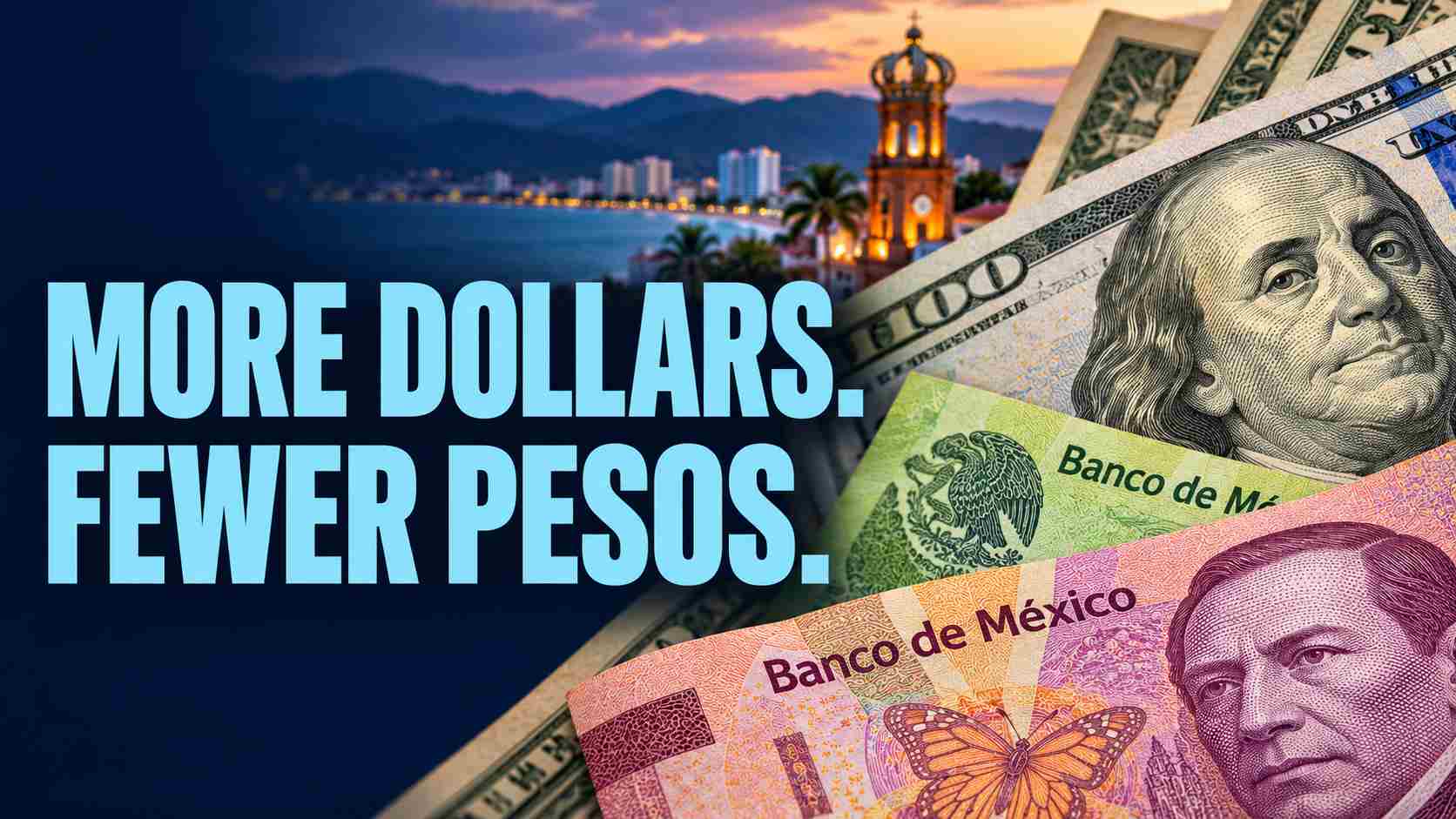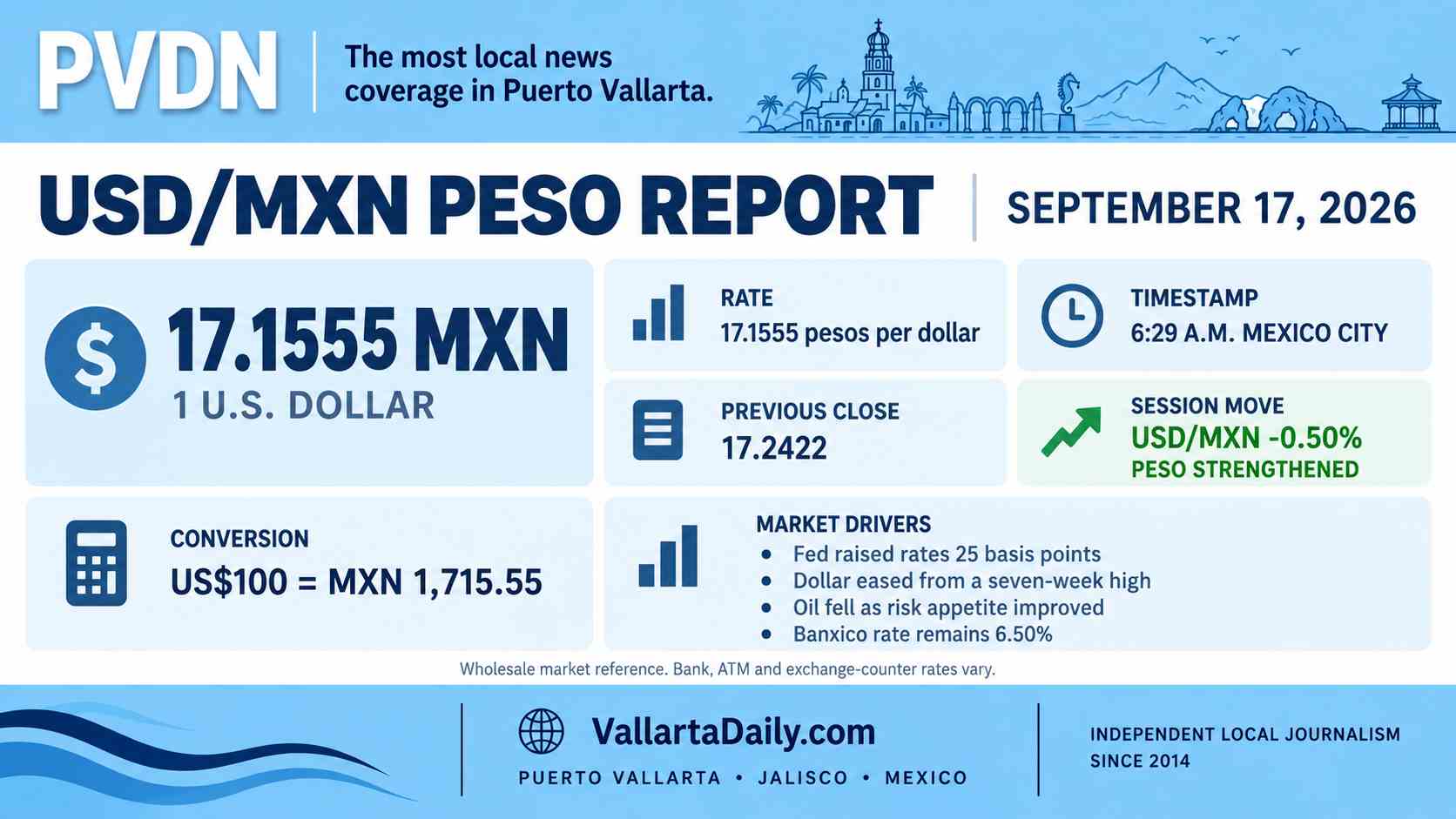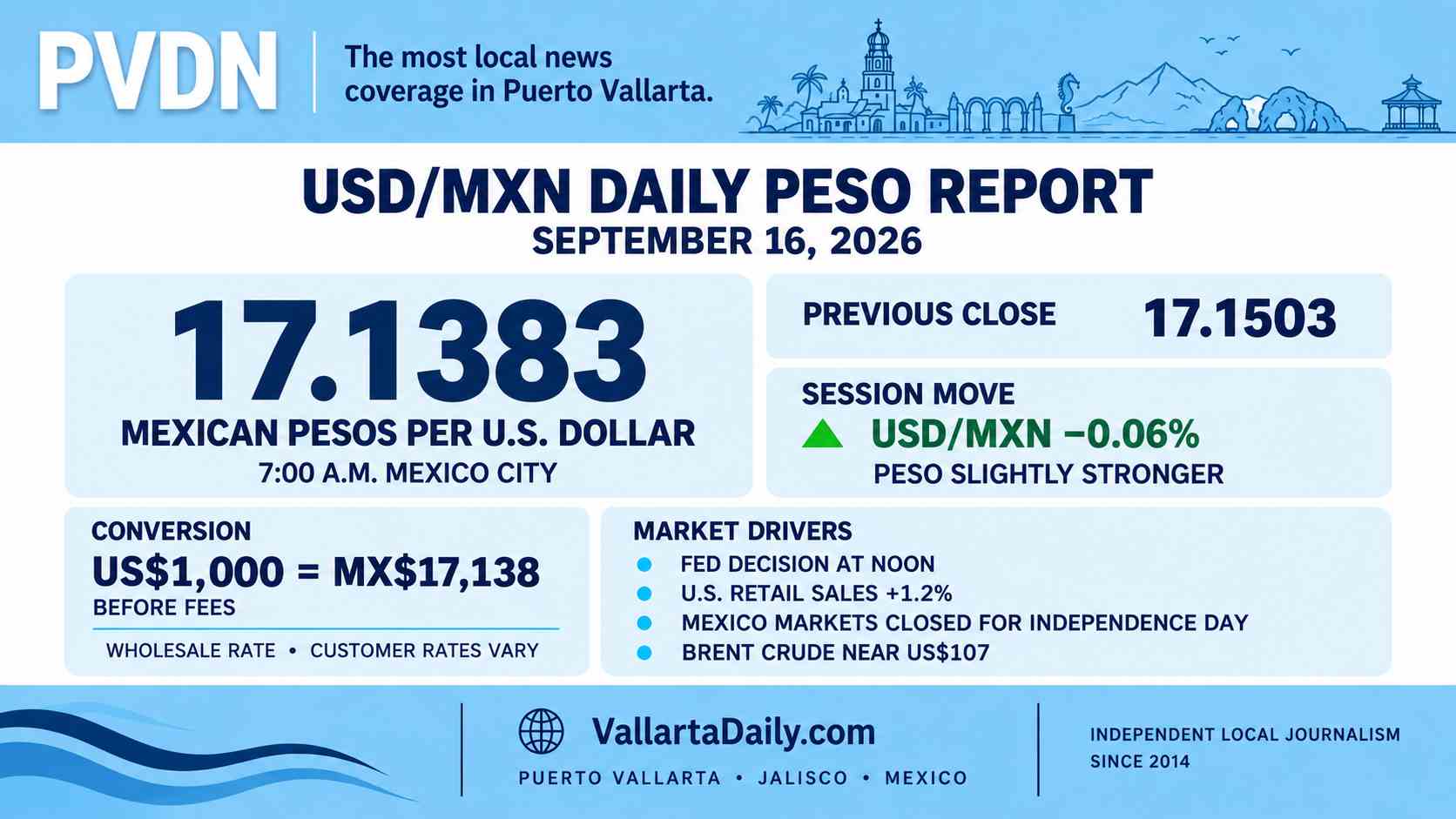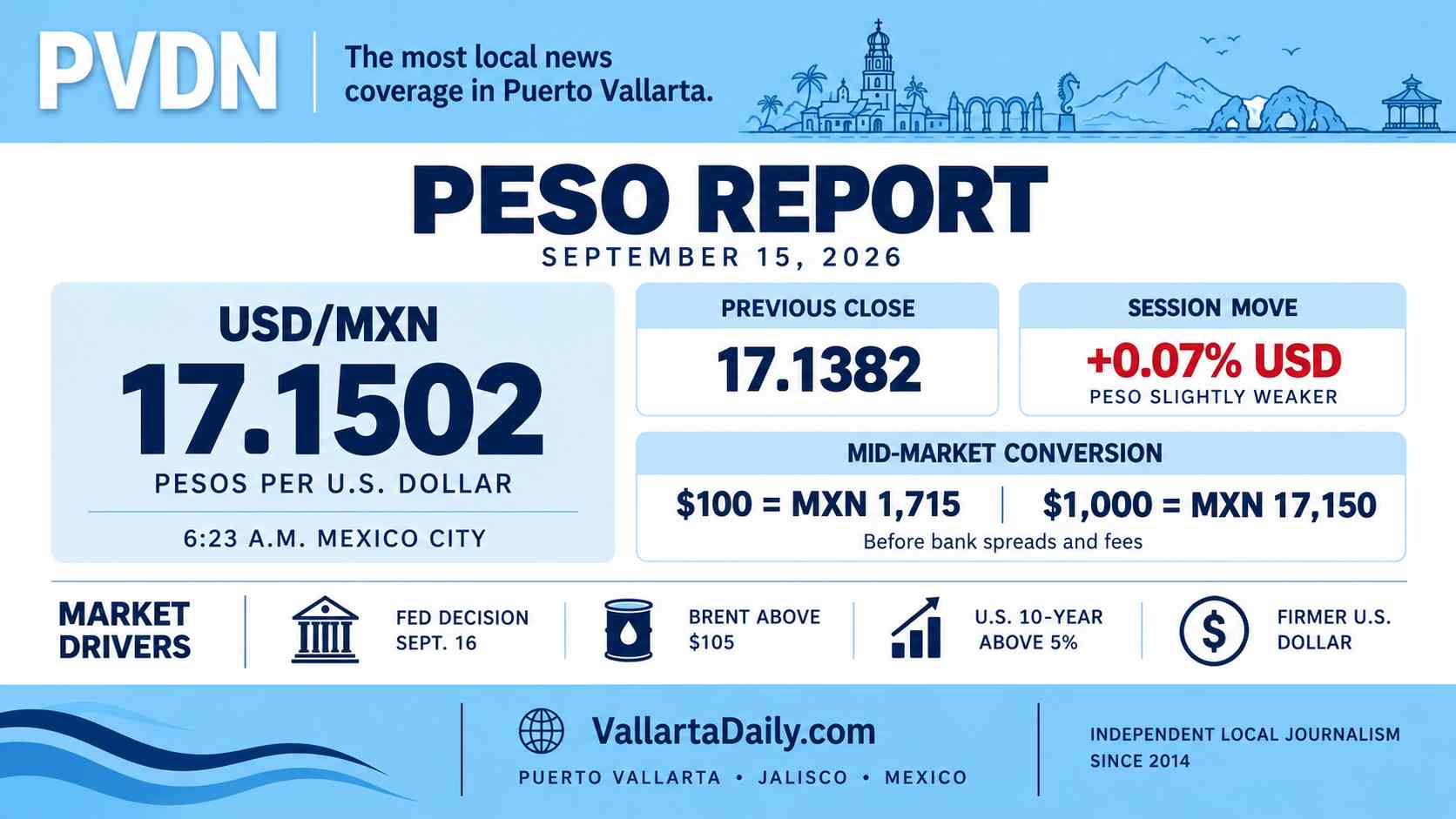
Mexico’s peso fell 2.26% against the dollar, its worst day since April 2025. Here’s what drove the decline and what it means in Vallarta.
Mexico City, Mexico, November 19, 2026 – The Mexican peso suffered its biggest one-day decline in more than 19 months on Wednesday, losing 2.26% against the U.S. dollar as investors reacted to signs that American interest rates could remain higher than previously expected.
The peso closed November 18 at 18.8456 per dollar, compared with 18.4298 the previous day. That’s a loss of nearly 42 centavos in a single trading session, according to figures from Banco de México reported by El Economista.
It was the currency’s steepest daily decline since April 4, 2025, when it lost 2.62%. The dollar also reached levels not seen since August 2025.
Early Thursday reporting from N+ placed the dollar around 18.87 pesos, although currency markets continue trading throughout the day and rates can change quickly.
For Americans and Canadians living in Puerto Vallarta, particularly those receiving income in U.S. dollars, the move means their money can suddenly buy more pesos. For Mexicans purchasing goods or paying bills priced in dollars, the same exchange-rate movement works in the opposite direction.
But Wednesday’s selloff wasn’t simply a case of investors losing confidence in Mexico. The dollar strengthened against currencies around the world.
The Federal Reserve changed the mood
The peso’s decline accelerated after the U.S. Federal Reserve released the minutes of its October 27–28 meeting.
The minutes showed that Federal Reserve officials remain concerned about inflation and that many expect additional interest-rate increases will be needed to bring it under control.
The Fed left rates unchanged at its October meeting, but two members voted for an increase. Other officials indicated they could support higher rates in the coming months if inflation remains stubborn.
That matters to Mexico because interest rates are one of the reasons international investors have been willing to hold pesos.
For years, Mexico’s relatively high interest rates have attracted investors looking to earn better returns than they could get in other currencies. One common strategy, known as the carry trade, involves borrowing money in a currency with lower interest rates and investing it in one that pays more.
Mexico has benefited from that arrangement.
When U.S. rates rise, or investors believe they’re about to rise, the difference between the returns available in the two countries becomes smaller. Holding pesos can become less attractive, especially when currency fluctuations threaten to wipe out the extra interest earned.
Some investors respond by selling pesos and buying dollars.
Wednesday showed how quickly that can happen.
Gabriela Siller, director of economic analysis at Banco Base, told El Economista that the peso was the hardest-hit currency in the session as the dollar strengthened broadly.
Mexico wasn’t alone. South Africa’s rand lost 2.09%, Brazil’s real declined 1.89%, and Colombia’s peso fell 1.55% against the dollar.
The widespread selling points to a change in global investor expectations, not a problem confined to the Mexican economy.
Banxico has been moving in the opposite direction
The peso’s slide also comes during a period when Mexico’s central bank has been lowering borrowing costs.
On November 5, the Junta de Gobierno of Banco de México cut its benchmark interest rate by a quarter of a percentage point, bringing it to 6.25% effective November 6.
The decision reflected Mexico’s need to support economic activity while keeping inflation under control.
Lower interest rates can make borrowing less expensive for businesses and households. They can also reduce the returns investors earn on peso-denominated investments.
That creates a difficult situation for Banxico.
Mexico’s economy has been dealing with uneven growth, while inflation remains a concern. As Vallarta Daily previously reported in its analysis of Banxico’s economic outlook, the central bank has been trying to balance weaker economic momentum with the need to keep prices stable.
Now the Federal Reserve appears to be moving toward additional increases while Mexico has been cutting rates.
Neither central bank has announced a new change in response to Wednesday’s exchange-rate movement. Still, the difference in their expected policies helps explain why investors reacted so strongly.
The peso has been losing ground for months
One bad trading day doesn’t tell the whole story.
Mexico’s currency spent portions of 2026 considerably stronger than it is today. Banco de México’s monthly exchange-rate records show the average dollar exchange rate was approximately 17.07 pesos in August.
By October, that monthly average had risen to about 18.43 pesos.
The move from August to October was gradual compared with Wednesday’s sudden decline, but it shows that the peso was already under pressure before the latest Federal Reserve minutes arrived.
There have been similar periods of currency volatility in recent years. During the first half of 2024, the peso traded near 16.3 to the dollar before weakening substantially later that year. It then recovered ground during parts of 2025 and 2026.
The difference now is the combination of a stronger U.S. dollar, expectations of higher American interest rates and Mexico’s own easing cycle.
Financial markets are also watching the future of trade relations between Mexico and the United States. Those negotiations remain important to the peso’s longer-term outlook, although Wednesday’s broad currency selloff was primarily tied to changing interest-rate expectations.
What the weaker peso means in Puerto Vallarta
The immediate effects depend largely on which currency people earn and which currency they spend.
Someone living in Puerto Vallarta on a fixed U.S. dollar pension or retirement income can receive more pesos when the peso weakens. That can help with rent, groceries, utilities and other expenses billed in Mexican currency.
The benefit isn’t automatic for everyone. Exchange services and banks charge different rates, and fees can reduce the amount received.
It also doesn’t mean local prices suddenly become cheaper. The peso price of a restaurant meal, a utility bill or a monthly apartment rental may remain exactly the same.
For households earning pesos, a weaker currency can create different problems.
Imported products, equipment and supplies purchased in dollars become more expensive in peso terms. Businesses that depend on imported goods may eventually pass some of those higher costs to customers, although a single day of currency movement doesn’t guarantee immediate price increases.
The issue is particularly relevant in Puerto Vallarta, where tourism, foreign property ownership, international payments and money sent from abroad are regular parts of the local economy.
Earlier this month, Vallarta Daily reported that Puerto Vallarta and Bahía de Banderas received US$167.1 million in remittances during the first nine months of 2026.
Despite receiving more dollars than during the same period of 2025, the combined peso value of those remittances was approximately 190 million pesos lower because the exchange rate had been less favorable to dollar recipients.
That earlier decline shows just how much exchange rates can matter to families receiving money from the United States.
Wednesday’s weaker peso moves the exchange rate in their favor, at least for the moment. Whether that benefit lasts will depend on where the currency settles over the coming weeks.
What happens next
Investors will be watching the next signals from both central banks.
The Federal Reserve’s next scheduled policy meeting is December 8–9. Its November 18 minutes suggest officials are prepared to raise interest rates if inflation continues to resist their efforts to bring it down.
Mexico’s monetary policy outlook will also matter. Investors want to know whether Banxico will continue cutting rates, hold at 6.25%, or adjust its plans as the peso and inflation respond to developments abroad.
For now, there’s no reliable basis for saying Wednesday’s decline marks the beginning of a prolonged peso selloff. Exchange rates can reverse direction quickly, particularly after unusually large daily movements.
There is, however, a measurable change in what dollar income can buy in Mexico.
At Tuesday’s market closing rate of 18.4298 pesos per dollar, US$1,000 was worth approximately 18,430 pesos before exchange fees.
At Wednesday’s close of 18.8456, that same US$1,000 was worth approximately 18,846 pesos.
That’s about 416 additional pesos from the same US$1,000 in just one day, calculated at wholesale market closing rates rather than the rates banks or exchange businesses necessarily offer customers.
For a household converting US$3,000 in monthly income, the difference between those two closing rates works out to almost 1,250 pesos before fees.
Whether that advantage remains when the next pension payment or international transfer arrives will depend on what happens to the peso after Wednesday’s unusually sharp fall.