You do not need perfect Spanish to handle day-to-day in Mexico. You need the right phrases, said clearly, in the moments that matter. The same lines show up at the pharmacy, the fruit stand, the bank queue, the taxi, and the repair call. Miss them, and small tasks get slow fast. Learn them, and most problems shrink. This explainer breaks down 50 phrases that cover errands, services, and emergencies, plus the small tweaks that make them sound natural.
Most Spanish courses start with long vocabulary lists. Real life usually does not.
Day to day in Mexico, you repeat a small set of lines in the same places. You say them at the cashier, the pharmacy counter, the clinic desk, and the repair call. The goal is not perfect grammar. The goal is to get what you need, fast, and stay safe when something goes wrong.
This guide focuses on 50 phrases that cover errands, services, and emergencies. They are written for polite “you” with strangers, which is the safer default for most interactions. Each one can stand alone, even with an accent or a pause. Many include a blank you can fill with a place, item, or symptom.
The fastest progress comes from treating these phrases like tools, not trivia. Keep them on your phone. Practice saying them out loud at normal speed, then again when you feel rushed. When a problem repeats, add one phrase that solves it. Over time, the phrases start to link together.
Why these phrases matter more than vocabulary lists
Most everyday Spanish is built from reusable “chunks.” A chunk is a short set of words people say as one unit. That matters because it cuts down decision-making. You are not building sentences from scratch in the checkout line. You are pulling a familiar line off the shelf.
Chunks are also easier to access under stress. In a noisy store or during a health scare, memory narrows. A short, practiced phrase can keep the interaction moving. It also signals cooperation. That helps when you need patience or extra explanation.
This list leans on polite structure, especially the usted tone used with strangers and service workers. That is why many phrases use “me puede,” which stays respectful and direct. Do not worry about perfection. Clear words, a calm pace, and the right phrase usually do more than flawless grammar.
Daily errands and services in Mexico
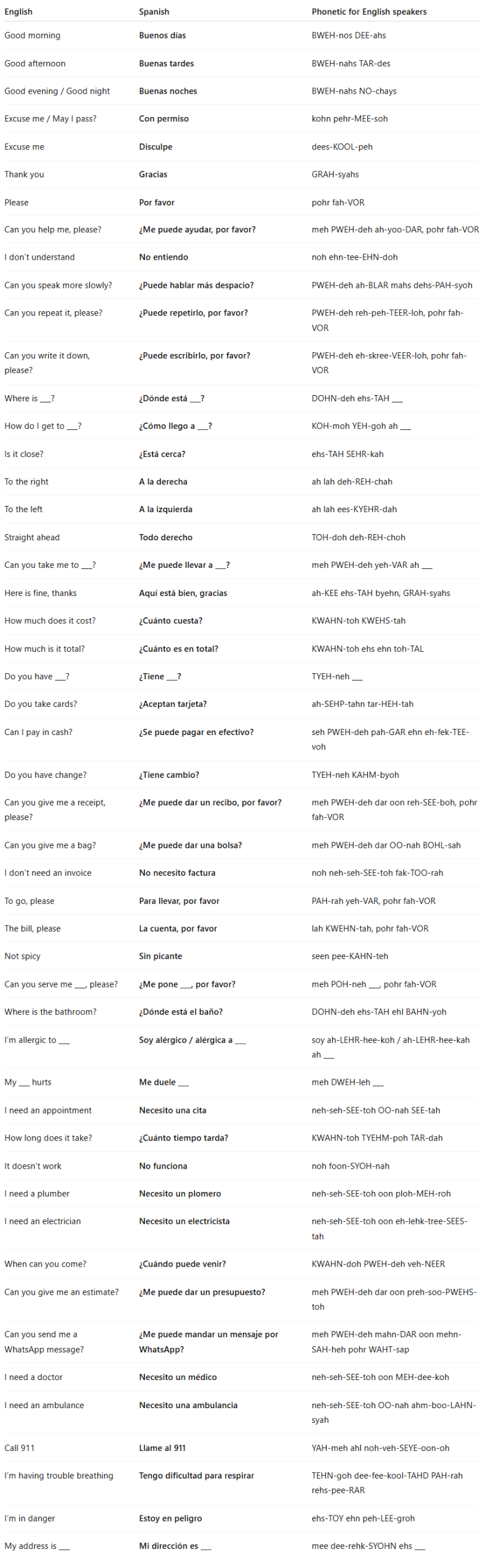
Start with greetings that fit the time of day. Use Buenos días. for “Good morning,” Buenas tardes. for “Good afternoon,” and Buenas noches. for “Good evening” or “Good night.” When you need to slip past someone in a line or a narrow aisle, Con permiso. means “Excuse me.” If you need someone’s attention, Disculpe. also means “Excuse me.” Close the loop with Gracias. for “Thank you,” and add Por favor. for “Please.”
When the conversation speeds up, go straight to control phrases. ¿Me puede ayudar, por favor? means “Can you help me, please?” No entiendo. means “I don’t understand.” If you need a slower pace, ¿Puede hablar más despacio? means “Can you speak more slowly?” If you missed a detail, ¿Puede repetirlo, por favor? means “Can you repeat it, please?” If the issue is a name, address, or instruction, ¿Puede escribirlo, por favor? means “Can you write it down, please?”
For directions, keep your question short and to the point. ¿Dónde está ___? means “Where is ___?” and works for almost any place. ¿Cómo llego a ___? means “How do I get to ___?” If you are deciding between walking and a ride, ¿Está cerca? means “Is it close?” People often answer with gestures. The three directional phrases to listen for are A la derecha. (“To the right”), A la izquierda. (“To the left”), and Todo derecho. (“Straight ahead”).
In a taxi, a driver, or a private ride, the most useful line is ¿Me puede llevar a ___? which means “Can you take me to ___?” Say the place name, then pause. When you arrive, Aquí está bien, gracias. means “Here is fine, thanks.” It is a polite way to stop at the right corner, not the next block.
Money talk runs on a handful of questions. ¿Cuánto cuesta? means “How much does it cost?” and can be asked for one item. ¿Cuánto es en total? means “How much is it total?” and works at the register. If you are hunting a specific item, ¿Tiene ___? means “Do you have ___?” To avoid surprises at checkout, ¿Aceptan tarjeta? means “Do you take cards?” If you prefer cash, ¿Se puede pagar en efectivo? means “Can I pay in cash?” When small bills matter, ¿Tiene cambio? means “Do you have change?” You may also hear it asked the other way around.
Receipts matter in Mexico, especially for returns and warranties. ¿Me puede dar un recibo, por favor? means “Can you give me a receipt, please?” Bags are not automatic everywhere, so ¿Me puede dar una bolsa? means “Can you give me a bag?” You may also hear people ask about an official tax invoice. If you do not need one, No necesito factura. means “I don’t need an invoice.”
Food and quick service have their own shortcuts. If you are taking food home, Para llevar, por favor. means “To go, please.” When you are ready to pay, La cuenta, por favor. means “The bill, please.” If you want to avoid heat, Sin picante. means “Not spicy.” For taco stands, juice bars, and counter spots, ¿Me pone ___, por favor? means “Can you add/serve ___, please?” If you need facilities, ¿Dónde está el baño? means “Where is the bathroom?”
Health needs show up in everyday places, including pharmacies and clinics. If you have a food or medication concern, Soy alérgico/alérgica a ___. means “I’m allergic to ___.” For pain, Me duele ___. means “My ___ hurts.” For scheduling without long explanations, Necesito una cita. means “I need an appointment.” For timing, ¿Cuánto tiempo tarda? means “How long does it take?” That question works for meals, repairs, and deliveries.
Home life brings new vocabulary fast, but you can keep the structure simple. No funciona. means “It doesn’t work,” and you can point to the appliance or internet box. Necesito un plomero. means “I need a plumber.” Necesito un electricista. means “I need an electrician.” To set expectations, ¿Cuándo puede venir? means “When can you come?” For cost clarity, ¿Me puede dar un presupuesto? means “Can you give me an estimate?”
In many parts of Mexico, service coordination happens by messaging. A single line can save time and mistakes. ¿Me puede mandar un mensaje por WhatsApp? means “Can you send me a message on WhatsApp?” It works for address details, photos, and confirmations. It also gives you a written record of the plan.
Emergencies and health situations
In an emergency, the first goal is getting help moving toward you. Necesito un médico. means “I need a doctor,” and Necesito una ambulancia. means “I need an ambulance.” If someone nearby has a phone, Llame al 911. means “Call 911.” If you can speak but you are struggling, Tengo dificultad para respirar. means “I’m having trouble breathing.” If you are being threatened or cannot safely stay where you are, Estoy en peligro. means “I’m in danger.”
Location is what turns a request into a response. Keep your address written in Spanish on your phone and on a card in your wallet. When you need to say it out loud, Mi dirección es ___. means “My address is ___.” Say the street name slowly, then the exterior number. In Spanish, the street name comes before the exterior number. If you say the number first, you might confuse the operator that you live on a numbered street. If you do not know the address, use a clear landmark and the nearest cross street.
Mexico’s national emergency number is 911, and it connects you to police, medical, or fire services. Tourist support lines exist, too, and can be useful for urgent but non-life-threatening issues. One national tourist assistance line is 078. In Mexico City, LOCATEL can support residents and visitors with information and guidance at 55 5658 1111, and it offers an English option.
Even with good phrases, stress can raise your voice and speed. Slowing down often helps more than adding new words. Use one clear phrase, then pause. If the other person responds fast, slow the pace again or ask for the details in writing. Written details reduce errors when names and numbers matter.