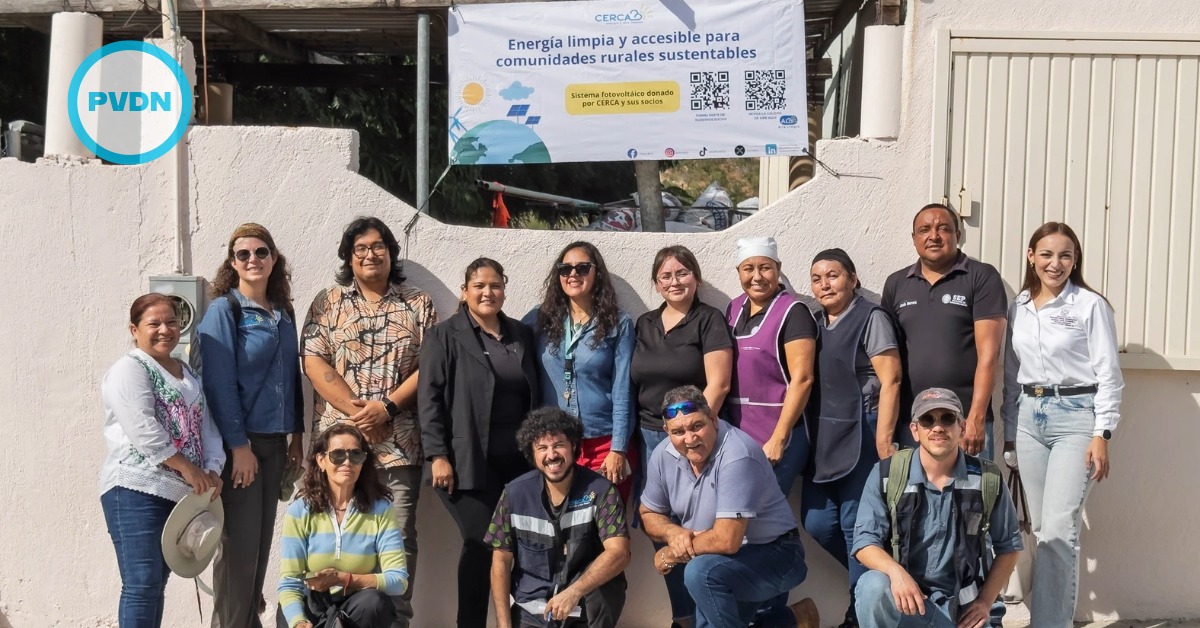
With a new solar kiosk, the remote community of La Candelaria finally gets reliable power for families, students and daily life in northern Los Cabos.
On a late November morning in the northern sierra of Los Cabos, a small concrete kiosk came to life in La Candelaria. The structure is simple from the outside. On the roof, solar panels catch the desert sun. Inside, outlets, lights and a compact refrigeration system now give the village something it has never really had before in its public spaces: reliable, clean electricity.
The installation is the first of its kind in the municipality, part of a rural electrification program led by the Centro de Energía Renovable y Calidad Ambiental (CERCA). It joins earlier kiosks in Puerto Chale and El Dátil, both in Baja California Sur, where similar systems have already supported longer school hours, safer clinics and night-time community events. In La Candelaria, the new kiosk is wired to priority sites chosen by residents, including the telesecundaria and a community boarding facility for students who live far up in the hills.
At the heart of the project is a compact, off-grid power system. Four photovoltaic panels feed a battery bank sized to keep basic equipment running for up to three days even if clouds or storms block the sun. That is enough to power lighting in classrooms and meeting halls, a refrigerator for food and medicines, a fan during the hottest hours and daily charging of phones, radios and computers. Around 90–100 people, many of them students and staff at the local albergue, will feel the change first.
A lifeline for La Candelaria
La Candelaria sits in the rural north of Los Cabos, several kilometres from the nearest urban grid. For years, authorities have promised full electrification through conventional power lines. In 2022, officials outlined a project to build about 23 kilometres of new distribution infrastructure to reach the community, estimating that roughly 200 families would benefit once the lines are in place. Those works, however, require complex permits, land agreements and large public investment, and are moving slowly.
In the meantime, local life has depended on a patchwork of solutions. Small diesel generators and irregular connections have provided a few hours of power in some spaces, but not the constant service needed to run a school, keep fresh food cool or guarantee a fan on the hottest afternoons. Teachers in the area have reported interrupted classes, equipment failures and limited enrollment because families know their children cannot count on stable conditions at the telesecundaria and the boarding facility.
CERCA’s director, Jacqueline Valenzuela, describes the kiosks as a way to close that gap while long-term grid projects advance. Her team identified 63 rural communities in Baja California Sur without a secure connection to the state grid. Many relied on diesel engines that could only afford a few hours of light at night, leaving residents vulnerable every time fuel ran out or a storm cut access roads. When the organization returned in 2022 to ask people what they needed most, the answers were consistent: refrigeration, lighting, communication and basic relief from the heat.
The kiosk in La Candelaria is built exactly around those requests. Underground cables connect the solar core to the points the community chose: the telesecundaria, the boarding house and other shared spaces. Instead of chasing individual household hookups, the first goal is to guarantee that children can study after dark, that a refrigerator can keep food safe and that people can charge a phone to call for help in an emergency.
Parents say the change is already visible. Students no longer have to rush through homework before sunset or wait for a noisy generator to start. Staff at the albergue can plan meals with fresh ingredients, knowing they will stay cold overnight. And when the heat spikes, turning on a fan is no longer a luxury that might drain a car battery or empty a fuel can. These may sound like small details in a city, but in a village that has waited decades for dependable power, they mark a quiet turning point.
Solar kiosk Los Cabos
The Solar kiosk Los Cabos project sits inside a much bigger debate about who still lives without electricity in Mexico, and what “electrification” really means. Official figures show that the country has reached more than 99.6 percent coverage: nearly every household appears on the map as connected to the grid. Yet the Comisión Federal de Electricidad (CFE) still counts about 295,000 people in 4,473 communities without service, most of them in rural areas, Indigenous regions and urban settlements on the edge of cities.
Baja California Sur reflects that mixed picture. Its average electrification rate is above 99 percent, but the state’s geography and isolation from the national grid leave pockets of deep energy poverty. Small fishing camps, mountain villages and scattered rancherías face long distances, complicated land tenure and fragile roads that can disappear for weeks after a strong storm. For those communities, waiting for a conventional substation and kilometers of cable can mean another decade without secure power.
That is where CERCA’s model of “energy social” comes in. Instead of treating electricity as something that arrives only through large infrastructure, the group works with residents to build micro-grids around shared priorities. Each kiosk creates a small island of stable power, managed locally, where the community decides which spaces to connect and under what conditions. The systems are delivered under agreements that tie their permanence to collective benefits, such as keeping the school open, holding cultural activities or supporting local health services.
In Puerto Chale and El Dátil, this approach has already reshaped daily life. Health clinics extended their hours. Students now attend evening study sessions under electric light. Community sports and cultural events take place after sunset without relying on noisy generators. According to program reports, the first two kiosks directly benefit around 700 people, while the number of medical consultations, classes and activities they support runs into the thousands each year.
La Candelaria’s kiosk is the first to reach a mountainous zone of Los Cabos, where access is often cut off by hurricanes and heavy rains. Here, the stakes are different. When roads vanish under mud or rock, it is not just food and comfort at risk, but also education. Boarding schools in rural Baja California Sur have closed in the past when they could not guarantee basic energy services. Local advocates warn that every closure pushes children from remote ranchos out of the school system entirely. Securing electricity for the La Candelaria albergue is one way to keep that door open.
For now, the kiosk does not replace the need for a full grid connection. Families still hope to see CFE lines and poles climbing the canyon, as officials have promised. But the new solar hub means they no longer have to wait for a mega-project to see real change. It offers a bridge between the statistics of national electrification and the lived reality of a village that has spent years on the margins of energy planning.
If the model works, La Candelaria may be a preview of what is coming for other off-grid communities in Los Cabos and across Baja California Sur. CERCA has already flagged at least 11 localities in the municipality that urgently need better electricity. State authorities, for their part, are under pressure to close the remaining gap for the thousands of people nationwide who still live without power.
In that context, the kiosk on a dusty hill in northern Los Cabos is more than a small shed with panels on top. It is a test of whether community-scale, renewable projects can deliver energy justice faster than traditional works alone. For the children who now fall asleep in a lit dormitory and wake up to cold milk in the fridge, the answer is already taking shape every time the batteries carry them through the night.