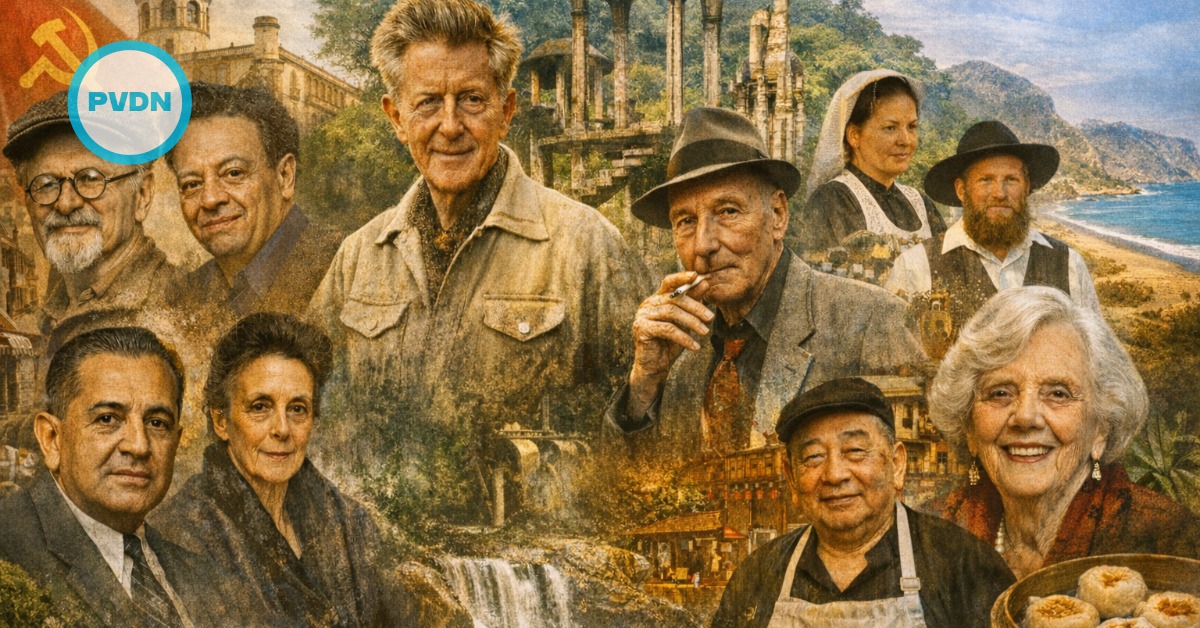
A Russian exile turned Coyoacán into an intellectual crucible, a British surrealist built a jungle dreamscape in the Huasteca, and Mennonite farmers introduced an award-winning cheese. Mexico’s story is rich with outsiders who fell in love with the land and left indelible imprints. From revolutionaries and artists to entire communities forging new traditions, these foreign trailblazers became part of Mexico’s own identity. Today’s expats will discover that being a foreigner in Mexico is nothing new — and their chapter in this ongoing exchange is just beginning.
Refuge for a Revolutionary in Coyoacán
In the late 1930s, Mexico became the unlikely haven for one of the world’s most famous exiles: Leon Trotsky, the Russian revolutionary on the run from Stalin. Trotsky arrived in Mexico City in 1937, granted asylum by President Lázaro Cárdenas at the urging of artists Diego Rivera and Frida Kahlo. For a time, Trotsky and his wife even lived at Kahlo’s family home, La Casa Azul, in the tranquil borough of Coyoacán. There, amid colorful courtyards, he found a brief peace – tending rabbits and writing scathing indictments of Stalin. Trotsky’s presence electrified Mexico’s intellectual circles. Left-wing writers, artists, and activists flocked to hear the fiery old Bolshevik speak in his accented Spanish about world revolution and freedom. His entourage turned Coyoacán into an unlikely hub of anti-Stalinist thought, symbolizing Mexico’s tradition of welcoming political refugees. Tragically, Trotsky’s asylum ended in violence: in August 1940, an assassin sent by Stalin mortally wounded him with an ice axe in his study. The modest villa on Río Churubusco Street where this drama unfolded is now the Leon Trotsky House Museum, preserved much as it was – bullet holes in the walls from a prior attack, Trotsky’s study left intact. It stands as a haunting reminder of how a foreigner’s tumultuous final chapter became part of Mexico’s own story. Trotsky’s time in Mexico was brief but profound, tying the country to a global fight for ideals and underscoring its role as a sanctuary for the persecuted.
The Diplomat Who Saved Thousands
Not all trailblazers were foreigners coming into Mexico – one was a Mexican going out into the world and bringing the persecuted back to safety. Gilberto Bosques Saldívar was a Mexican diplomat posted in France during World War II, and his humanitarian work earned him the nickname “the Mexican Schindler.” In 1940, as Nazi occupation loomed, Consul Bosques sprang into action. From his office in Marseille, he began issuing Mexican visas by the thousands to Jews, Spanish Republicans fleeing Franco, and other refugees desperate to escape Europe’s horrors. He even rented a chateau and a summer camp facility, declaring them to be Mexican territory, to shelter families while he arranged their passage to Mexico. All told, Bosques helped rescue around 40,000 people from the clutches of Nazi Germany and Vichy France. His efforts were not without sacrifice: the Gestapo eventually arrested Bosques, holding him and his family captive in Germany for a year until Mexico negotiated their release. After the war, Bosques quietly returned home, his heroism largely unheralded for decades. Yet the legacy lives on in those thousands of refugees – and their descendants – who began new lives in Mexico thanks to his bold compassion. In Puebla, his home state, and beyond, Bosques is now remembered as a symbol of Mexico’s humanitarian tradition. His story adds a reverse angle to the expat experience: a Mexican abroad who saved foreigners and brought them to Mexican soil, reinforcing the country’s role as a welcoming refuge in times of darkness.
Beats, Bebop, and Burroughs in Mexico City
Mexico City’s allure has long attracted foreign writers and free spirits, but perhaps none as notorious as William S. Burroughs. The American novelist and Beat Generation icon lived as an expat in the capital from 1949 to 1952 – years that would prove pivotal for both author and city. To Burroughs, post-war Mexico City offered a kind of lawless freedom he couldn’t find back home. He roamed the working-class neighborhoods around the Centro and Colonia Roma, reveling in the bohemian nightclubs and pulquerías. In cheap apartments with bougainvillea-draped balconies, he found the liberty to live openly on society’s margins – feeding a heroin habit, carrying a revolver, and exploring his identity as a gay man – all with a bribe-ready impunity he later described in lurid detail. Amid this decadence, Burroughs also found his literary voice. Mexico, he later said, was where he finally “started writing seriously.” He penned his first novel, “Junky,” drawing on his gritty daily life among fellow expats, street hustlers, and morphine sellers in Mexico City’s underbelly. He also began the manuscript of “Queer,” a novel explicitly set in the bars and backstreets he haunted. These works – some drafted in Mexican cafes and cold-water flats – would become classics of modern American literature, with Mexico City indelibly stamped on their pages. The expat scene around Burroughs included other Beats like Jack Kerouac and Allen Ginsberg dropping in, as well as colorful characters from around the world drawn to the city’s creative ferment. The tragic, darker side of Burroughs’ Mexico sojourn was the death of his wife, Joan Vollmer, whom he accidentally shot during a drunken “William Tell” stunt. That 1951 incident forced Burroughs to flee Mexico, and it shadowed him forever. Yet even this grim event became entwined with Mexico’s lore – the stuff of expat legend and cautionary tale. In later years, Burroughs credited the psychic fallout from Mexico with spurring his most famous work, “Naked Lunch.” For better or worse, his time in Mexico City left a mark on him – and through his writing, he left Mexico immortalized in the annals of counterculture. It’s an unlikely legacy: the meandering streets and cheap diners of mid-century Mexico City captured through the eyes of a wayward Beat, showing future expats that the metropolis has long been a canvas for reinvention.
Pioneers of Paradise in Baja
Sun-scorched and isolated, Baja California’s cape region didn’t always beckon throngs of tourists. It took a few adventurous foreigners in the 1940s and ’50s to put places like Cabo San Lucas on the map – and in doing so, they forever changed the trajectory of this once-sleepy peninsula. One early trailblazer was Ray Cannon, a Californian angler and writer who fell in love with the Sea of Cortez. In the 1940s, Cannon’s exuberant articles in Western outdoor magazines painted Baja’s waters as a sport-fishing paradise teeming with giant marlin and sailfish. American fishermen began making the arduous journey down dusty desert tracks to experience the bounty themselves. They found little villages with no electricity – but endless stars, pristine beaches, and fish beyond imagination. Entrepreneurs took note. In 1950, an enterprising expat named Bud Parr teamed up with former Mexican President Abelardo Rodríguez’s son to create Rancho Las Cruces, a luxurious fly-in fishing club on the Sea of Cortez coast near La Paz. With its private airstrip, beachfront bungalows, and flowing tequila, Rancho Las Cruces became a secret retreat for Hollywood celebrities and wealthy adventurers. John Wayne, Bing Crosby, and Errol Flynn all made the trek, swapping Los Angeles soundstages for Baja’s wild beauty. Their star power spread the word that this remote corner of Mexico was the next exotic playground. By the mid-1950s, Bud Parr and his local partners opened the Hotel Palmilla near San José del Cabo – the region’s first full-service resort. Accessible only by yacht or small plane, Palmilla drew a rarified crowd seeking big-game fishing by day and martinis at sunset. Even U.S. President Dwight Eisenhower reportedly came to cast a line and relax incognito by the turquoise coves. These early expat ventures laid the foundation for Los Cabos as a destination. They trained local crews in deep-sea angling and hospitality, effectively kick-starting a tourism economy that had not existed before. Word of Baja’s magic spread further through travelogues and radio shows – famed broadcaster Lowell Thomas, for example, glowingly recounted his Baja explorations, enchanting American audiences. Over time, the trickle of curious anglers turned into a steady stream of sun-seekers. Roads improved, a small airfield became Cabo’s international airport, and by the late 20th century, Los Cabos blossomed into a booming tourist corridor. Looking around today at the luxury marinas and golf courses, it’s hard to imagine it all began with a few intrepid foreigners who saw paradise in Baja’s rugged cape and helped reveal it to the world. Their legacy lives on each time a traveler lands in Cabo to chase marlin or simply bask in the desert-meets-ocean splendor that those early trailblazers adored.
The Surreal Garden of Xilitla
Tucked in the emerald jungles of San Luis Potosí lies an enchanted garden that seems conjured from a dream – concrete stairways leading nowhere, towering columns wrapped in vines, and orchid-filled pools where the tropical mist hangs thick. This otherworldly place, Las Pozas, was the vision of Edward James, an eccentric British poet and patron of the arts who made Mexico his canvas. In the 1940s, Edward James arrived in the remote Huasteca village of Xilitla seeking a verdant refuge where art and nature could intertwine. A wealthy heir and a confidant of Surrealist artists, James was enchanted by Mexico’s mysticism and lush landscapes. He bought a coffee plantation on a mountain slope and, after an unexpected snowstorm destroyed his prized orchid collection, decided to build living art that no frost could kill – a Surrealist wonderland in the rainforest. Over the next three decades, James poured his fortune and imagination into creating a labyrinth of surreal structures amid waterfalls and orchids. He employed dozens of local craftsmen to realize his fantastical sketches in concrete. The result was Las Pozas: eighty acres of meandering paths and whimsical architecture. Visitors encounter staircases spiraling into the treetops, elaborate gates opening onto the sky, and platforms shaped like giant blossoms. Names of the structures hint at their creator’s wry humor – The House with a Whale Roof, The Stairway to Heaven, The Temple of the Ducks. As James built, he lived simply on site, bathing in stream pools and befriending the townspeople who called him “El Inglés loco” – the crazy Englishman. Yet his endeavor provided steady work for the community and drew other artists and dreamers to Xilitla. Edward James’s presence turned this quiet coffee-growing area into a secret bohemia in the Sierra Madre. By the time of his death in 1984, James had spent millions (and sold off much of his famous art collection) to raise his concrete follies in the jungle. Today, Las Pozas is preserved as a public sculpture garden, astonishing visitors from around the world who venture to this remote pocket of Mexico to see James’s surreal legacy. The jungle has begun to reclaim some structures, wrapping them in vines and moss – just as James intended, letting nature and art meld over time. The fantastical garden stands as literal proof that a foreigner’s whimsy can become part of Mexico’s cultural landscape. Edward James left a mark as solid as concrete in Xilitla, a place where locals now proudly guide tourists through a land of dreams that only could have been made in Mexico.
An Emperor’s Short Rule, Long Shadow
Mexico even once found itself under the rule of imported royalty. In 1864, Archduke Maximilian of Austria arrived in Mexico City with his Belgian wife, Carlota, to occupy a throne offered by Mexican conservatives and backed by Napoleon III of France. The experiment of the Second Mexican Empire was brief and doomed – ending with Maximilian’s execution just three years later – yet the European monarchs left a surprisingly enduring cultural footprint in Mexico. Maximilian set up court in Chapultepec Castle, a hilltop former viceregal palace overlooking the capital. He had the aging mansion lavishly refurbished with Parisian furnishings, classical murals, and manicured gardens to suit an emperor. On Sundays, the palace threw open its doors – Maximilian and Carlota would stroll its halls to meet ordinary Mexicans, from indigenous villagers to wealthy landowners, in a gesture of royal approachability. The emperor’s aim was to win over his subjects, but even those skeptical of foreign rule were charmed by the cosmopolitan flair of the imperial couple. To better connect his castle with the city center, Maximilian commissioned a grand boulevard slicing through the capital. Lined with imported trees and gaslights, the wide avenue was named Paseo de la Emperatriz (Promenade of the Empress) in Carlota’s honor. Carriages would clip along its length from Chapultepec to the city – a little taste of Paris in Mexico. After Maximilian’s fall, the boulevard was renamed Paseo de la Reforma, now one of Mexico City’s most iconic avenues, famed for its towering angel statue and array of monuments. Every time chilangos parade down Reforma or protest in its roundabouts, they unwittingly travel the path Maximilian carved into the city’s map. The imperial couple also subtly influenced Mexican tastes. Carlota brought European fashion and court etiquette; ballroom dances and lavish operas gained favor among the elite during their tenure. Maximilian, for his part, had a sweet tooth and a love of fine baking. His personal chefs introduced Mexican palates to new breads and pastries. In fact, the popular bolillo – the crusty white bread roll now ubiquitous on every Mexican table – is said to be adapted from the Austrian Vienna bread recipes brought over by Maximilian’s bakers. Though the emperor met a tragic end – executed by Republican forces in 1867 at Querétaro – and Carlota descended into madness back in Europe, pieces of their legacy live on. Chapultepec Castle remains, later home to presidents and now the National History Museum, where visitors can still see Maximilian’s ornate chambers and Carlota’s conservatory. The elegant styles they encouraged helped shape the blossoming of Mexican society in the late 19th century under Porfirio Díaz, who admired European grandeur. Maximilian and Carlota’s story is a cautionary tale of hubris, but also a chapter in which foreigners left unexpected imprints – from city planning to daily bread – on Mexico as it forged its national identity.
Mennonites: A Century of Cheese and Traditions
On the high plains of Chihuahua, a very different kind of foreign legacy has quietly thrived for nearly a hundred years: the distinctive farming colonies of the Mennonites. These devout, German-descended people first arrived in Mexico in the 1920s, seeking religious freedom and fertile land. In their black overalls and bonnets, they must have cut an unusual figure against the cactus-dotted landscape. Yet they persevered, and today, northern Mexico’s dairy and agricultural sectors owe much to these hardy settlers from Canada and Europe. The Mennonites came at the invitation of President Álvaro Obregón in 1922. Mexico, recovering from revolution, had vast swaths of undeveloped land. The Mennonite migrants – numbering about 3,000 families initially – were promised the freedom to maintain their own schools, speak their Plautdietsch (Low German) language, and live according to their Anabaptist Christian beliefs, which emphasized pacifism and community. In return, they would cultivate the land and share their agricultural know-how. They established their first colonies in the plains outside Cuauhtémoc, Chihuahua, erecting orderly villages of wood-plank houses amidst the scrubland. Farming was tough at first, but the Mennonites applied relentless hard work and collective organization. They soon became renowned for improving dairy farming and cheese production. By mid-century, the creamy “queso Chihuahua” – also called queso Menonita – emerged as a regional specialty, thanks to Mennonite cheesemakers blending Old World techniques with rich local milk. This mild cheese, perfect for melting, grew so popular it spread to markets across Mexico. To this day, a wheel of asadero cheese at a Oaxaca street stall or a juicy quesadilla norteña may trace its roots back to Mennonite craftsmanship. The communities also excelled in wheat farming, introducing modern machinery and methods that boosted yields. Fields of golden grain began to checkerboard parts of Chihuahua, transforming the landscape. Over decades, Mennonite farmers helped turn northern Mexico into an agricultural breadbasket. Culturally, the Mennonites remained somewhat apart, preserving their 18th-century way of life. Visit the colonies, and you might think you’ve stepped back in time to rural Europe: horse-drawn buggies clatter along unpaved lanes, and tidy farms lack electricity by choice. They continue to speak their German dialect at home and Spanish when trading in town markets. But a mutual respect grew between the Mennonites and their Mexican neighbors. Locals came to appreciate the community’s honesty, work ethic, and quality products (their smoked cheeses and apples are especially prized). In turn, some Mennonites gradually adapted – today, a number run trucking businesses and modern dairy operations, and younger generations navigate an identity that is both Mexican and Mennonite. Now numbering over 100,000 across several states, Mexico’s Mennonites have become an intrinsic thread in the national fabric. They are recognized not as outsiders but as one of Mexico’s many ethnic mosaics – a living reminder that foreigners can arrive, integrate on their own terms, and leave a positive mark for generations. Every time someone bites into a gooey Mennonite cheese quesadilla, they are tasting a tradition imported nearly a century ago that has flourished into something uniquely Mexican.
A Chinese City in the Desert
Travel to the far northwest border, and you’ll find a city famous for two things: blistering heat and mouthwatering Chinese food. Mexicali, the capital of Baja California, is home to a thriving Chinese-Mexican community dating back over a hundred years. Here, Cantonese-signaged restaurants crowd the streets, and locals savor plates of chow mein and fried rice as much as tacos – a delicious legacy of immigrants from half a world away who made Mexicali their home and transformed its culture. The story begins in the late 1800s, when Chinese migrants crossed the Pacific to seek fortunes building railroads and working mines in the Americas. Many toiled in California until the United States all but closed its doors with the Chinese Exclusion Act. Facing discrimination up north, thousands of Chinese workers headed south to the more welcoming climate of Porfirian Mexico. By the early 20th century, Mexicali – then a small settlement in the Colorado River delta – saw an influx of Chinese laborers employed in developing cotton farms and irrigation canals. They lived in crowded quarters known as La Chinesca, an underground labyrinth of basements and tunnels downtown that offered respite from the searing desert sun. At one point, Mexicali’s Chinese population reportedly outnumbered the Mexican-born residents. These immigrants, mostly from Guangdong province, carried with them their language, traditions, and of course, their cuisine. At first, ingredients like bok choy or soy sauce were hard to find in Baja’s remote desert, so the Chinese cooks adapted. They substituted local produce and spices into traditional recipes, unwittingly creating a new fusion cuisine. Chinese stir-fries met Mexican chiles; Cantonese dumplings might be stuffed with Baja shrimp. A signature dish emerged in Mexicali’s early cafes: chop suey loaded with beef, celery, and onions, topped with a flourish of jalapeño – a true border hybrid. Over the decades, Chinese-owned restaurants proliferated, and Mexicali became renowned across Mexico for its distinctive “Mexicali Chinese” fare. By mid-century, there were hundreds of eateries, from no-frills wonton soup counters to banquet halls decked in red lanterns. Local families – whether of Chinese descent or not – made a tradition of Sunday dim sum brunches and late-night fried rice feasts. A visitor wandering Mexicali’s Chinatown today might think they were in Hong Kong if not for the Spanish chatter at neighboring tables. The community endured hardships along the way. In the 1930s, a wave of anti-immigrant sentiment in Mexico led to restrictions and even deportations of some Chinese. But Mexicali’s enclave proved resilient. The Chinese-Mexican families formed associations to support each other and integrated into the city’s life. Intermarriage between the groups increased, creating proud Chinese-Mexican lineages. Festivals like the Chinese New Year are celebrated with as much zeal as Mexican Independence Day here. Perhaps the most enduring legacy is culinary: Mexicali’s unique Chinese-Mexican fusion has become increasingly popular. Chefs in California and other parts of Mexico now trek to Mexicali to learn the secrets of its camarón enchilado (spicy shrimp chow mein) or the proper technique for bilingual menus. The city even hosts a Museum of Chinese Immigrant History and Cuisine, where younger generations can appreciate how this community’s struggle and creativity left an indelible mark on northern Mexico’s identity. In a land far from Guangzhou, the descendants of those early pioneers continue to serve up dishes that tell a story of resilience, adaptation, and the melting-pot nature of Mexico itself.
Artistic Émigrés and the “Surrealist Mexico”
Mexico’s vibrant arts scene has been enriched time and again by foreign talents who found inspiration on its soil. In the 1940s, as war ravaged Europe, waves of refugee artists arrived in peaceful Mexico, which embraced them. Among these were Surrealist painters and bohemians who not only took shelter here but also contributed profoundly to Mexican art – blending Old World avant-garde ideas with the myths and colors of their new home. Leonora Carrington, a young British Surrealist, landed in Mexico City in 1942 after a harrowing escape from Nazi-occupied Europe. What she discovered was a place she later called “a deeply surreal country” – and indeed, the movement’s founder André Breton had famously pronounced Mexico “the Surrealist place par excellence.” Carrington fell in love with Mexico’s rich tapestry of folklore, indigenous cosmology, and the very feel of the land. She settled in an old house in the capital, filled it with fantastical paintings and stray animals, and proceeded to create much of her most celebrated work over the next five decades as a Mexican citizen. Her canvases fused Celtic legends from her upbringing with Huichol and Mayan symbolism, populated by mystical creatures and wise feminine figures. Carrington also became a galvanizing force in Mexico’s emerging women’s liberation movement in the 1970s, using her art and voice to challenge conventions. It’s a remarkable legacy for someone who arrived as a traumatised exile. Alongside Carrington was her close friend Remedios Varo, a Spanish Surrealist who fled Franco’s dictatorship. Varo, too, made Mexico her permanent home and found endless muse in its eclectic spiritual traditions and landscapes. Her meticulous, dreamlike paintings – featuring androgynous alchemists and enchanted forests – are today considered Mexican national treasures and are displayed in Mexico City’s museums. Varo and Carrington, along with other expatriate artists such as the Hungarian photographer Kati Horna and the English painter Bridget Tichenor, formed a small expat artistic circle. They mingled easily with celebrated Mexican contemporaries like Frida Kahlo and Diego Rivera, proving that foreign-born and local artists could cross-pollinate ideas in fertile collaboration. Their presence helped turn mid-century Mexico City into a crucible of Surrealist and avant-garde creativity unique in Latin America. Foreign influence in the arts wasn’t limited to painting. Famed Spanish filmmaker Luis Buñuel took refuge in Mexico in the 1940s and proceeded to direct some of the greatest Mexican films of all time. Works like Los Olvidados (1950) and El Ángel Exterminador (1962) are imbued with Buñuel’s European absurdist touch but are deeply rooted in Mexican reality, from gritty slums to bourgeois salons. He essentially gave Mexican cinema an international arthouse credibility, even winning Cannes’ Best Director for Los Olvidados. Buñuel became a Mexican citizen and often quipped that he felt more at home wandering the streets of Mexico City than anywhere else on earth. The pattern repeats through the decades: when foreign creatives come, they often collaborate with or mentor local talent, leaving an artistic lineage that persists. In our own time, Mexico City’s art galleries and music halls continue to draw cosmopolitan crowds. Strolling through Roma or Condesa today, you might hear a French filmmaker discussing a project in a café or catch an indie concert led by expat musicians from half a dozen countries. They are the latest chapter in a long story of foreign artists invigorating Mexico’s cultural life. Each adds a bit of their background to the mix – and invariably, they find themselves transformed by Mexico in return, producing art that could only have been made in this particular melding of worlds.
Carrying the Torch Today
Looking back at these tales – revolutionaries, monarchs, artists, farmers – it becomes clear that Mexico’s identity has never been shaped in isolation. This land, so proud of its deep indigenous and mestizo roots, has also been a meeting ground for global currents. Foreigners have come here as dreamers, fugitives, entrepreneurs, and devotees, and in ways big and small, they’ve left their mark. For modern expats sipping coffee in Mexico City or planting new roots by a Yucatán beach, there’s a humbling perspective: you are part of a lineage stretching back generations. The exchange between Mexico and the world is age-old and ongoing. Today’s English teacher volunteering in Oaxaca or the tech founder launching a start-up in Guadalajara might be carrying on the legacy of those past trailblazers – perhaps not as dramatically, but every cultural exchange adds a thread. In towns like San Miguel de Allende and Puerto Vallarta, expatriate communities run art cooperatives, sponsor local charities, and fuse international flavors with Mexican traditions, echoing the contributions of those who came before. Mexico, for all its fierce sense of self, has shown a remarkable openness of heart. Time and again, it has offered foreigners not just refuge but the chance to flourish – and in turn to enrich the country. The stories in this mosaic show the many forms that enrichment can take: a new idea, a new art form, a new crop, a new cuisine, even a new road through the capital. Not every foreigner who arrived left a positive legacy, of course, but those who did demonstrate that being an outsider is no barrier to loving Mexico deeply and contributing to its story. As current expats navigate life here – learning the language, adapting to the rhythms, finding ways to give back – they are writing the next verses in this long-running tale of intercambio. Perhaps years from now, people will tell anecdotes about the early 21st-century foreigners who helped revive a craft in a village or started a festival that became a local tradition. In Mexico, the door is always open for meaningful exchange. The trailblazers of the past set a vibrant example, reminding us that cultural borders are porous, and that anyone with passion and respect for this country can leave a lasting footprint. For every Trotsky or Carrington whose name ends up in history books, there are countless unsung expat heroes quietly building bridges every day. Together, they affirm a beautiful truth: Mexico is shaped not only by those born to it, but also by those who come to love it as their own.