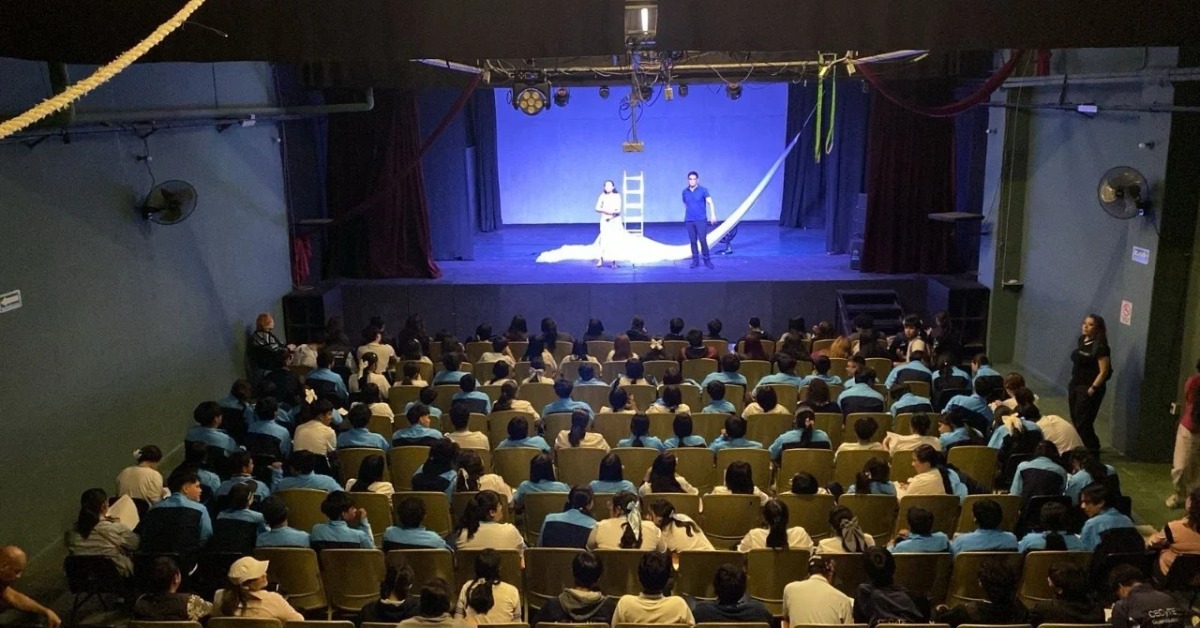
Centro Cultural El Sindicato is taking free theater performances to rural schools around San Miguel de Allende, expanding a cultural program aimed at children and young people who may have limited access to live arts.
The program brings students from public schools to free performances at El Sindicato’s venue in the city center. Now, the center is also sending theater directly to communities farther from the urban core.
The move responds to a practical problem. For some rural schools, taking students into central San Miguel for a performance can mean transportation costs, scheduling challenges, and long travel times. By moving the stage to the schools, the program reduces one of the main barriers between students and cultural activities.
The first rural stop was San José de los Allende, a community located about an hour from San Miguel’s historic center. Students there saw the children’s play “La vaca que se creía mariposa,” presented as part of the effort to build new audiences outside the city’s usual cultural circuit.
Why this matters in San Miguel de Allende
San Miguel de Allende is known internationally for its art scene, architecture, festivals, and expat community. For many visitors and foreign residents, culture is one of the city’s biggest draws.
But access is not evenly shared. Much of San Miguel’s cultural life is concentrated in the historic center, where venues, galleries, restaurants, and tourism activity are clustered. Rural communities often have fewer chances to attend theater, concerts, workshops, or museum programs.
That gap is not unique to San Miguel. Federal cultural planning documents have highlighted a broader national issue: many people in Mexico have never attended a theater performance, dance event, museum, archaeological site, or cultural festival.
For rural students, the issue is not only interest. It is access. A play in the city center may be free, but transportation, school logistics, and distance can still keep students away.
That is why rural cultural outreach can matter. It changes the question from whether students can reach the venue to whether the venue can reach them.
A community space with deep local roots
El Sindicato is one of San Miguel’s long-running independent cultural spaces. It operates from a site tied to the former textile workers’ union connected to Fábrica La Aurora, a major part of the city’s industrial past.
After the factory closed, the space was repurposed for community use. Over time, it became a venue for arts, education, recreation, and social programming.
That history gives the current program added meaning. El Sindicato is not just presenting theater as entertainment. It is using the arts as a form of community access, especially for students who might not otherwise see a live performance during the school year.
The school program works with public education contacts to invite groups of students to performances. At its venue, El Sindicato has hosted groups of roughly 100 to 120 students at a time. The rural version of the program takes that same idea into communities where bringing students downtown is harder.
Theater as education, not just performance
For students, live theater can offer something different from a regular school day. It creates a shared experience, asks children to listen and respond, and introduces them to stories told through movement, voice, music, and imagination.
The value is not only artistic. Programs like this can support confidence, attention, language skills, and social connection. They also help students see the arts as something they can take part in, not just for tourists, private schools, or people living near the city center.
That is especially important in a place like San Miguel, where the city’s public image is often shaped by international tourism, restaurants, hotels, and real estate. Rural communities are part of the municipality too, but their daily life is often less visible to outsiders.
By bringing theater to rural schools, El Sindicato is giving those students a place on the city’s cultural map.
Workshops inside the local prison
The program also extends into the local Centro de Reinserción Social, known as CEPRERESO. El Sindicato has been offering cultural and recreational workshops for people deprived of liberty.
Those activities have included creative writing, theater, boxing, breakdance, singing, and painting. The center has also worked toward theater and painting workshops, along with a performance group supported by cultural staff.
This part of the project adds another layer to the idea of cultural access. It treats art not only as something for audiences but also as a tool for expression, discipline, and personal development.
Prison cultural programs do not replace legal, social, or institutional responsibilities. But they can support reintegration by offering structured activities, creative outlets, and contact with skills that may continue after release.
El Sindicato has also discussed creating reading clubs inside the prison and seeking book donations to support them.
The larger question for San Miguel
The program arrives at a time when San Miguel continues to market itself as a cultural destination. That reputation brings economic benefits, but it also raises questions about who is included in the city’s cultural growth.
For foreign residents, this story offers a useful reminder. San Miguel’s cultural identity is not limited to festivals, galleries, and restaurant openings. It also includes local schools, rural communities, independent venues, and social programs that rarely receive the same attention.
Theater in a rural classroom may not look like the version of culture promoted in travel campaigns. But for a student seeing a live performance for the first time, it may be more meaningful than a major event downtown.
That is the point of the program. It brings theater, education, and community access together in places where the stage usually does not go.