
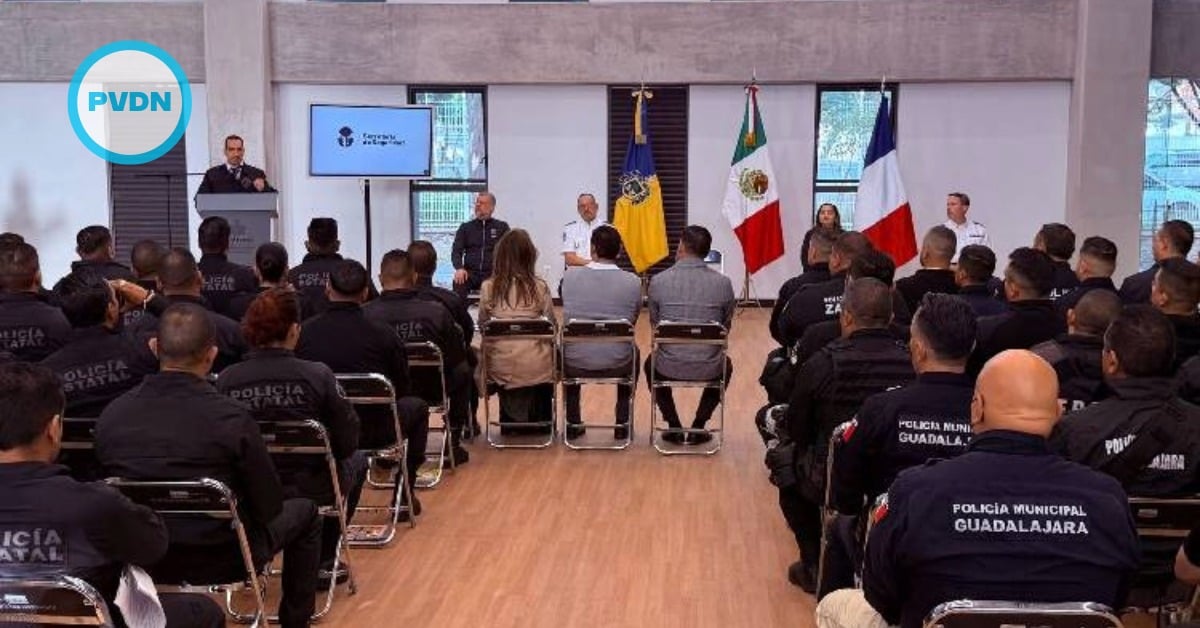
Guadalajara just hired France’s CRS to teach “democratic crowd management,” which, in Almost News translation, means baguettes, mime, and a stretcher ballet sharp enough to cut glass. Sixty-five officers are learning how to calm thousands with polite shrugs, how to summon order with a whistle that sounds suspiciously like Edith Piaf, and why a croissant is the perfect nonlethal shield. Will any of this help when the World Cup turns Zapopan into a human river? That’s the show we’re all waiting to see.
The first clue that Guadalajara was entering a new era of public order arrived inside a refrigerated truck: hundreds of baguettes labeled “nonlethal.” Behind them, a squad of French CRS specialists stepped onto the tarmac in matching berets that screamed, “Calm down, or we’ll politely ask again.” Their mission is simple. Teach 65 Jalisco and metro officers the ancient Parisian art of making huge World Cup crowds behave using only manners, choreography, and bread.
For two weeks, classrooms hum with words like ‘mediation’ and ‘proportionality,’ while the training yard smells like a bakery. Helmets are adjusted. Radios are checked. Someone shouts “ligne délicate,” and a dozen officers lock shields into a gentle S-curve that, according to the syllabus, invites tense fans to breathe and reconsider life choices. The instructors demonstrate voice control by projecting soothing phrases that sound firm, even when delivered in a bedtime-story tone. A medic from SAMU times a stretcher sprint to the beat of an accordion. It’s cardio with panache.
There is a reason for the pageantry. Estadio Akron is getting four World Cup dates, which is like asking the city to host four weddings and a riot while the world watches on 4K. Zapopan knows traffic will flow like a river trying to remember which way gravity works. The metro police know emotions come pre-loaded. And Jalisco’s state force knows every camera will be hungry for the first mistake. Enter the French, who have seen more stadiums, marches, and festivals than most humans see tortillas in a year.
French police training
Today’s module is “De-Escalation by Mime,” which sounds outrageous until you witness a silent officer communicating an entire paragraph with only eyebrows and hand gestures. The crowd, embodied by a dozen recruits, tries to push the line. The mime officer performs the universal gesture for “let’s use the other gate,” then conjures an invisible rope that the crowd must step over one by one. It should not work. It absolutely works. A veteran from the Guadalajara force mutters “esto sí está raro” and copies the eyebrow move into his notebook.
Next comes “Baguette as Barrier.” The French insist it’s about symbolism. You hold the loaf not as a weapon but as a reminder that we are all humans just trying to get to the bathroom. Paired with soft-tone commands and a generous aisle, the bread becomes a visual cue: this is a place of order and carbohydrates. A skeptical Zapopan officer taps a baguette against his forearm and nods. “Está firme,” he says. The instructor beams. Yes. Very firm. Also delicious.
Over in the med bay, SAMU runs “Stretcher Pas de Deux.” Medics practice gliding through a dense knot of pretend fans with the precision of a ballet company that took a wrong turn at the opera and landed inside a fútbol match. They pivot, they open a lane with the gentlest of elbows, and they arrive at the patient as if pulled by magnets. A French coach whispers that panic is a pathogen and choreography is the vaccine. A nurse writes it on the whiteboard and draws a little syringe full of glitter.
Between drills, the CRS explains its democratic crowd-management creed. You start with information, not intimidation. You design the path so the crowd wants to take it. You keep the tone low, the body calm, the exits obvious. You have force, yes, but you treat it like the red salsa that looks mild and then lands a punch—there if necessary, used with care, and never dumped on the whole plate.
The local officers test the creed against the Guadalajara reality. What about the fan who insists his ticket is for this gate, which it is not, and he’s already behind on churros? The French suggest a three-step dance: empathize, redirect, reward. “Oh no, amigo, I’d want the nearest gate too,” says the officer, committing to the bit. “But the fastest line is there, and they’re serving your favorite today.” The recruit playing the fan surrenders instantly, saluting the imaginary churro.
At dusk, the yard converts into “Wave Management,” a drill named after the stadium movement but aimed at the incoming tide of humanity that hits an entrance ten minutes before kickoff. The officers practice guiding currents with rope lines and calm chants that sync the crowd’s footsteps into a slow, language-free beat. “Boom. Step. Boom. Step.” It feels absurd, like a yoga class for tens of thousands. It is also weirdly effective. Phones come down. Shoulders drop. A father with a kid on his back mouths the rhythm and laughs.
The French keep dropping small miracles. They demonstrate “The Beret Tilt of Non-Threat.” You angle the cap by exactly nine degrees, which the human brain reads as competent but approachable. They unveil “The Apology Shield,” where the front line—through genuine contrition for the inconvenience of a security check—halves the time it takes for people to accept it. They show “The Triangle of Good Options,” a layout trick that makes any two-minute delay feel like a 45-second pause because snacks, bathrooms, and photo ops are visible in the same frame.
One recruit, a traffic cop drafted into the operation, asks the question every Guadalajarense wants answered. “And if a thousand people ignore the triangle and decide the best option is all directions at once?” The head CRS instructor smiles the way only someone who has wrangled a Parisian crowd in the rain can smile. “Then we go to Plan B,” he says, lifting a whistle with a tricolor ribbon. The whistle sounds, bright and clear, and thirty volunteers appear from nowhere with portable speakers playing a playlist engineered by scientists to reduce cortisol. The top track is suspiciously close to “La Vie en Rose.”
What could possibly go right
By week two, the officers move like a team that could land a plane with hand signals. The baguettes are replaced with foam props because the first batch keeps disappearing during breaks. The mime gloves are optional. The calm voice becomes muscle memory. And the city starts to absorb the point of the spectacle. We’re not rehearsing a crackdown; we’re rehearsing hospitality at scale.
There will still be a line that snakes into a parking lot. There will still be a family that arrives at the wrong gate because the universe has a sense of humor. There will still be someone who believes the shortcut is through a closed fence and refuses to accept the concept of fences. But there will also be dozens of small, quiet interventions that no camera will catch. A gate opened ten minutes earlier than planned because the flow demanded it. A metro car is held for thirty seconds longer so a crush never forms. A rumor extinguished by a person with a radio who bothered to explain, not shout.
Outside the stadium, the city learns some of the tricks. Transit installs signage that behaves like a friendly GPS rather than a ransom note. Vendors are nudged into boulevards that make sense for circulation and commerce. Neighborhood groups are briefed on matchday rhythms so locals can either embrace the parade or outsmart it. It is all very boring if you prefer your policing loud, which is why it might actually work.
Will any of this survive the first red card, the first summer storm, the first group of fans who treat rules as a dare? That’s the honest tension humming under the rehearsal. And yet, even here in Almost News, where facts stretch like churro dough and our sources include a mime named “El Silencio,” the most believable part is the simplest. People follow a plan when the plan feels human.
So when Guadalajara meets the world next summer, don’t be shocked if the most viral clip isn’t a goal or a scuffle but a police line that looks like a conga, a medic who glides like a figure skater, and a crowd that parts, laughs, and keeps walking. If French police training leaves us with that muscle memory—firm hands, soft voices, and zero panic—then the baguettes were worth every crumb.