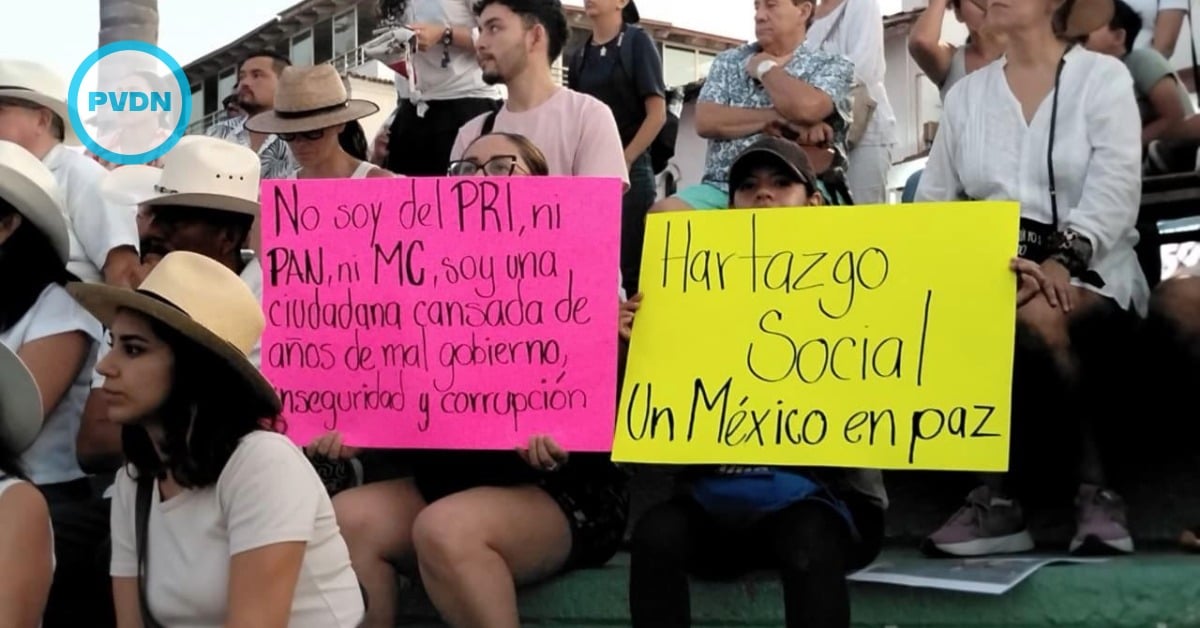
The crowd in Puerto Vallarta did not arrive all at once. It started with a couple of hundred teenagers and twenty-somethings who gathered outside a hotel across from the sports complex, nervously adjusting cardboard signs and white T-shirts as Saturday traffic rolled past. By the time they reached the stone arches on the Malecón, they had become more than 500 people, stretched along the seafront in a line of families, students, and older neighbors walking together for peace and security.
They marched under a national wave now known as the Gen Z protest, a loose, online-born call that brought people into the streets of more than fifty cities on 15 November. In the capital, the same banner was linked to violent clashes and clouds of tear gas. In Vallarta, the only smoke in the air came from food carts and the sunset haze over the bay.
From the Sheraton area toward the Malecón, tourists stopped to film on their phones. Some applauded, some complained, but the march stayed orderly. Parents pushed strollers between university students holding signs about missing people and medicines. Grandparents walked arm in arm with their grandkids, repeating chants that have become familiar in Mexico: “We want to live without fear,” “Health is a right,” and “Mexico deserves better.”
At the arches, the crowd settled into a loose circle while speakers took turns with a megaphone. The tone was calm but steady. No party flags, no candidate banners, just paper signs and a constant drumbeat of the same worries: empty shelves at pharmacies, hospitals without enough doctors, rising disappearances and murders that no longer shock anyone.
A quiet march in a noisy country
The assassination of Uruapan mayor Carlos Manzo during a Day of the Dead event earlier this month shook the country and helped turn online frustration into street action. For many young people, his killing symbolized a state that cannot or will not protect even its own local leaders, much less ordinary residents.
In Mexico City, thousands of people, including many older critics of the government, filled avenues under pirate flags inspired by the anime “One Piece.” What began as a youth-led call against violence, corruption, and impunity ended at the Zócalo with toppled barriers, scuffles, and dozens of injured police officers. Authorities reported more than a hundred officers hurt and around twenty detainees after the confrontations.
The government’s response only deepened the sense of fracture. Days before the march, the federal administration presented an investigation claiming that the online campaign behind it was boosted by bots, conservative networks, and even foreign money. The president echoed that message from the national podium, suggesting the protests were not genuinely grassroots but part of a broader right-wing operation. Young organizers say that, in practice, those slides on a big screen translated into being treated as “criminals” just for inviting others to march.
In Puerto Vallarta, those accusations felt distant and personal at the same time. One of the local organizers, law student Sergio Maigret, told the crowd he walks the city with a knot in his stomach, afraid that something might happen on an ordinary night out. He insisted he has no party behind him and no money to gain from the movement. For him, the point of standing in front of the arches with a microphone was simple: to prove that his generation is not for sale and will not stay silent.
He reminded people that the march had grown from a modest Telegram group and social media chats into a real-world gathering. The numbers were not as large as in the capital, but that was not his metric for success. What mattered, he said, was that hundreds of people who usually keep their opinions to group chats and living rooms had decided to show their faces and their fear in public.
Behind him, handwritten signs spelled out the everyday costs of that fear. One referenced the more than 133,000 people registered as disappeared across the country. Others talked about parents skipping medication to pay for their kids’ antibiotics, and students planning their careers around where they feel least likely to be kidnapped or shot.
For many in the Vallarta crowd, health and security are not abstract policy debates. They are visits to crowded waiting rooms, nights lying awake until a teenager answers a text, the quiet calculation of how far you can push your luck in a city that still feels safer than many, but no longer untouched.
Gen Z protest Mexico
By the time the sun dropped, the Vallarta march had turned into a kind of open-air town hall. Young speakers moved between grief and stubborn optimism. One after another, they insisted that this mobilization is not about swapping one party’s logo for another, but about demanding a country where they can build a future without having to choose between fear and hunger.
In that sense, the scene on the Malecón echoed stories from across Mexico. In state capitals and small towns alike, young people have described the same mix of anger and exhaustion: the sense of living in a country with record homicide figures, profound inequality, and a public health system that often fails them, while being told online that they are manipulated, lazy, or ungrateful.
Critics of the movement point out that, in many cities, the majority of marchers were adults rather than Gen Z. Photos from Mexico City and other urban centers show a heavy presence of older opposition activists and retirees walking alongside teens in anime T-shirts and white shirts. For some, that mix is proof that the protests were hijacked. For others, it is a sign that the frustrations of a younger generation have finally cracked open something much wider and older.
What is hard to ignore is the emotional through-line. Whether they carried pirate flags or simple cardboard, people on the streets talked about the same things: fear of crime, the emptiness of official speeches, and the constant feeling that the state sees them as either statistics or potential troublemakers. In Vallarta, that mistrust took the form of a peaceful walk, but the message was still sharp.
As the gathering wound down, Maigret thanked those who had stayed until the end and promised this would not be the last time they met in the arches’ shadow. Even if next time only a handful show up, he said, they owe it to the missing, to the murdered, and to the people too scared or too busy to stand there themselves.
On the Malecón that evening, the country’s big arguments about bots, geopolitics, and political branding felt far away. What remained, as families drifted off toward taco stands and bus stops, was something quieter and harder to measure: a generation trying to learn how to use its voice without losing its hope.