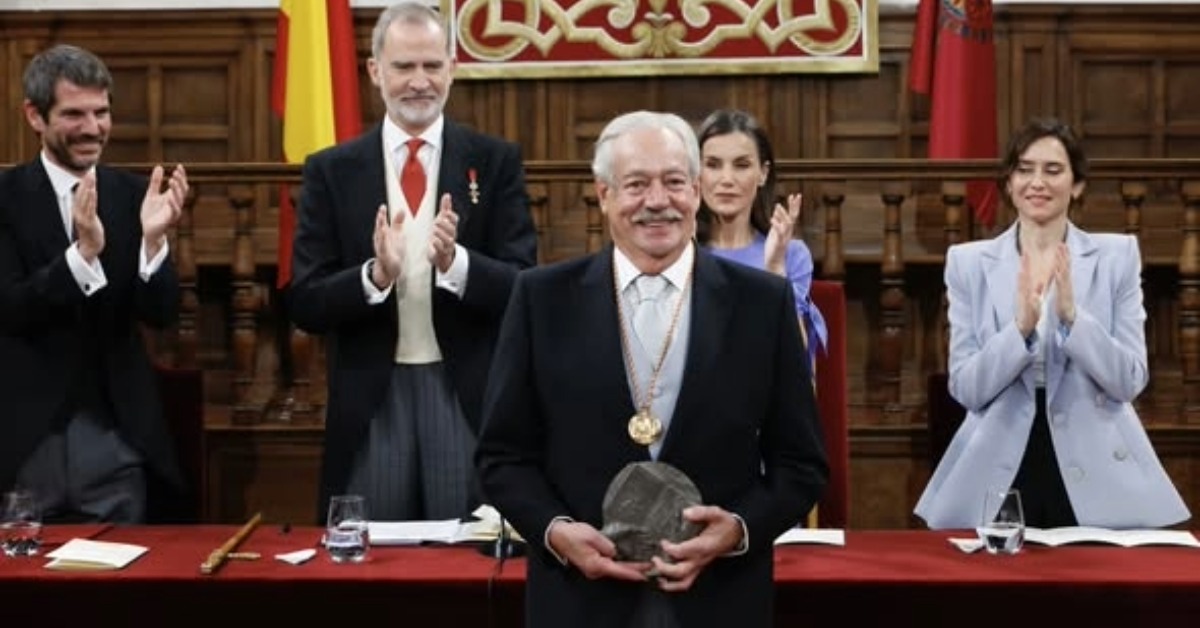
Mexican writer Gonzalo Celorio received the Premio Cervantes 2025 on Thursday in Alcalá de Henares, Spain, becoming the seventh Mexican author to receive the highest honor in Spanish-language literature.
The award was presented during the traditional April 23 ceremony held in the Paraninfo of the University of Alcalá. The prize recognizes a writer’s full body of work, not a single book. That matters in Celorio’s case because his career has unfolded across several fields at once. He has worked as a novelist, essayist, editor, academic, and cultural administrator.
For many readers in Mexico, the headline is about prestige. For international readers, the deeper point is context. The Cervantes Prize is often regarded as the top lifetime award in Spanish. It is one of the clearest markers that a writer’s work has moved beyond national importance and entered the shared literary canon of the Spanish-speaking world.
Why the Cervantes Prize matters
The Cervantes Prize was first awarded in 1976. It is granted each year to an author whose work has made a lasting contribution to literature in Spanish. The award is administered by Spain’s Culture Ministry and carries both symbolic weight and a substantial cash prize.
That may sound formal, but its meaning is simple. This is the prize that places a writer in direct conversation with the biggest names in modern Spanish-language literature. Past winners include Octavio Paz, Carlos Fuentes, Mario Vargas Llosa, Elena Poniatowska, and Fernando del Paso.
Mexico has had an unusually strong presence in that history. With Celorio’s recognition, the country now has seven Cervantes winners. That total reinforces Mexico’s place as one of the central producers of literary work in Spanish, not only in Latin America but across the language as a whole.
Who is Gonzalo Celorio
Gonzalo Celorio, born in Mexico City in 1948, has spent decades moving between literature, teaching, and cultural institutions. He studied at UNAM, where he also built a long academic career. Over the years, he held major cultural posts, including leadership roles at the Faculty of Philosophy and Letters at UNAM and at the Fondo de Cultura Económica.
His work is often tied to memory, identity, Mexico City, and the unstable border between lived experience and literary invention. That helps explain why he is respected not only as a novelist but as an intellectual figure whose books and essays help readers think about modern Mexico.
Among the titles most often linked to his career are Amor propio, Y retiemble en sus centros la tierra, Tres lindas cubanas, El metal y la escoria, and Mentideros de la memoria. His writing has also been recognized with major prizes in Mexico before the Cervantes Prize arrived. In other words, this award did not make him important. It confirmed a stature he had already built over decades.
Why this is bigger than one ceremony
Awards stories can feel distant, especially when they come from formal ceremonies in Spain. But this one connects to a broader question that matters in Mexico: who gets remembered as part of the country’s cultural inheritance.
Celorio’s win adds his name to a short Mexican list that includes Octavio Paz, Carlos Fuentes, Sergio Pitol, José Emilio Pacheco, Elena Poniatowska, and Fernando del Paso. That is not just a roll call of famous authors. It is a map of different traditions inside Mexican literature, from poetry and the essay to the novel, the chronicle, and politically engaged writing.
Celorio’s place in that group is significant because he represents a slightly different path. He is not only a public literary figure. He is also a scholar of language, a long-time teacher, and a writer whose work repeatedly returns to recollection, urban life, family history, and the ways personal memory can reflect national change.
What Celorio said when he received the prize
In Spain, Celorio used the moment to talk about literature, freedom, and the historical relationship between Mexico and Spain. He described the novel as a libertarian genre, a phrase that drew attention because it framed fiction as a form that resists fixed rules and rigid authority.
He also spoke about the role of the Spanish language in the formation of modern Mexico and other Latin American nations. That is a sensitive subject, but also a revealing one. His remarks placed the ceremony inside a larger debate about history, language, and identity in the Spanish-speaking world.
For readers outside Mexico, that may be the most useful lens. This was not just a celebration of one writer’s career. It was also a reminder that literature remains a space where cultural memory, national identity, and historical argument meet.
Why international readers should care
Many foreign readers living in Mexico know names like Octavio Paz or Elena Poniatowska, but less-known figures often explain more about the country’s literary depth. Celorio belongs to that second category. He is widely respected in intellectual and academic circles, yet less familiar to general international audiences.
That makes this award a useful entry point. It draws attention to a writer whose work addresses questions many readers in Mexico already care about: how cities shape identity, how families carry history, how language preserves and distorts memory, and how cultural inheritance travels across borders.
It also serves as a reminder that Mexico’s global cultural influence extends beyond film, food, music, and visual art. Literature remains one of the country’s strongest exports, even when the names do not always cross into mainstream international coverage.