Puerto Vallarta has many everyday city problems that can be reported before they become bigger headaches: potholes, broken streetlights, water leaks, missed trash collection, noise, blocked sidewalks, loose manhole covers, illegal dumping, and construction work that appears unsafe or outside normal hours.
Getting a response usually depends on two things. The first is sending the report to the right office. The second is to provide enough detail so a crew, inspector, or dispatcher can find the problem without guessing.
That sounds simple, but local government is split across departments, public utilities, and enforcement offices. A streetlight problem is not the same as a power-line hazard. A water leak is usually a SEAPAL issue, not a general City Hall complaint. A noisy party, a loud business, and a construction site running machinery after hours may require different handling depending on the circumstances.
For a broader look at which services fall under local government, see how public services work in Puerto Vallarta.
Start with the right office
For street-level maintenance, Dirección de Servicios Eficientes is the name to know. This area is tied to public services such as street cleaning, waste management, parks, gardens, public lighting, and other basic municipal services. Reports about broken streetlights, uncollected trash in public areas, overgrown public green spaces, damaged municipal fixtures, and similar issues usually belong in this lane.
Road problems can be more complicated. Local streets, potholes, sidewalks, drainage grates, and missing signs may fall under municipal attention, but larger roads or highway sections can involve state or federal authorities. Start with the municipal directory or switchboard and ask for the department handling baches, vialidad, obras públicas, or servicios públicos, depending on the problem.
Water and drainage leaks should usually go to SEAPAL Vallarta, the local water and sewer operator. SEAPAL lists 073 for user attention, along with the phone numbers (322) 226-9191 and (322) 226-9190. It also lists WhatsApp at (322) 105-8226 for reports. Use SEAPAL for fugas de agua, sewage leaks, low water pressure, drainage issues, and suspected broken water lines.
Noise is trickier because the right channel depends on the source. A loud party late at night may require police attention if it disturbs the peace or poses a safety concern. Noise from a bar, event venue, or commercial establishment may be subject to municipal inspection or regulations. Construction noise should be reported with the site address, hours, photos or video, and any visible permit information, then directed toward Desarrollo Urbano, inspection, or the municipal office handling construction enforcement.
Construction problems should be documented carefully. Useful reports include work without visible permits, crews blocking sidewalks, debris left in the street, runoff carrying mud or other materials onto public roads, unsafe excavation, damage to public infrastructure, and work occurring outside permitted hours. Puerto Vallarta’s construction rules give municipal authorities a role in reviewing, inspecting, and addressing irregular work, but the person reporting it must provide a verifiable location.
What to include before sending a report
Good reports are specific. Instead of writing that a street has “a big pothole,” write the colonia, street name, nearest cross streets, side of the road, direction of traffic, and a nearby landmark. A report that says “large pothole on the northbound side of Avenida México, near the corner with X street, in front of X business” is far easier to act on than a complaint with only a neighborhood name.
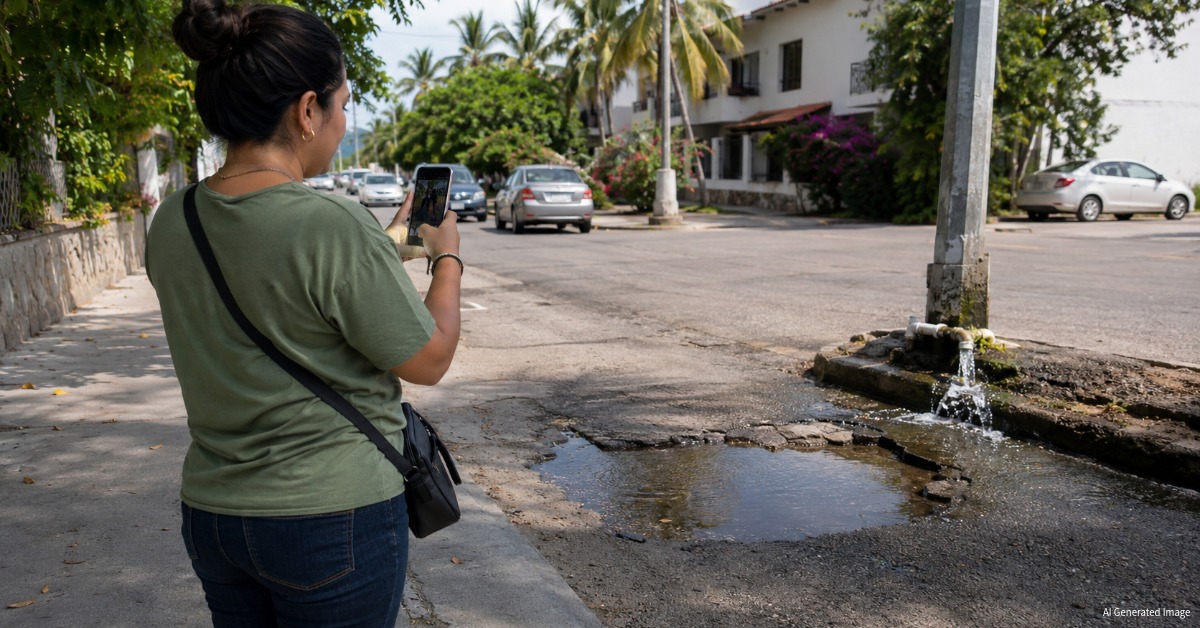
Photos help, especially when the issue is visible from the street. Take one close photo showing the problem and one wider photo showing where it is. For streetlights, include the pole number if applicable. For water leaks, record whether the water is clean or dirty, whether it is flowing from the pavement, coming from a meter, or pooling near a storm drain. Trash complaints should specify whether the issue is missed household collection, loose trash in a public space, illegal dumping, or an overflowing container.
Street descriptions matter because Puerto Vallarta has duplicate business names, similar landmarks, and informal neighborhood references that may not align with official maps. Screenshots from a map can help, but do not rely only on a pin. Write the location in plain language as well.
Spanish helps when filing through local channels. Useful words include reporte for report, queja for complaint, bache for pothole, alumbrado público for public lighting, fuga de agua for water leak, drenaje for drainage or sewer, basura for trash, ruido for noise, escombro for construction debris, banqueta obstruida for blocked sidewalk, and obra irregular for irregular construction work.
How to file and follow up
Begin with the channel most likely to match the problem. For water or sewer issues, contact SEAPAL directly. Public lighting, trash, parks, or street-level municipal maintenance use the Puerto Vallarta government directory or the main switchboard and ask for the department responsible for public services. For construction issues, ask for Ordenamiento Territorial y Desarrollo Urbano, Obras Públicas, or the inspection area handling construction complaints.
Phone calls are still useful because they can tell you which office is currently receiving that type of report. Ask for a folio, case number, or the name of the person who received the complaint. Write down the date, time, and department. That record becomes important if the issue is not addressed and you need to follow up.
Online forms and email can work better for issues that need evidence. Send the same core details every time: what happened, where it happened, when you saw it, whether it is ongoing, and what risk it creates. Attach photos or short videos when possible. Keep the message factual. Reports that read like a clear field note are easier for staff to route than long, frustrated complaints.
Written complaints may be better for recurring problems, especially construction, business noise, illegal dumping, or damage to public infrastructure. A written complaint creates a paper trail. Include your contact information if you want a response, but avoid sending sensitive personal details unless the office specifically requires them.
When the problem is urgent
Some problems should not wait for a routine municipal report. A downed wire, fire, active flooding, exposed electrical hazard, open manhole in traffic, collapsing wall, major sewage spill, gas smell, or violent situation should be treated as an emergency. Call 911 when there is immediate danger.
Public lighting is different from a dangerous electrical cable. A broken streetlight is generally a municipal service issue. A sparking wire, fallen cable, or electrical hazard should be reported as an emergency and may also involve CFE.
Construction sites can create urgent risks, too. An open trench without barriers, falling material, blocked emergency access, unstable scaffolding, or heavy machinery operating dangerously should be reported immediately. Take photos only from a safe distance.
What to do when nothing happens
A single report may not be enough. Follow up with the folio number, the original date, and the exact location. Keep the message short and reattach the original photos. A second report should make clear that the issue is still present, not start the story over.
Neighbors can also file separate reports using the same location details. That does not mean flooding an office with copied complaints. It means several people affected by the same problem can document it from their own homes, businesses, or streets.
Recurring issues deserve a simple log. Note each date the trash was missed, each night the noise occurred, each time water reappeared after a repair, or each day construction debris blocked the sidewalk. Patterns are easier to evaluate when they are documented.
Recent trash collection delays in Puerto Vallarta showed how neighborhood-level complaints can pile up when service problems spread across several colonias. In those cases, clear reporting helps distinguish isolated misses from broader route or equipment issues.
Keep the report clean and usable
The best report is short, specific, and repeatable. It should say what the problem is, where it is, how long it has been happening, what risk it creates, and what evidence is attached. Anger may be understandable, but it rarely helps a dispatcher, inspector, or crew locate the problem faster.
A useful first line might read: “Reporte de bache profundo en calle X, entre calle Y y calle Z, colonia X; afecta el carril derecho hacia el norte; foto tomada hoy a las 8:30 a.m.” That gives the office a location, a problem, a direction, and a time.
For leaks, use the same approach: “Reporte de fuga de agua limpia saliendo del pavimento en la calle X, frente al número X, colonia X; el agua corre hacia la esquina con la calle Y.” For noise, include the source, dates, hours, and whether it is music, machinery, construction, vehicles, alarms, or amplified announcements.
Puerto Vallarta has the same reporting problem many cities have. The person filing the complaint sees one obvious issue. The government sees jurisdiction, department, crew assignment, budget, inspection authority, and backlog. A clear report is the bridge between the two.