Quintana Roo authorities seized a 30,000 m² Bonfil property and vowed tougher action against illegal land sales that leave families unprotected.
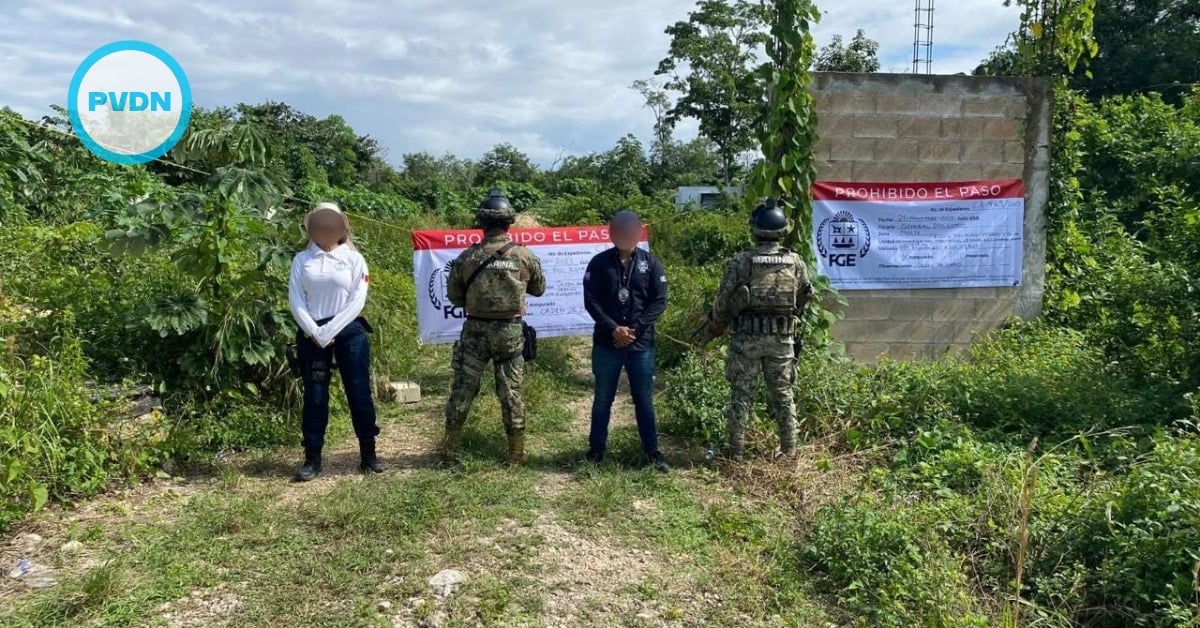
On the edge of Alfredo V. Bonfil, just a few kilometers from the Cancún airport, a stretch of nearly three hectares of cleared land now sits under guard. State investigators say the plot was stripped of its original vegetation, filled with rock and carved into rough roads, in preparation for a housing project that had no authorizations and was already offering lots for sale. The site has been sealed and placed under the custody of the Quintana Roo Attorney General’s Office while prosecutors pursue possible environmental crimes and fraud.
According to officials, the operation was launched after the mayor of Benito Juárez filed formal complaints about apparent illegal lot sales and the damage to the local jungle. Specialists from the College of Biologists of Quintana Roo and personnel from the Navy joined investigators on the ground, documenting how the soil had been leveled and compacted, a pattern they say is typical of clandestine subdivisions carved out of conserved areas.
City hall had already tried to stop this project once. Benito Juárez authorities say the same development was closed in July 2024 during a multi-agency operation and denounced for environmental offenses, a complaint that later allowed prosecutors to secure the land through a court order. For the municipal government, the weekend seizure is proof that some operators ignore earlier closures and keep selling.
Illegal land sales Bonfil crackdown widens
Local officials stress that this is not an isolated case. They describe the Bonfil seizure as part of a broader campaign that began several years ago to curb irregular settlements marketed without proper documentation or basic services. Since 2018, authorities in Benito Juárez say they have shut down thousands of lots offered in unregulated developments, and they confirm there are several other active complaints under investigation.
This year alone, more than a dozen properties across Cancún have been closed for similar reasons, including other large tracts in the urban fringe that were being cleared and parceled out despite lacking land-use and environmental permits. The newly secured Bonfil plot adds to that list and underscores how quickly these ventures can move, often transforming jungle into streets and sale-ready parcels in a matter of months.
Behind every file on an “irregular development” are families chasing the promise of a small piece of land. In the ejidal fringe of Bonfil, irregular neighborhoods such as La Chapaneca have already become hotspots for scams in which outsiders resell communal land they do not legally own, leaving buyers exposed to eviction and loss of their savings. Ejido representatives in the area have repeatedly warned that people posing as community leaders take advantage of households desperate to secure a lot at a price they can afford.
That is why municipal officials keep returning to the same message: a cheap lot on the outskirts is not necessarily a safe investment. They are urging would-be buyers to demand proof of ownership and to verify the status of any property directly with municipal offices or the ejido before signing contracts or handing over deposits. In the Bonfil case, prosecutors say there are already buyers who reserved plots in good faith, and part of the investigation will be to establish how they were approached and what they were told about the land.
Environmental damage is the other front in this story. When authorities entered the Bonfil property, they found what one report describes as a devastated landscape: the vegetation cleared, soil scraped and compacted, and piles of felled branches and trunks pushed aside. Biologists warn that this kind of clearing disrupts habitat for local wildlife and can affect how rainwater filters into the aquifer beneath Cancún. This concern has also been raised in other cases where developments encroach on conservation zones.
Long fight against irregular developments
For the city government, the Bonfil operation fits into a longer-term plan. Officials describe three main lines of work: regularizing areas that were never formally incorporated into the municipality, blocking new projects that try to sell lots or houses without permits, and improving infrastructure in neighborhoods that already grew up in irregular conditions. The goal, they say, is to prevent new fraudulent projects from appearing while beginning to repair past damage in areas where people are already living.
The recent seizure also highlights how many agencies now share responsibility for these cases. The Bonfil action brought together the state prosecutor’s office, the Navy, municipal ecology and urban development departments, and technical experts, all working off a complaint filed months earlier. Authorities argue that this level of coordination is necessary because land traffickers move quickly, shifting sales pitches from one part of the city to another as soon as enforcement tightens.
Even with a growing list of closed sites, the pressure on the urban fringe is not easing. As Cancún expands, demand for low-cost land keeps pushing development deeper into ejidal areas and conservation zones, creating fertile ground for new schemes. Officials in Quintana Roo say more complaints are moving through the system and warn that further seizures are likely as inspectors continue to patrol semi-urban neighborhoods like Bonfil.
For families in Cancún, the Bonfil case is another reminder that buying land on a handshake or a photocopied contract can carry heavy risks. Authorities insist they will keep targeting operators who clear the jungle and sell irregular lots. Still, they also acknowledge that enforcement alone cannot solve the problem if people keep being drawn into unsafe deals. The next chapter of this crackdown will be measured not just in seized hectares, but in how many residents manage to secure a home with real legal certainty.