
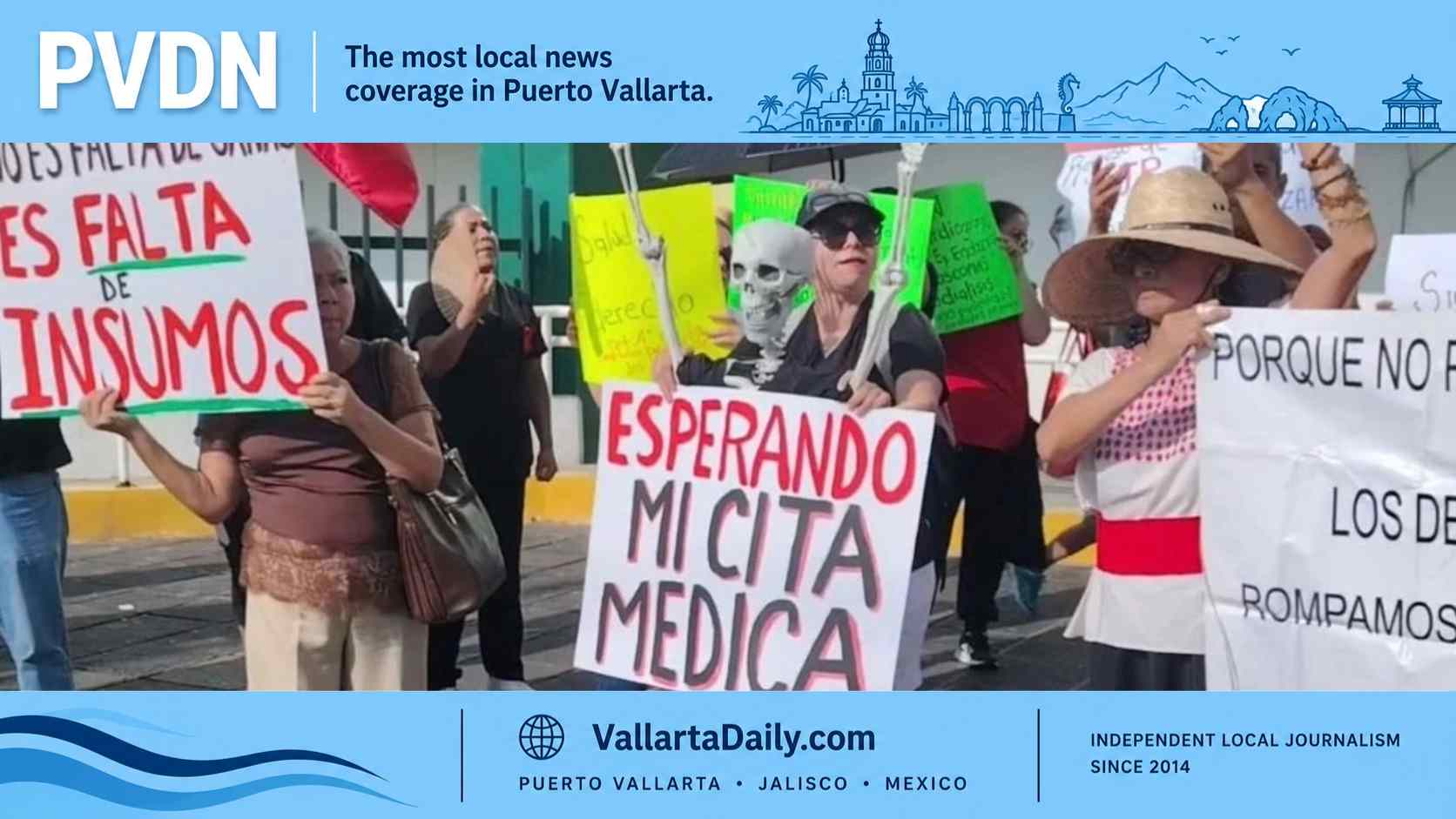
Puerto Vallarta, Jalisco, October 13, 2026 – IMSS announced hospital talks Monday after protests disrupted local services, amid pharmaceutical suppliers’ reports of 14 billion pesos in unpaid government bills.
The Mexican Social Security Institute’s Oct. 12 response to workers’ complaints calls for senior officials to visit 277 hospitals to address supply shortages, staffing gaps and equipment problems. A separate vote on the disputed salary agreement is scheduled for Oct. 14.
For people relying on public healthcare in Puerto Vallarta, the immediate question is practical: Can they get the consultation and medicine they need?
Local reporting shows that access has already been affected. In its coverage of the Oct. 9 protest, Tribuna de la Bahía documented the mobilization at Family Medicine Unit 170 in Palmar de Aramara. Workers reported that routine consultations and other nonurgent services were suspended, while emergency care continued.
The disruption also reached people trying to collect prescriptions. According to Vallarta Independiente’s patient accounts, a woman who went to Unit 179 for insulin said she could not access the pharmacy because of the stoppage.
By Monday, NoticiasPV reported that local employees were working under protest, with union representatives saying patient care had not stopped completely.
IMSS, meanwhile, has said its facilities remain operational nationwide and that emergency care, hospitalization, intensive care, childbirth services and dialysis are guaranteed. Those national assurances and local accounts do not establish the status of every service at every Vallarta unit Tuesday.
The salary dispute helps explain why the protests have continued. Local demonstrators have demanded a 10% increase in base pay. IMSS describes the proposed agreement as a 6.8% overall increase, comprising 2.9% in base salary and 3.9% in benefits. Workers are scheduled to accept or reject it through a secret ballot Wednesday.
But their complaints extend beyond their paychecks. Vallarta workers told Tribuna that shortages sometimes force them to buy their own thermometers, blood pressure monitors, and stationery. They also described understaffing and heavier workloads.
That connects the labor dispute directly to patient care: having an appointment does not resolve a missing supply or adequately staff an overburdened service.
The pharmaceutical debt raises a separate concern about keeping medicines moving through the public system.
In El Financiero’s Sept. 30 report on unpaid supplier bills, Rafael Gual, then director of the national pharmaceutical industry chamber, Canifarma, estimated the outstanding amount at approximately 14 billion pesos. He said it was concentrated mainly in IMSS-Bienestar, with debts also involving IMSS, ISSSTE and the National Institutes of Health.
“There are problems with deliveries because there are payment problems,” Gual said.
The distinction between IMSS and IMSS-Bienestar is important. The similarly named IMSS-Bienestar is a separate public body created to provide free healthcare and medicines to people without social security in participating states. The 14 billion pesos therefore should not be described as IMSS’s debt alone.
It is also an industry estimate reported in September, rather than a verified October balance. It does not establish that unpaid invoices caused a particular shortage at a Vallarta clinic.
Suppliers nevertheless describe a clear financial pressure: companies awaiting payment for medicines already delivered must also finance production and deliveries for new contracts. El Financiero reported that some unpaid medicines dated from 2024 through 2026. The government has attributed part of the supply problem to contractors delivering fewer medicines than they agreed to provide.
There has been progress on future purchasing. According to the Health Ministry’s tender results reported by El Economista, the first tender for 2027-2028 awarded contracts covering 85% of the medicine items included in that round. An additional tender was planned for the remainder.
Those contracts concern next year’s supply. Patients still depend on medicines reaching their particular pharmacy and being replenished when stocks run down.
That operational challenge also affects the government’s broader healthcare reform. The April decree establishing the Universal Health Service schedules the first phase of expanded service sharing for Jan. 1, 2027, prioritizing emergency care, high-risk pregnancies, vaccination and other services.
These are scheduled changes. Their practical benefit will depend on institutions having the staff, equipment, and medicines to deliver that care. For foreign residents comparing public coverage and private alternatives, the distinctions remain central to how healthcare works in Puerto Vallarta.
In its Oct. 10 assessment, IMSS reported an average medicine supply level of 94%, while acknowledging continuing shortages, congestion, and waiting times. A national average cannot establish whether a particular prescription is available locally.
Patients whose prescriptions are not supplied in full can report them through Receta Completa or by calling 800 953 2218, the channels IMSS is promoting for follow-up. Under Monday’s hospital plan, each problem identified by workers should have a deadline and a named official responsible for resolving it.