Calle Albatros is getting another round of underground work, Marina Vallarta’s beachfront hotels are trying a new crocodile-watch system, and the neighborhood association continues paying for services that many other colonias leave entirely to City Hall.
That is the quick read on Marina Vallarta this week. The neighborhood still looks orderly from the outside, but several of the systems holding it together — water lines, drainage, lighting, cleaning and traffic control — are being repaired, privately supported or left waiting for municipal approval.
Albatros is back at the center of the neighborhood
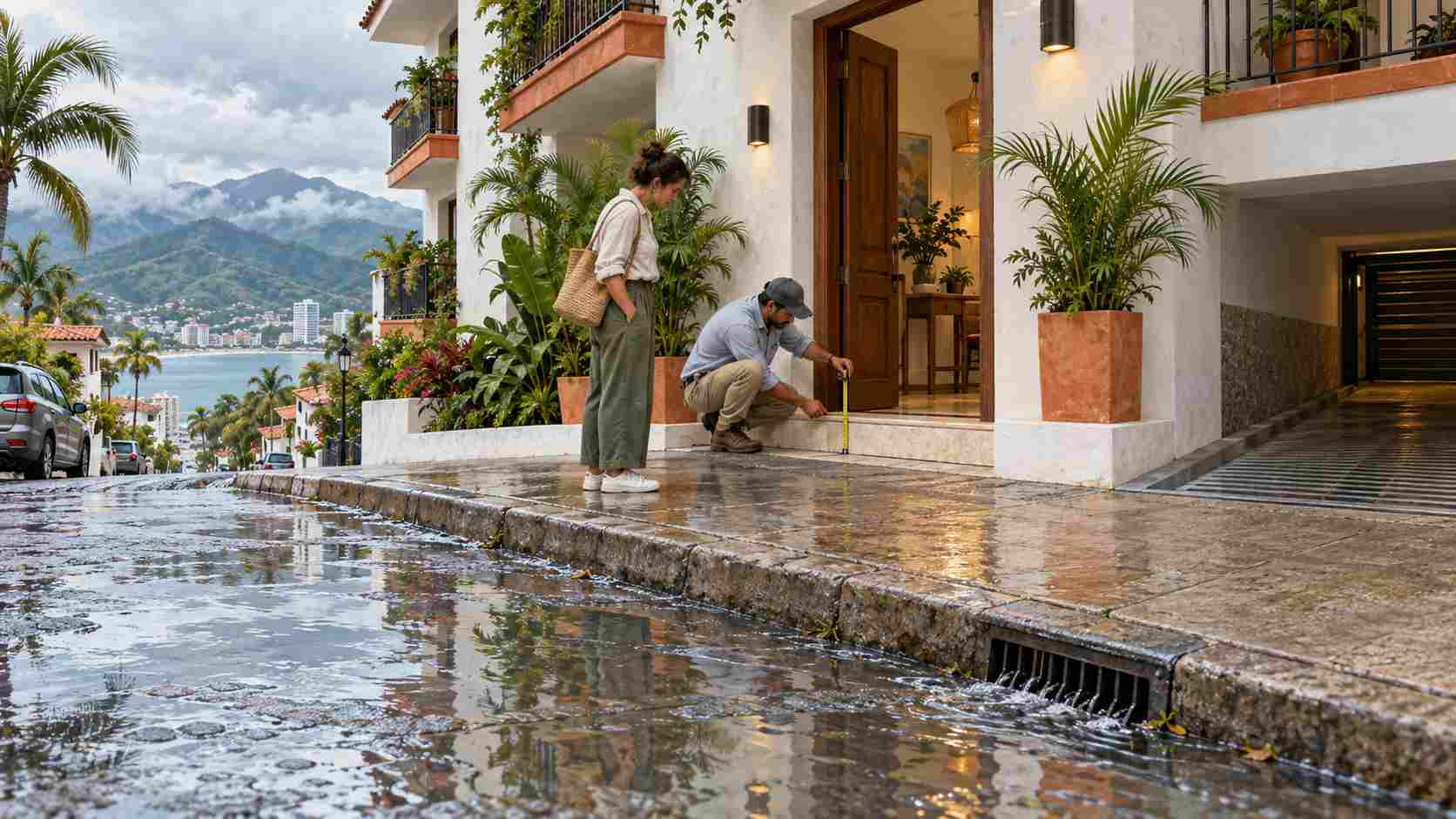
The most immediate inconvenience is a new partial closure on Calle Albatros, where SEAPAL is installing approximately 200 meters of potable-water pipe between Gaviotas and Pelícanos.
The work was scheduled to begin Monday, July 20, and is expected to last between three weeks and one month. It includes a new two-inch line and the reconnection of residential water service, according to the project announcement provided through the Marina Vallarta Residents Association.
This is not simply routine pipe replacement. The existing line runs beneath private homes, making future leaks or repairs difficult to reach without entering residential property. Moving the line into the public roadway should make maintenance easier, but first the neighborhood has to absorb another construction period.
The affected section passes the park, the church and the Residents Association office. Drivers should expect the usual problems that come with a partial closure: narrower passage, work vehicles, temporary obstructions and slower movement when two directions of traffic try to use the same space. SEAPAL has not published daily working hours or a detailed traffic-control map.
One repair keeps leading to another
Anyone feeling that Albatros has been under construction forever is not imagining it.
SEAPAL began a larger intervention in May involving the sanitary sewer and the neighborhood’s treated-water network. An official progress report issued May 30 said the sanitary-drainage portion was 90 percent complete after crews replaced 163 meters of pipe, much of it 20 inches in diameter, between Pelícanos and Paseo de la Marina Norte.
Then another damaged sewer section was identified. Vallarta Daily reported on July 9 that SEAPAL was extending the repair effort, bringing fresh traffic disruption to a street that had already endured months of work.
Now the potable-water relocation is beginning along another portion of the same road.
The positive side is that several aging systems are finally being corrected rather than patched individually after failures. The less comfortable truth is that the work is revealing how much of Marina Vallarta’s buried infrastructure has reached the point where one completed repair does not necessarily mean the street is finished.
For property owners near Albatros, the question worth asking is not only when the current closure ends. It is whether SEAPAL has completed a full condition survey of the remaining water and sewer lines, or whether more weak sections will be discovered as crews move through the area.
Private money is carrying part of the public realm
Marina Vallarta’s tidy appearance is often treated as though it happens naturally. It does not.
A July 15 report on neighborhood lighting said the Residents Association continues maintaining public lighting with its own resources. Earlier in the month, the association also described the private spending and organization behind street cleaning and neighborhood upkeep.
That arrangement delivers visible results. It also raises a fair question for homeowners, condominium administrators and businesses paying association fees: which services are being supplemented because residents want a higher standard, and which municipal responsibilities are effectively being replaced with private money?
The published lighting report did not include a complete inventory of fixtures, repair costs, outstanding dark spots, or the share of work being handled by the municipality. Those numbers would make it easier to judge whether the arrangement is an efficient neighborhood upgrade or a growing substitute for public services.
A failed fixture along a pedestrian route, near a driveway or around the marina promenade changes how comfortable the area feels after dark and can make uneven pavement harder to see.
Beach safety has changed since the fatal attack
The most important public-safety development remains the response to the fatal crocodile attack in late June near the beachfront hotel zone.
Under the three-stage prevention plan agreed with hotels and Civil Protection, each beachfront hotel was asked to assign a security guard to patrol its section of beach daily from 7 a.m. until 7 p.m.
The guards are expected to watch for crocodiles, warn people away from an animal, and contact the appropriate authorities. After 7 p.m., hotels are supposed to warn guests about entering the water when visibility is poor and, where possible, limit beach access through hotel property.
A second phase calls for purchasing a quad bike, personal watercraft, drone, radios, binoculars, life jackets and other equipment. A longer-term proposal would examine GPS tracking or intelligent buoys capable of detecting identified crocodiles approaching the beach.
The plan is more substantial than simply adding another warning sign, but the equipment and technology portions remain proposals. Vallarta Daily’s earlier coverage provides the background on how the hotel patrol system was developed.
The practical rule has not changed: avoid entering the water near the Boca Negra estuary, particularly around dusk, dawn, or after heavy rain. Do not approach a crocodile on the sand or attempt to move it back into the water.
The city’s summer operation includes 30 lifeguards deployed across Puerto Vallarta’s beaches through August 30, while the Mexican Navy has placed additional personnel and rescue resources along the coast. Those are citywide deployments, however, not 30 lifeguards assigned exclusively to Marina Vallarta.
The whale entrance traffic proposal is still unresolved
The neighborhood’s other unfinished piece of business is the proposed traffic modification near the whale sculpture, where Paseo de la Marina meets Popa.
The Residents Association submitted the project to Puerto Vallarta’s traffic authorities in May. The association says the entrance handles an estimated 5,000 to 6,000 people a day in low season and more than 10,000 during high season.
The proposal is intended to make entering and leaving the neighborhood easier, particularly where vehicles heading toward the commercial and marina areas mix with traffic continuing around Paseo de la Marina.
I could not find a published municipal approval, implementation date, or final traffic diagram as of July 21. That makes this a genuine watch item rather than a project residents should assume is moving ahead.
The missing details are important. A change that helps cars enter more quickly could create a new conflict for pedestrians crossing near the whale, vehicles emerging from Popa, or drivers unfamiliar with the revised pattern. The final design needs to be judged by how it handles all of those movements, not simply whether cars clear the entrance faster.
Two business changes to keep on the radar
The Westin Playa Vallarta began operating May 1 as an all-inclusive resort at Paseo de la Marina Sur 205. The property is described by Puerto Vallarta’s official tourism office as the first all-inclusive Westin in Mexico.
For the neighborhood, the interesting question is what that conversion does to spending outside the hotel. An all-inclusive property can bring more guests into Marina Vallarta while also giving them fewer reasons to eat, drink, or shop elsewhere. Nearby businesses will be able to judge the real effect more accurately after a full high season.
Natureza is also advertising a new Marina location at Nima Shop on Calle Popa, serving breakfast through dinner. No major permanent restaurant or retail closure could be independently confirmed for this edition.
The next few weeks
The Albatros waterline work should be the daily nuisance residents notice first. The beach patrol program is the change with the greatest safety consequence. The traffic proposal near the whale is the item most likely to disappear into an approval process unless someone keeps asking about it.
Lighting and cleaning deserve attention for a different reason. They show that Marina Vallarta’s quality of life depends heavily on an organized association willing to collect and spend private funds. That arrangement may work well, but homeowners should still be able to see what they are paying for, what the municipality contributes, and which obligations are gradually shifting from the city to the neighborhood.
Insider Subscribers who see the Albatros closure extending beyond the announced section, dark fixtures that remain unrepaired, blocked sidewalks, or changes near the whale entrance can send Vallarta Daily the exact location, approximate time, and a photograph. Those details are often what turn a general complaint into something the neighborhood can document and follow.
Additional Marina Vallarta updates are collected on the Vallarta Daily neighborhood page