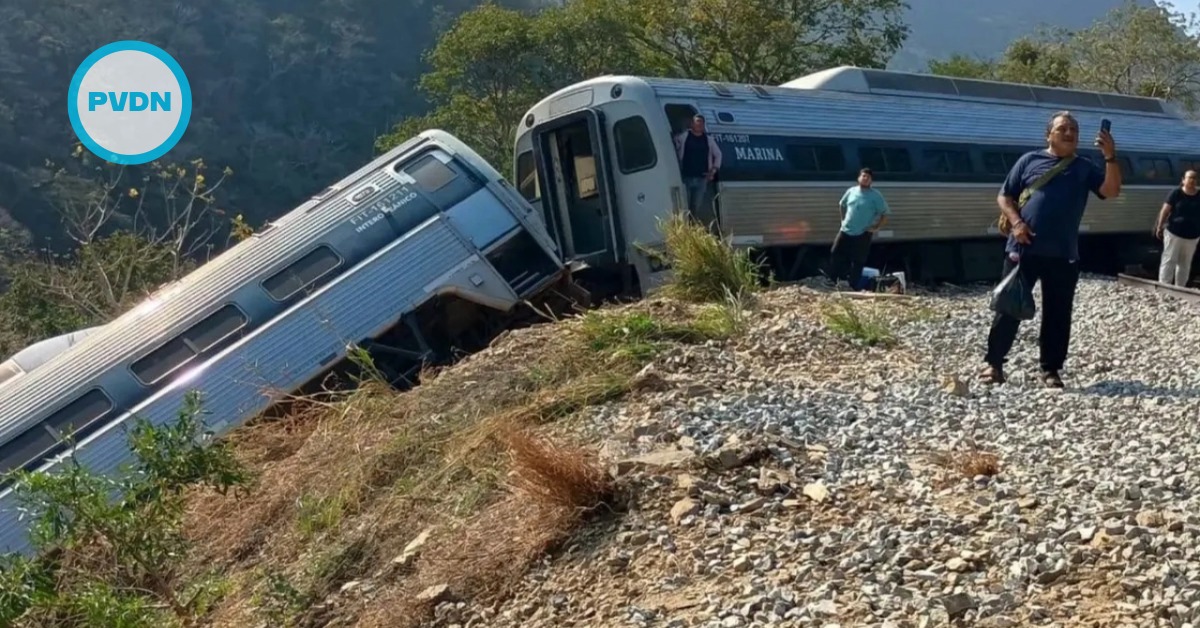
Interoceanic train derailment in Oaxaca left 13 dead and 109 injured. Officials say 44 remain hospitalized as ‘Pulse’ data is secured.
Federal authorities said Monday morning, December 29, that the death toll from Sunday’s Interoceanic train derailment in Oaxaca had reached 13 people, including a minor. Officials reported 109 injured passengers. They said 44 people remained hospitalized across the state, while others were treated on-site or discharged after their condition improved.
Health officials described a heavy mix of trauma injuries. Several patients have fractures and orthopedic damage, and surgeries have been scheduled. Even so, authorities said the current hospital caseload does not include anyone in a life-threatening situation. IMSS and IMSS-Bienestar teams remain in the region, coordinating care and transfers between facilities as needed.
For many families, the hardest part has been the waiting. Authorities said recovery work continued as rescue teams searched the area and worked to confirm the identities of the dead. As of Monday morning, officials indicated that one victim had not yet been located.
What happened on the Z Line
Authorities said the derailment happened on the Z Line of the Interoceanic Railway, between the communities of Nizanda and Chivela, in Oaxaca’s Isthmus region. A locomotive left the tracks, causing four passenger cars to derail. The first car slid into a ravine estimated at about 6.5 meters deep. The second was left partially overturned and suspended. Two additional cars derailed but did not suffer the same level of damage.
Officials said roughly 250 people, including crew, were aboard the train. Emergency response included state and federal forces, medical staff, and civil protection teams. Patients were triaged in the field, then transported by ambulance to hospitals in Matías Romero, Salina Cruz, and other nearby cities, depending on the type of injury.
The Z Line is one of the routes tied to the federal Interoceanic Corridor project, a revived rail link across the Isthmus of Tehuantepec. The train is used by local residents, workers, and travelers moving between Oaxaca and Veracruz. That mix of passengers complicates the aftermath. Some families are local and close to the hospitals. Others are hours away, trying to piece together information from a distance.
What investigators are examining
The federal Attorney General’s Office, working with Oaxaca state prosecutors, has opened an investigation into the cause of the derailment. Alongside the legal process, authorities said there will also be a separate technical evaluation led by federal rail regulators in coordination with the Ministry of Infrastructure, Communications and Transportation.
A central piece of evidence is the train’s electronic recorder, known as “Pulse.” Officials described it as the rail equivalent of a black box. They said it stores operational data such as speed, braking, and other locomotive performance information. The Navy’s leadership said the device has been secured under chain-of-custody rules to protect its integrity for the investigation.
Authorities also highlighted a detail that raises the stakes for the technical review. Before the passenger trip, they said an inspection unit ran the line and reported normal operating conditions. That does not rule out failures that can emerge quickly—track shifts, equipment malfunctions, obstructions, or human error—but it does frame the questions investigators will need to answer. What did the inspection actually measure? What did it miss? And what changed between that check and the moment the cars left the rails?
The next phase will likely involve downloading and interpreting the recorder data, inspecting the track and rail bed at the derailment point, evaluating the locomotive and rolling stock, and collecting witness and crew statements. Until those findings are in, authorities have urged caution about speculation.
Support for victims and families
Federal officials said a comprehensive support plan has been activated for victims and the families of those who died. The Interior Ministry’s human rights and migration office reported that, under instructions from President Claudia Sheinbaum, a public servant has been assigned to each affected family to help with paperwork and administrative steps. That includes assistance tied to hospital coordination and, when necessary, arrangements linked to the deceased.
Authorities reiterated a phone number set up for families trying to locate people who were traveling on the train: 55 2230 2106. The line is staffed by personnel trained to guide relatives through the process and connect them with official information.
For expats living in Mexico, tragedies like this can feel both distant and uncomfortably close. Many foreign residents travel domestically, host visiting relatives, or rely on long-distance ground transport in regions where air travel is limited. The practical takeaway is simple: if someone you know may have been on that route, use the official line first. It can reduce the risk of chasing rumors while hospitals and agencies work through formal identifications.
What comes next
President Sheinbaum said the federal government’s immediate focus remains on caring for victims and families, determining exactly what happened, and ensuring the safety of Interoceanic Railway infrastructure before service resumes. That last point matters because this rail corridor is not a symbolic project for the communities it crosses. It is a working transportation link, and now it is also the subject of intense scrutiny.
The coming days will bring two parallel timelines: the human timeline of recovery, funerals, and family support, and the technical timeline of evidence review and conclusions. The public will be watching for answers that go beyond a single cause and address whether broader safety systems worked as intended.