
Puerto Vallarta, Jalisco, August 7, 2026 – Jalisco officials are now putting the current state administration’s investment in Puerto Vallarta at more than MXN 2 billion, but the headline number represents an umbrella of projects spanning transportation, health, roads, education and other infrastructure rather than a single new appropriation announced this week.
Diego Franco Jiménez, regional coordinator of the Jalisco government in the Costa-Sierra Occidental region, said in an interview published Friday that the administration has directed more than MXN 2 billion toward projects in the city. He pointed to the Las Juntas interchange, electric transportation, road improvements, schools and the Hospital Civil de la Costa among the investments.
The interview did not include a project-by-project accounting showing how the administration arrived at the MXN 2 billion figure or how much of the total comes exclusively from the state treasury.
Separate public records help put the number into perspective. The Universidad de Guadalajara places the Hospital Civil de la Costa investment at MXN 1.197 billion. SITEUR says approximately MXN 360 million was invested in infrastructure needed by Puerto Vallarta’s new electric bus system. The Las Juntas interchange carried an estimated price tag of MXN 374 million.
Published totals attached to those three projects alone add up to about MXN 1.93 billion.
That arithmetic shows the scale of current work, but it should not be interpreted as a clean state-only spending ledger. The hospital is a joint undertaking involving Jalisco and the Universidad de Guadalajara. Las Juntas belongs to a broader Puerto Vallarta and Bahía de Banderas connectivity program valued at over MXN 2.2 billion and financed through a combination of federal, state, municipal, and private participation.
The distinction matters because several large investment figures have been used to describe overlapping Puerto Vallarta projects during the past year. Vallarta Daily reported in April that Governor Pablo Lemus was already placing planned investment in the city above MXN 1.7 billion while signaling another major health announcement.
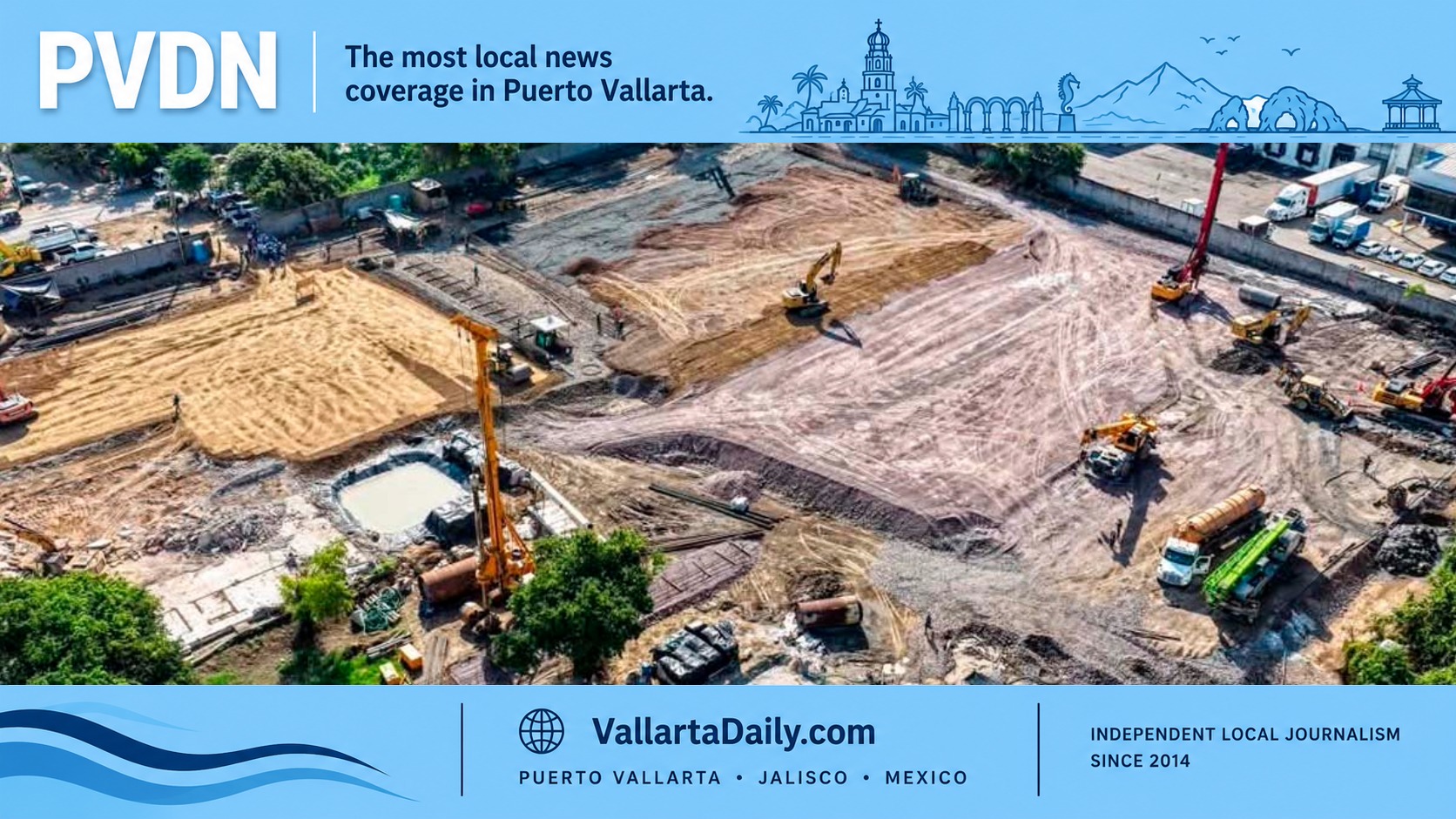
The hospital became that announcement. Its planned 35,846-square-meter complex near CUCosta will include 13 specialized units as well as teaching and research areas. University officials say the hospital is intended to serve more than 300,000 people across nine municipalities. Deep foundation work was already underway by late July, moving the project beyond the ceremonial and planning stages that dominated earlier announcements.
Electric transportation has also begun operating. SITEUR launched service on August 1 with 19 state-operated electric buses, accompanied by 10 additional electric buses operated by concessionaires. Two principal routes connect Ixtapa, Las Juntas, Galerías, the Hotel Zone, and central Puerto Vallarta with an integrated fare of MXN 11. The system is projected to carry more than 9,000 passengers daily. Vallarta Daily had tracked the electric buses as their launch repeatedly slipped earlier this year.
Security is another part of the administration’s current push in Puerto Vallarta. Franco cited increased videovigilance among the state’s actions, although at least one recently announced expansion illustrates the mixed financing behind some initiatives. C5 Escudo Jalisco Director Juan Carlos Contreras said new facial-recognition cameras around the Puerto Vallarta bus terminal will be purchased by private businesses and then connected to the state surveillance network.
Franco’s promotion of the administration’s record also comes as his own political plans move into public view. On August 6, he confirmed that he intends to seek the Puerto Vallarta mayoralty in the next election and said he has begun assembling a political team.
That does not change the status of projects that can be documented independently, but it provides additional context for Franco’s presentation of the Lemus administration’s record. Several of the largest works are now visible or operating. What remains unavailable is a consolidated public accounting that reconciles the more than MXN 2 billion figure with the individual state, university, federal, municipal, and private contributions behind those projects.