
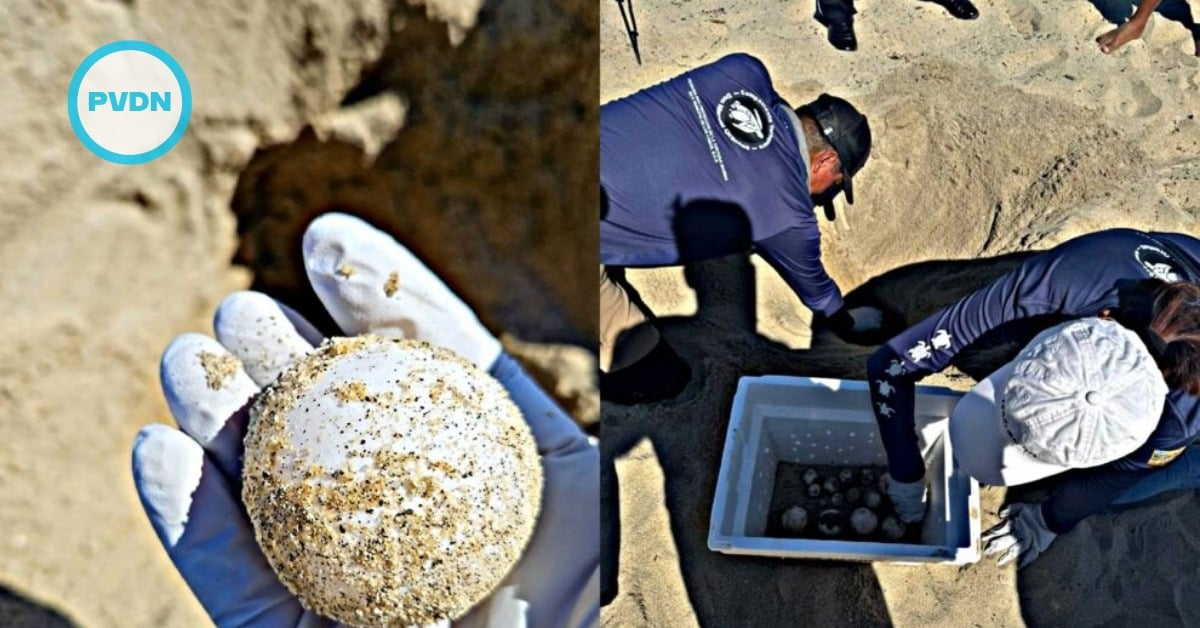
Los Cabos has logged a second leatherback nest of the season, and 56 eggs are now under protection after a careful relocation in La Ribera. Municipal environmental staff, supported by Costa Palmas personnel, moved the clutch to a protected corral to keep it safe from tides and predators. The find was reported on November 11, 2025, and confirmed by local authorities.
Last week, crews working the same shoreline secured a separate leatherback clutch of 65 eggs. Two nests in as many weeks do not signal a rebound, but they matter here, where sightings are rare and each viable hatchling could tip the balance. Together, at least 121 eggs are now incubating under watch in the East Cape.
La Ribera sits on the Sea of Cortez side of Los Cabos, near the protected waters that make this coastline a magnet for marine life. Conservation teams say the beach patrols and incubators are already in place for the season. The response looks routine at a glance. It is not. Leatherbacks in the eastern Pacific have been on the edge for years.
Los Cabos leatherback nest
Officials say the nest was relocated by trained staff using standard handling protocols. That process is simple but exacting: identify the chamber, recover eggs in sequence, and rebury them in a guarded enclosure that mimics natural depth and sand conditions. In Los Cabos, private partners often pitch in on equipment and manpower. The municipality credited Costa Palmas for technical support on this rescue.
Local context helps: sea turtle nesting on Los Cabos beaches runs largely from June through December, with hatching peaking late summer into fall. Leatherbacks remain the rarest of the nesters here, but the coastline is part of Mexico’s network of monitored beaches where nests are protected and crowds managed.
The caution is justified. The eastern Pacific leatherback subpopulation is listed as Critically Endangered, and scientists estimate it has declined by roughly 97% over recent decades. Fisheries bycatch, historical egg harvest, beach development, and warming sands all work against survival. That is the backdrop for any celebration in La Ribera.
Leatherbacks also don’t put many eggs in one basket. Typical clutches hit roughly 85 to 95 eggs, and females may nest several times a season at week-long intervals. A 56-egg clutch in La Ribera, then, falls within the life history variability of the species, especially this late in the year. What matters most is incubation success and safe emergence.
Beach management can shift those odds. Los Cabos has leaned on a mix of municipal patrols, community groups, and resort partners. Conservation programs tied to East Cape resorts, including those connected to Costa Palmas, highlight biodiversity work and fund on-the-sand logistics that public budgets can’t always cover alone.
Hatching is still weeks away. Leatherback incubation often runs about two months, though timing flexes with sand temperature. Too warm, and hatchling survival drops, and sex ratios skew. That is why corals track temperature closely and why lights and vehicles are kept off nesting beaches at night. If the weather holds and predators stay out, the La Ribera clutch could break the surface around New Year’s.
Why this rare clutch matters
The second nest in La Ribera hints at something basic but hopeful: intact habitat, night patrols that catch crawls in time, and a public that gives nests space. A week earlier, the first clutch of the season here counted 65 eggs. That find set up today’s rescue, proving that patrols are sweeping the right sand at the right hours.
The municipality’s note credits its turtle protection team and Costa Palmas for the November 11 operation. Collaboration is the model across Los Cabos because response windows are short and storms move fast. When calls come in, teams need vehicles, trained hands, and a guarded corral ready to go. That is what happened on this beach. [Municipal staff, with Costa Palmas,] handled the move and locked the nest down before daylight.
There’s a larger map at work. The eastern Pacific population now nests at scattered beaches from Mexico to Costa Rica. Scientists warn that without steady bycatch reductions offshore and strong nest protection onshore, the decline continues. That makes each protected clutch in Baja California Sur—however small—a step that keeps time on the clock for a species famous for crossing entire oceans.