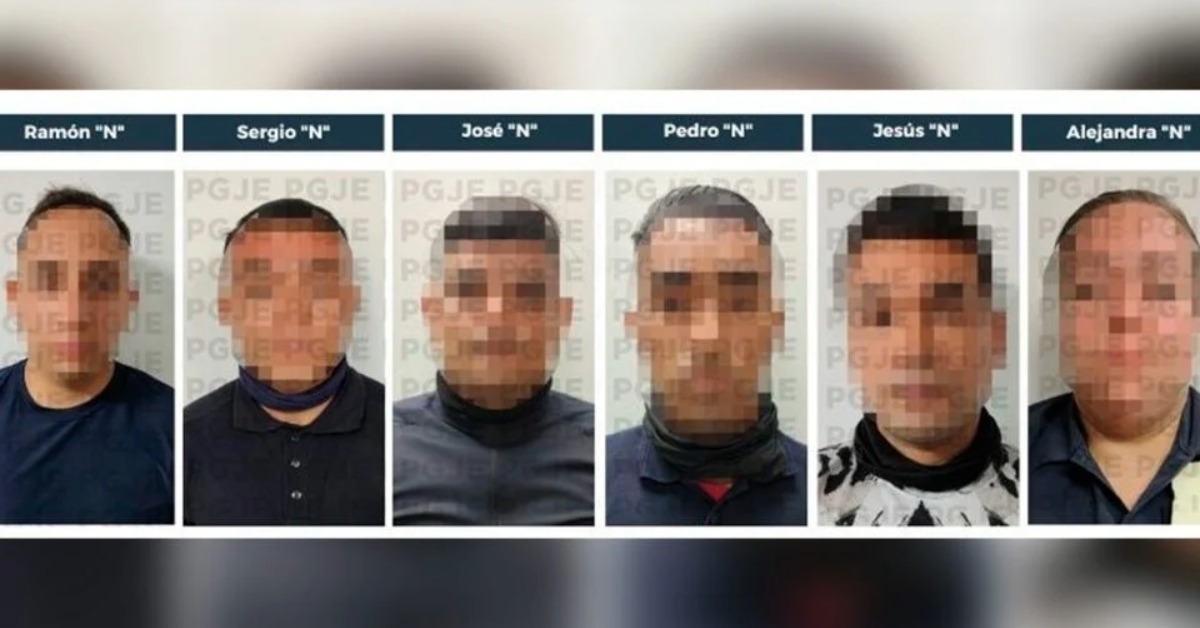
Cabo San Lucas, BCS – Six active municipal police officers were arrested July 29 in Los Cabos after a search of a home in the Lomas del Sol neighborhood by personnel from the Mexican Navy (SEMAR), the Baja California Sur State Attorney General’s Office (PGJEBC) confirmed. The detentions are connected to the kidnapping of at least two young men on the beaches of Cabo San Lucas in June.
The officers, all assigned to the Immediate Reaction Unit (URI) of the General Directorate of Public Security of the Preventive Police and Municipal Traffic of Los Cabos, are named as Alejandra “N,” 32; Ramón “N,” 30; Sergio “N,” 23; Jesús “N,” 33; José “N,” 26; and Pedro “N,” 21. Two are originally from Mexico City, three are from the municipality of Los Cabos, and one is from Chiapas.
Local authorities said the arrests followed intelligence-gathering and a coordinated operation involving SEMAR, underscoring the seriousness of the allegations. The involvement of the Navy in the raid and arrests signals an effort to keep the investigation insulated from possible local interference and to signal interagency commitment to resolving the case.
Active officers now under investigation
City officials confirmed all six were active members of the municipal police at the time of their arrest. Arnoldo Alberto Rentería, secretary general of the Los Cabos city council, said the case is already under formal review and that the municipal government is working with state and federal authorities. “We continue to work in coordination with the three levels of government to ensure the safety of families in Los Cabos,” he said. (Information from local official statement provided by municipal sources.)
State prosecutors have not publicly released the full list of charges, and it remains unclear whether the officers will face formal accusations of forced disappearance, abuse of authority, kidnapping, or related crimes. Their surnames are being withheld in public communications in line with Mexican legal practice, which uses “N” during early judicial proceedings.
Sources close to the investigation say authorities are probing whether the officers acted alone or as part of a wider internal network within the URI. The immediate reaction unit is intended to respond quickly to critical incidents; the arrest of multiple members from that same unit has prompted an internal review of operational conduct and command oversight. (Inference based on the pattern of multiple arrests within a single specialized unit and standard investigative protocols.)
Community pressure and broader context
The arrests come amid growing public concern over unresolved disappearances in the Los Cabos area, particularly those tied to coastal zones where young men were reported missing in recent months. Earlier in June, the disappearance of individuals near Cabo San Lucas beaches had already raised alarms among residents and advocacy groups, adding pressure on authorities to produce results and accountability.
Families of missing persons have long criticized delays and lack of transparency in prior cases, and the involvement of uniformed officers has intensified public demand for a thorough, impartial investigation. Human rights observers in the region have called for clear judicial timelines and, if required, federal oversight should local mechanisms falter.
The PGJEBC has pledged to keep the public updated as the case advances. Prosecutors say the next steps include presenting the arrested officers before a judge for potential preventive detention hearings, while continuing to gather evidence such as witness testimony, digital data, and items seized during the SEMAR-led operation.
Trust and the future of local security
The unfolding investigation tests trust in public safety institutions in a municipality that relies heavily on both local policing and tourism-driven perceptions of security. The outcome will be watched closely by victims’ families, local leaders, and national observers tracking reform and accountability in Mexico’s security forces.
Officials in Los Cabos have framed the arrests as a necessary step to restore confidence, but the deeper questions about recruitment oversight, internal discipline, and how alleged abuses became possible within a rapid-response unit remain. The case’s progression—and whether it leads to transparent prosecutions and systemic changes—could determine if the community sees this as a turning point or another episode in a cycle of mistrust.