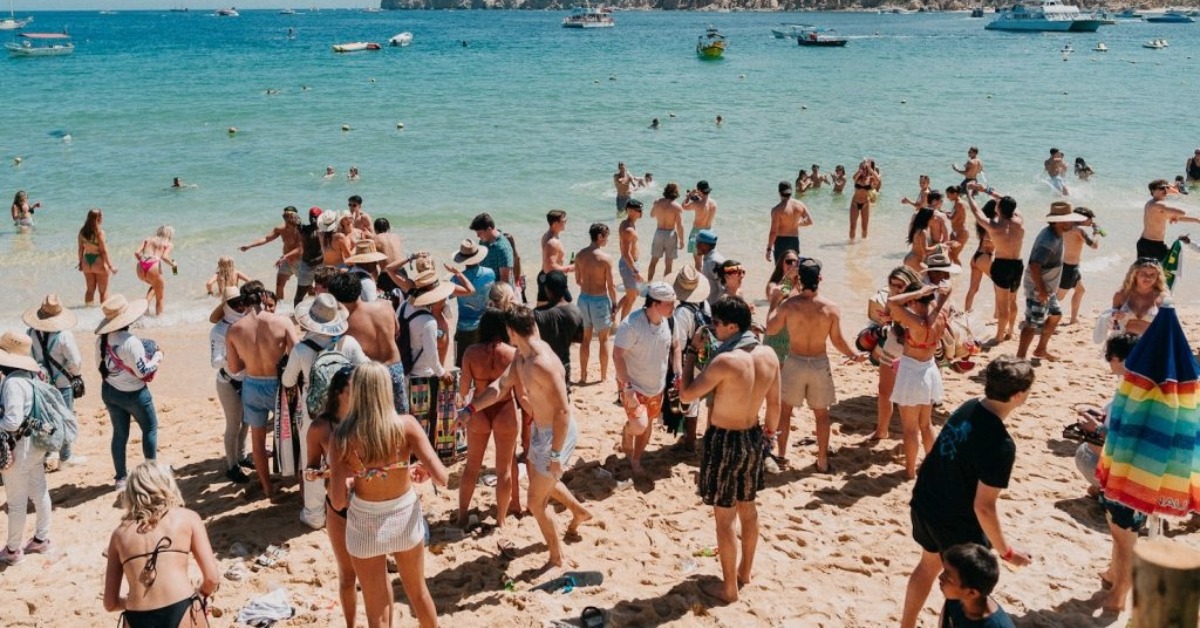
Baja California Sur says this year’s Spring Break season ended stronger than expected. Earlier in the cycle, state officials projected that Los Cabos would receive between 45,000 and 50,000 young visitors from March 1 to April 3. The latest public figure now places the season at about 58,000 visitors, which would put the final total above that initial range. For a destination built around airlift, hotels, restaurants, tours, and beach services, that is not a small revision. It signals that the spring student market still matters, even in a tourism economy that often presents itself as more luxury-driven than party-driven.
That matters for another reason, too. Spring Break is short, but it arrives during a period when the region is already balancing international demand, family travel, and Easter vacation flows. In practical terms, a stronger-than-expected finish means more pressure on roads, beaches, emergency services, nightlife districts, and short-term tourism staffing. It also means more money moving through the local economy in a very concentrated window. For foreign residents and long-stay visitors, that helps explain why a headline about college-age travelers can still have wider importance for the destination.
Why officials see this as more than a student travel story
State tourism officials say this season showed changes in the profile of the Spring Break visitor. The public message was not only that more people arrived, but that many travelers spent more than expected. Authorities said some visitors booked higher-end hotels instead of sticking to lower-cost packages, and they also noted a growing pattern of young travelers arriving with relatives. In a market like Los Cabos, that changes the math. Spending does not stop at clubs and bars. It spreads into transportation, excursions, dining, retail, waterfront services, and hotel operations.
That helps explain why officials were quick to frame the season as a sign of pricing power. Los Cabos has long been one of Mexico’s more expensive beach destinations. Even so, the state argues that demand held up despite added costs and the destination’s premium positioning. For readers outside Mexico, this is a useful clue about how the region works. Los Cabos is not selling itself as a bargain destination. It is selling itself as a place where international travelers will still pay more if they believe the experience, air access, and security environment justify the cost.
The bigger economic backdrop in Los Cabos
The Spring Break figure matters more when placed against the broader tourism machine behind it. A recent public review of Los Cabos tourism promotion said the destination received more than 3.77 million visitors in 2025 and generated a direct economic impact of 133 billion pesos. Datatur’s 2025 airport tables also placed Los Cabos third nationally for foreign-air tourist arrivals, behind only Cancún and Mexico City. That does not mean every season is equally strong, but it does show why even a narrow travel segment can draw outsized attention from officials, hotel operators, and service businesses.
For readers living in Mexico, this is often the missing context. A headline about young foreign travelers can sound superficial on its own. In Los Cabos, it is tied to tax revenue, jobs, airport performance, hotel occupancy, infrastructure pressure, and the state’s broader argument that international tourism remains one of its core economic engines. When officials celebrate a Spring Break total, they are also trying to send a message to investors, airlines, and the travel industry that the destination can still fill rooms and move visitors at scale.
The safety claim needs more context than a slogan
The most careful way to read the safety part of this story is to separate promotion, operations, and public data. Municipal authorities in Los Cabos said the Spring Break security operation ended with saldo blanco, or no major incidents, and they tied that result to an interagency deployment across beaches, roads, and high-traffic areas. That is important. It suggests the local government views the season as a logistical and public-order test, not just a tourism celebration.
At the same time, officials are not all using the same number. While state tourism messaging and local reporting cited about 58,000 young visitors, the Los Cabos municipal government said its operation covered about 70,000 visitors. Those figures may not be direct contradictions. They may reflect different counting methods, dates, or visitor categories. But they are not identical, and readers should not treat them as interchangeable.
There is also a wider point here. In Mexico, tourism safety claims often mix marketing language with operational results and perception surveys. The latest ENSU survey from INEGI said 39.0 percent of adults in Los Cabos considered their city unsafe in December 2025. That was well below the national figure of 63.8 percent, which supports the idea that Los Cabos performs better than many urban areas in Mexico on perceived insecurity. But it is still more nuanced than a simple ranking claim. For international readers, that distinction matters because official safety messaging is often strongest when tourism competition is also at its peak.
What foreign residents and repeat visitors should watch next
The immediate takeaway is that Los Cabos appears to have had a better-than-expected Spring Break season. The more important question is what that says about the months ahead. A strong spring surge can help local businesses, but it does not erase concerns about future demand, operating costs, exchange rates, or the way security headlines affect travel choices. In other words, this story is not only about how many students came. It is about whether Los Cabos can continue to attract international demand at the higher end of the market while still managing public space, infrastructure, and resident concerns.
That is why the 58,000 figure matters. It is a tourism number, but it also functions as a signal. Officials are using it to argue that Baja California Sur remains competitive, that Los Cabos still commands spending power, and that the destination can handle a high-pressure season without losing control of the visitor experience. Whether that argument holds through the rest of 2026 will depend less on one Spring Break headline and more on how the destination performs once the seasonal rush fades.