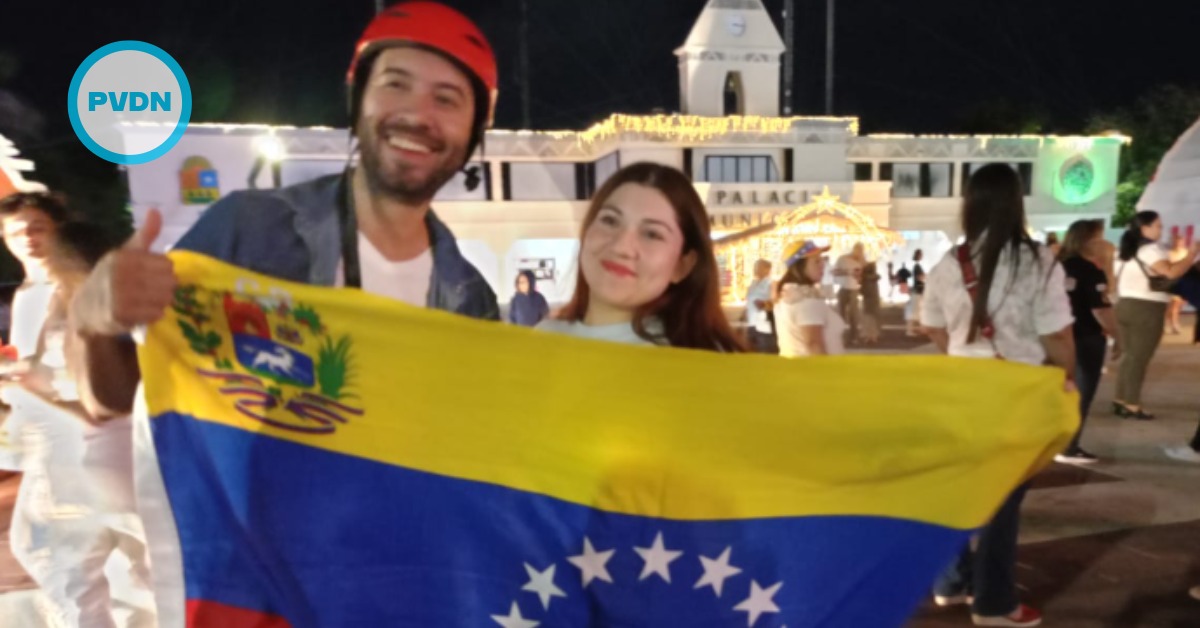
Car horns, flags, and tearful chants echoed off Playa del Carmen’s city hall as Venezuelan residents marked a moment many thought they would never see. After news broke that Nicolás Maduro had been captured, the community started with a mass, then rolled into the center in a vehicle caravan, gathering at Plaza 28 de Julio well past dark. Some talked about going home. Others admitted Mexico now feels like home, too. Behind the celebration sits a harder question: what does ‘Maduro’s capture’ change, and what might it trigger next?
A late-night rally in Playa del Carmen
The celebration in Playa del Carmen did not look like a planned march. It looked like a release. People arrived in small groups, then in clusters, then as a stream that kept growing. Venezuelan flags appeared first. Then the honking began. By the time the crowd settled in at Plaza 28 de Julio, the mood had turned into something closer to a vigil with a pulse.
For many, the night followed a simple sequence. A mass, held earlier in a neighborhood church, set the tone. Then came the caravan. Cars rolled through town in a loose procession toward the square across from city hall, where people sang, clapped, and hugged strangers who felt like family. They stayed for hours, riding the adrenaline of a headline they had waited years to read.
No major disturbances were reported during the gathering. The scene played out as a public celebration, loud at times, emotional throughout, and tightly focused on one idea: a chapter might finally be ending.
Relief, grief, and the pull of home
The people who turned up were not tourists passing through. Many have lived in Playa del Carmen for years. Some have built families here. A few now have children who are Mexican by birth. That detail matters, because it complicates what “freedom” can look like in real life.
Several Venezuelans at the gathering described the same push-and-pull. They want to return to Venezuela and reunite with relatives they have not seen in years. They also know that a sudden departure is not simple when your life has roots in Mexico. Jobs, partners, kids in school, residency paperwork, rent, routines. The things that quietly turn exile into a second home.
One woman described the news as the start of something “very big,” while admitting it hit her with mixed emotions. Another said the moment had been a long time coming, but warned that Venezuela’s broader political structure would not vanish overnight. Others talked about family members who cannot safely return, or who left under circumstances that still feel raw.
In Playa del Carmen, that reality sat beside the cheers. You could hear both. The joy was real. So was the grief underneath it.
The shockwave behind the celebration
The gathering was sparked by international news that landed like a thunderclap: U.S. authorities said Nicolás Maduro had been captured in a military operation and transferred to the United States. Reports described him being moved into federal custody and expected to face court proceedings tied to long-running allegations, including drug trafficking charges.
The geopolitical stakes are massive, and they are not abstract. Even supporters of Maduro’s removal acknowledge the obvious risks of what happened: questions about sovereignty, legality, and the possibility of retaliation or prolonged instability. In the first hours after the operation, the story drew sharp condemnation from some governments and cautious approval from others, while legal experts argued over whether the seizure crossed lines that international law is supposed to protect.
Inside Venezuela, the most immediate question is power. If leadership shifts to an interim authority, the country could move toward elections, or it could harden into a new version of the same system. Outside Venezuela, the most immediate question is fallout. Diplomatic relations, sanctions, energy politics, migration pressures, and regional security could all pivot fast.
In Playa del Carmen, that global storm arrived as a late-night caravan. That is what diaspora life often looks like. World history hits your phone, and then it shows up at the town square.
What happens next for Venezuelans in Mexico
For Venezuelans living in Mexico, the next phase will likely feel less like a celebration and more like waiting. Waiting for clarity about who governs Venezuela, what guarantees exist for return, and whether family members back home are safe. Waiting to see whether travel becomes easier or more dangerous. Waiting to learn whether the country they left is about to open, or crack down.
Playa del Carmen is used to people rebuilding their lives. It is a city of arrivals. That makes it a fitting place for a moment like this, where joy and uncertainty occupy the same space. The crowd in the plaza was not just celebrating a capture. They were trying to picture the morning after.
Some will keep their lives here no matter what happens in Caracas. Others will start planning a return, even if it takes time. Most will do what they have already been doing for years: keep working, keep parenting, keep surviving, and keep watching their homeland from a distance that never quite stops hurting.