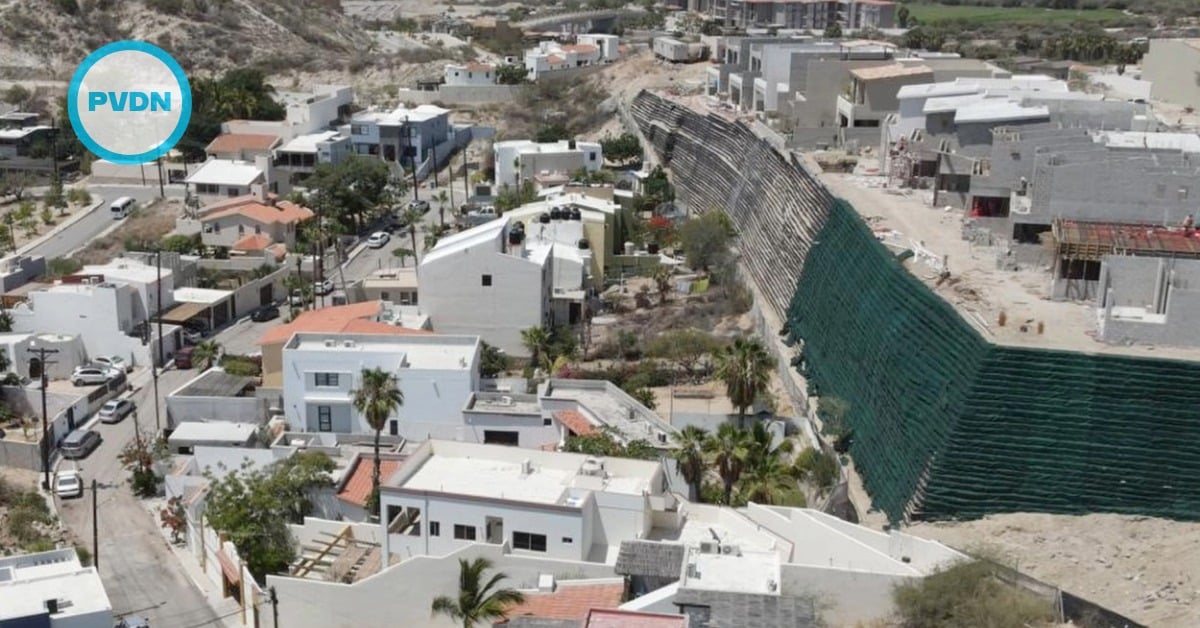
Residents of Magisterial in San José del Cabo fear a new hillside housing project and loose fill above their homes could trigger a dangerous landslide.
Neighbors in the Magisterial neighborhood of San José del Cabo say they no longer sleep easily when clouds gather over the hills. Above their homes, on a steep slope near Calle Nopal, a real estate project has raised the ground level and added new housing units. What used to be an open hillside is now a tall wall of earth with buildings on top, and residents fear that wall could one day come down on them.
Their worry is not new. Neighbors first noticed the works in 2023, when excavation and filling began on the lot that backs onto their street. They say they warned Civil Protection at the time, pointing to the removal of vegetation and the lack of visible containment works to guide rainwater away from their properties. The concern, they insist, is not only about cracked patios or damaged fences, but about the safety of the families who live directly below the new construction.
Today, the difference in height between the original street level and the filled platform is considerable. Residents describe a slope that has been cut and raised to support multi-story homes, with no clear information about soil studies or long-term stabilization measures. For people who have lived there for decades, the sense that their houses now sit at the foot of a man-made cliff has turned everyday life into a waiting game.
Magisterial landslide risk
The Magisterial landslide risk does not exist in a vacuum. Across Los Cabos, recent weeks have brought a series of landslides on hillsides weakened by heavy rains and a swarm of small earthquakes. Civil Protection has documented at least four slope failures in the municipality, including incidents in the Santa Rosa area of San José del Cabo and several colonias in Cabo San Lucas. In one case, a hill made of fill softened and partially collapsed next to a home; emergency crews responded, and while no one was hurt, the message was clear: the ground can move.
Municipal Civil Protection director Francisco Cota has warned publicly that many slopes around San José del Cabo and Cabo San Lucas are not solid rock but a mix of natural soil and artificial fill. When that material is not properly compacted and is later exposed to intense rain or shaking, it can erode and slide. He has described this combination of steep hills, loose fill and construction as a “latent risk” for neighborhoods built on or below those slopes.
Those warnings match what neighbors in Magisterial say they see from their windows: a tall embankment above their homes, in a city where landslides are no longer an abstract threat. They fear that one strong storm, or a sequence of heavy showers and small tremors, could turn that slope into a channel of mud and debris aimed directly at their roofs and bedrooms.
The wider context also fuels their anxiety. State Civil Protection officials estimate that around 50,000 people in Los Cabos live today in high-risk areas, many of them in riverbeds, ravines or on unstable hillsides. Ahead of what could be a busy hurricane season, authorities have urged families in those zones to consider relocation, warning that the municipality cannot afford another disaster like the one Acapulco suffered in 2023 with Hurricane Otis.
Authorities under pressure to act
Magisterial residents argue that their neighborhood should be part of that broader risk conversation. They question how the hillside project received its permits and whether the plans included soil-mechanics studies, retaining structures and drainage capable of handling tropical downpours. They are now asking the municipal government to review the authorizations already granted, verify that current building rules were followed and, if necessary, order reinforcement works before the next rainy season.
Civil Protection, for its part, has launched a municipality-wide program to inspect homes on or below steep slopes. Officials say they have already identified several zones with probable risk in San José del Cabo, including Santa Rosa, Lomas de Rosarito, Guaymitas and San Bernabé, as well as hillside areas such as El Pedregal, Lienzo Charro and Los Cangrejos in Cabo San Lucas. Inspectors are visiting those communities to check for signs of instability and to warn residents about the danger of cutting into or overloading the base of hills.
Parallel efforts focus on mapping who lives where. Local authorities, working with Civil Protection and urban development offices, have launched or announced censuses to locate families settled on landslide-prone slopes. The goal is to combine those field visits with risk maps and the municipal risk atlas, so that building permits and future growth take known hazards into account. Officials have stressed that irregular settlements in gullies or on unstable hillsides increase the chance that storms will turn into emergencies.
At the same time, Los Cabos’ Civil Protection personnel have been receiving federal-level training on using the National Risk Atlas and responding to landslide events during the rainy and cyclone seasons. Recent sessions have focused on incident command, updated climate forecasts and specific modules on slope instability, to improve coordination when storms threaten vulnerable neighborhoods.
For the families in Magisterial, those policies only matter if they translate into concrete actions on their street. They want inspectors to look closely at the new construction above Calle Nopal, to say whether the earthworks and retaining systems meet current standards, and to explain what will happen if the slope shows signs of movement. Some worry that, without timely intervention, authorities will be left to react after the fact rather than prevent damage.
The case highlights a recurring tension in fast-growing coastal cities: the push to build on every available hillside versus the slow, technical work of understanding what the ground can safely support. In Magisterial, that debate is not theoretical. It lives in the shadows cast by new walls and balconies rising above older homes, and in the way neighbors watch the sky each time the forecast mentions rain.
As Los Cabos prepares for stronger storms and more seismic activity, how the municipality responds to the Magisterial complaints will send a signal to other hillside neighborhoods. For residents there, the demand is simple: they want growth to continue, but not at the cost of living under a slope they fear could fall.