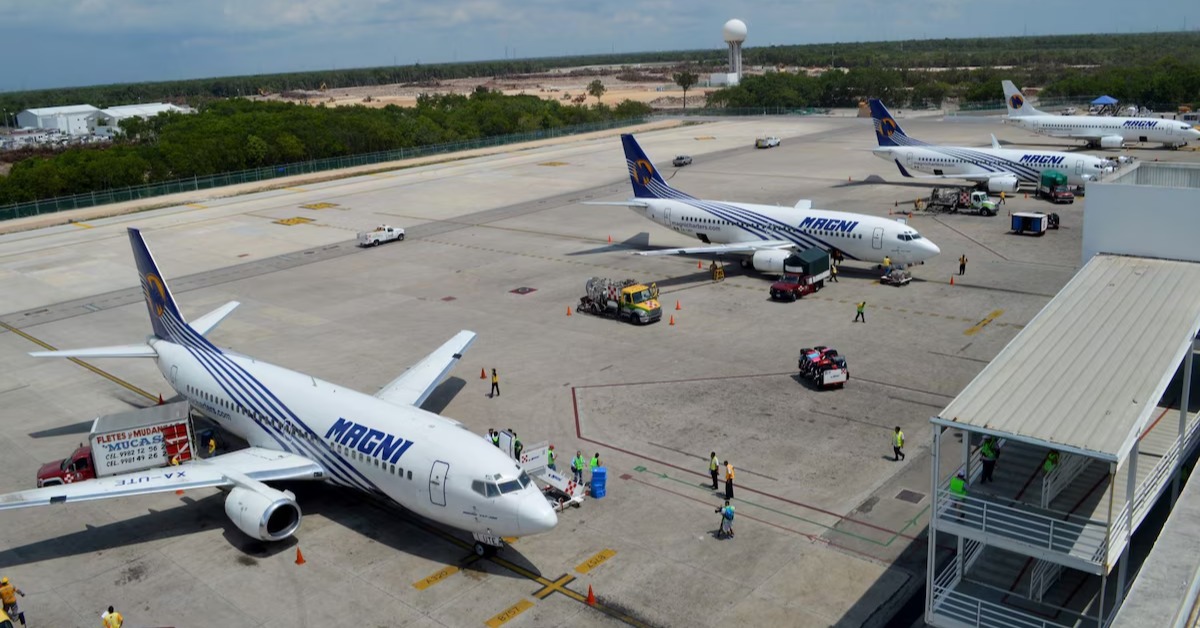
What began as a weekend travel disruption in Cancún quickly turned into a broader warning about the fragility of smaller carriers in Mexico’s tourism market. Magnicharters said it was stopping operations for two weeks due to logistical problems, but the impact spread quickly across airport counters, passenger itineraries, and rebooking desks. For travelers, the bigger question is no longer just which flights were canceled, but how much confidence remains in the airline’s ability to resume normal service on schedule.
Six flights in Cancún were part of a larger shutdown
The disruption in Cancún was not an isolated delay. It was part of a two-week suspension of operations announced by Magnicharters, a Mexican leisure airline that focuses on vacation and charter traffic. Over the weekend, six flights to Cancún were affected. The impacted routes included Mexico City, Monterrey, and Havana. That made the story more significant than a normal weekend cancellation, especially for passengers traveling at the end of a busy holiday period.
In practical terms, the airport problem was visible almost immediately. Counters closed, passengers had to seek answers elsewhere, and authorities began pushing travelers toward other airlines. The company’s official explanation was brief. It cited logistical problems and said the airline was working to resolve the situation. What it did not do was explain what those problems were, how many passengers would be affected nationwide, or how the airline plans to stabilize operations beyond the next two weeks.
Why this matters beyond a few canceled departures
For many international readers, Magnicharters is not a household name. That is part of the story. It is not one of Mexico’s largest carriers with a deep network and many backup aircraft. When a smaller airline pauses service, the disruption can spread faster because there are fewer built-in options to absorb the shock. That matters in Cancún, where many travelers depend on direct leisure routes and package-style bookings rather than flexible corporate itineraries.
It also matters because the suspension lands in a market where confidence is crucial. Travelers can accept bad weather. They can usually understand a mechanical delay. What creates more uncertainty is a broad stoppage with a thin public explanation. Recent reporting has linked the company to wider operational strain, including worker complaints over unpaid obligations. A separate public controversy involving the airline surfaced in late 2025 during a disrupted flight out of Mexico City. None of that fully explains this weekend’s shutdown, but it adds context that helps explain why the company’s brief statement is unlikely to calm worried passengers on its own.
What support is now being offered in Cancún
Federal authorities moved quickly once the shutdown became public. The government said travelers affected in Cancún, Mérida, and Huatulco could seek help through Aeroméxico, Viva Aerobus, and Volaris. In Cancún, emergency rebooking efforts began almost at once. Reports published early Monday said Viva Aerobus had already started operating support flights from Cancún, while Volaris was expected to take on part of the rebooking effort beginning Tuesday, depending on seat availability.
That response may soften the immediate damage, but it does not erase it. A support plan is not the same as a restored schedule. Passengers still face uncertainty about timing, available seats, missed hotel nights, onward connections, and vacation plans that may no longer align. For people flying to or from Havana, the problem can be even more complicated because international rebooking options are usually narrower than domestic ones. In short, the weekend disruption may have begun with six flights affected in Cancún, but the consequences could easily become a much larger travel headache.
What passenger rights look like in Mexico
This is the part many foreign residents and visitors need most. Under Mexico’s aviation consumer rules and the compensation policy registered for Magnicharters, passengers affected by cancellations are generally entitled to a clear set of options. Those options can include a refund, substitute transportation, or travel on a later date chosen by the passenger. The rules also provide for basic assistance, such as communications, food, and lodging, when an overnight stay becomes necessary.
There is also an important compensation issue. In certain cancellation scenarios, the airline must provide an additional indemnity that is at least 25 percent of the unused fare. That does not mean every traveler will receive the same result in the same way, because outcomes depend on which option the passenger chooses and how the airline processes the claim. Still, the key point is simple. A canceled flight is not only an inconvenience. It can also trigger financial rights that travelers should not overlook while they focus on getting home.
What comes next for Magnicharters
The immediate test is whether the airline can move from vague assurances to specific answers. Travelers will want to know whether the two-week timeline is realistic, whether routes will return all at once or in phases, and whether the company has the operational and financial room to rebuild confidence. That is especially important in Cancún, where the airport is one of the country’s most visible tourism gateways, and disruptions can quickly affect both residents and visitors.
For now, the safest reading is that this is no longer just a story about six canceled flights. It is a story about the vulnerability of niche carriers in a market that depends on reliability. The six affected flights in Cancún put the issue into focus, but the real question is whether this becomes a short interruption or the start of a deeper collapse in service. Until the airline offers a fuller explanation, that question will remain open.