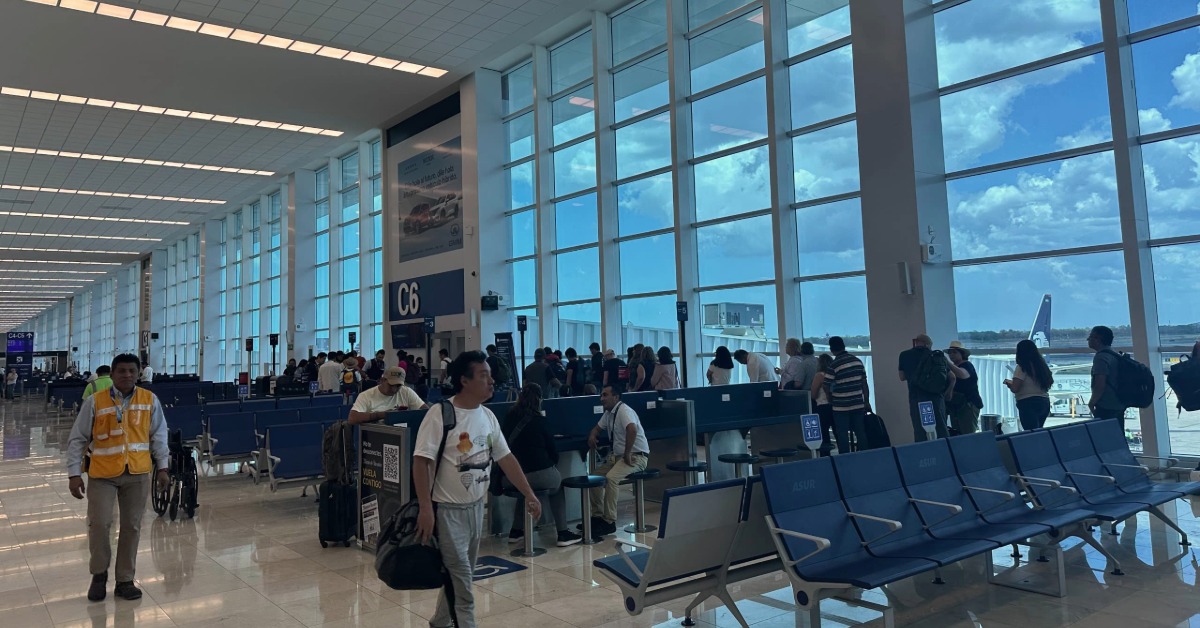
Mérida International Airport has launched a one-month book exchange program for passengers and airport users. The initiative, called “Lecturas al Vuelo,” places books in the airport’s final departure waiting area, where travelers can take a book and leave another in return.
The program was introduced on April 23, in connection with Spanish Language Day and the wider international focus on books and reading. For travelers, the idea is simple. A passenger waiting for a flight can pick up a book before boarding. Another traveler can leave behind a book they have already finished.
The exchange is being carried out by the airport in coordination with airlines operating at the terminal, the Liga de Acción Social, and CIFAL Mérida. The airport is operated by ASUR, the regional airport group that manages several airports in southeast Mexico.
How the exchange works
The program uses bookshelves installed in the Sala de Última Espera, the final waiting room used by departing passengers. Travelers may take books voluntarily and are encouraged to leave another book for someone else.
Airlines are also taking part by contributing books that were forgotten and later recovered inside aircraft cabins. Those books will be added to the exchange, giving them a second use rather than leaving them in storage or lost-and-found.
For passengers, the project does not require registration or a formal lending system. It follows the familiar take-a-book, leave-a-book model used in community libraries, cafés, neighborhoods, and public spaces around the world.
That simplicity is part of the appeal. Airports are often built around movement, schedules, security checks, and waiting. This program turns part of that waiting time into something quieter and more personal.
Why this matters for travelers in Mérida
For foreign residents and frequent visitors, Mérida’s airport is one of the main entry points into Yucatán. It connects the city to other parts of Mexico and to international routes, while also serving residents who travel for work, family, medical care, or tourism.
A small program like this will not change the airport experience on its own. But it does show how public spaces can become more useful and more human. A traveler delayed for an hour, a parent waiting with a child, or a resident flying to Mexico City can use the shelf at no cost or with no paperwork.
It also fits Mérida’s wider image as a city that leans heavily on culture, education, and civic identity. The city has long promoted museums, neighborhood history, public events, and local traditions as part of daily life. Bringing books into the airport extends that civic culture into a place many people only associate with transit.
A cultural message in a busy airport
The launch comes at a time when airports are being asked to do more than just move people efficiently. Many terminals now include local food, regional design, cultural displays, and public-service campaigns. These features can help visitors understand where they have arrived, while giving residents a stronger connection to the space.
In Mérida, the new book exchange does that modestly. It does not require a major redesign or large public spending. It uses books, shelves, and passenger participation.
The partnership with CIFAL Mérida also gives the program a development and education angle. CIFAL centers work around training and sustainable development themes, including education and community awareness. The book exchange follows that direction by linking travel with access to reading.
The involvement of the Liga de Acción Social adds another local layer. The organization has a long history in Yucatán’s civic and cultural life. Its participation places the airport program within a broader tradition of public education and cultural promotion in the state.
Books that keep traveling
The most memorable part of “Lecturas al Vuelo” may be the idea that books can travel much like passengers do. A novel left by a traveler from Mérida could end up with someone flying to Monterrey, Houston, Mexico City, or another destination. Another book forgotten on a plane could return to circulation instead of sitting unused.
That gives the program an easy-to-understand story for passengers. The airport is already a place where people and luggage move between cities. Now, books can move too.
The program is currently planned for one month. Its longer-term future may depend on how passengers use it, whether enough books keep circulating, and whether airport partners decide to maintain the shelves after the trial period.
For now, the airport is testing a simple question. Can a transit space also become a reading space? In Mérida, passengers will have a month to answer that by taking a book, leaving one behind, and letting the next traveler continue the journey.