Donovan Carrillo’s Olympic story didn’t end with his breakout week in Beijing. In Milan, the 26-year-old returned with a new base and new music. His route to the ice now runs through Canada. He also returned with more expectations. The scoreboard tells one version of what happened Friday night. The crowd tells another. An Elvis medley, risky jumps, and a kiss to the rink hinted at something bigger. It left one question hanging: can Mexico keep this momentum alive?
A second Olympic final, and a bigger statement
Donovan Carrillo closed his Milano-Cortina Games with a smile, then skated like the pressure was personal. The 26-year-old from Jalisco reached the men’s free skate final again. That is rare for Mexico in this sport. He also carried the Mexican flag at the opening ceremony, soaking up an arena-sized roar in Milan. He was Latin America’s lone figure skater at these Games. Carrillo finished 22nd overall, but the number misses the point. His 219.06 total was his best Olympic score. It also edged his Olympic mark from 2022, when he posted 218.13. That total came after a tight qualification with no margin. He slipped into the final as the 23rd qualifier in the short program. Then he carried that anxiety for days. For expats in Mexico, his run lands differently. For many, it meant an early coffee and a stream on a workday. It is a reminder that Mexico shows up in unexpected places, even on Olympic ice. His second appearance reinforces that visibility. It also keeps the door open for whoever comes next.
The free skate that carried the story
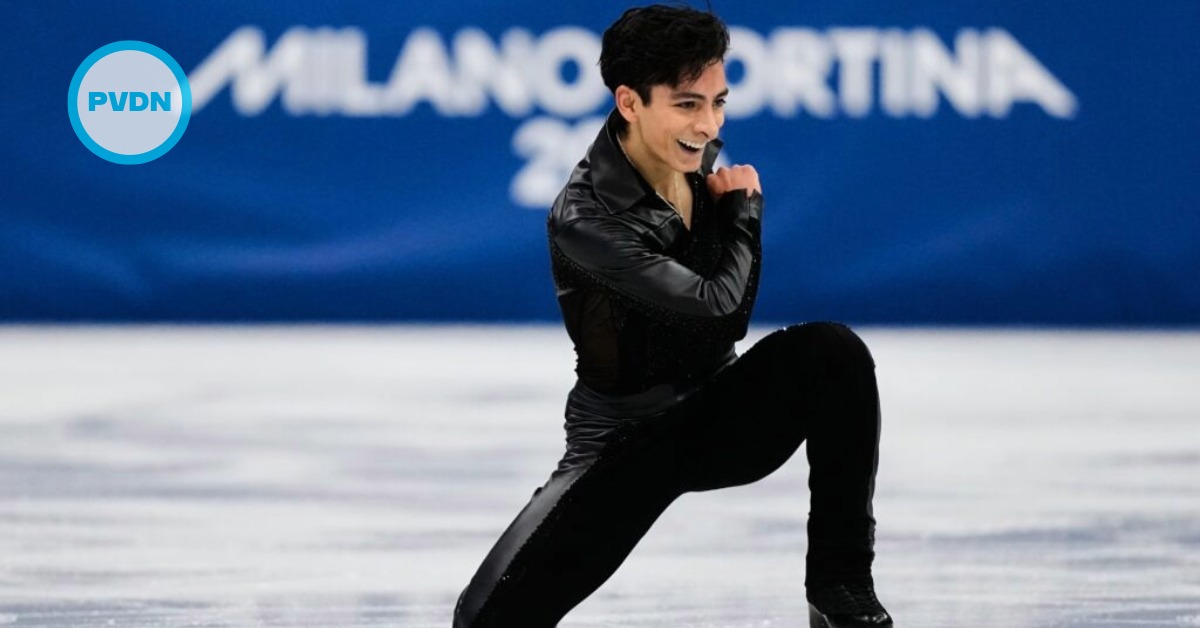
Friday night at the Milano Ice Skating Arena, Carrillo went out second. He treated the rink like a stage. He wore a sharp black suit that matched the soundtrack’s swagger. His free skate used an Elvis Presley mix, led by My Way. It then shifted into Trouble, Jailhouse Rock, and A Little Less Conversation. The vibe was classic showman, but the risk was modern. Carrillo opened with a quad Salchow. He followed with a quad toe loop and stayed on his feet. He also went for two triple axels, one in combination. He completed both axels without a fall. His technical and component marks both landed around 72 points. The judges gave him 143.50 for the segment. It was his best free skate of the season. That lifted his total to 219.06. He punctuated the finish by kissing the ice. This time, he kept the free skate deduction column at zero. Afterward, Carrillo called the jump historic for Mexico. He credited two and a half years of training in Canada. He also asked that institutional support and sponsorship remain steady.
Why Mexico’s visibility keeps growing
Carrillo’s path has always been a logistical puzzle, not just an athletic one. He first trained in diving and gymnastics, then moved into skating as a kid in Guadalajara. When he was 13, the local rink closed, and he relocated to León to keep training. Today, his base is in Thornhill, Ontario, where he works with coaches Jonathan Mills and Myke Gillman. That pipeline matters because Mexico still has limited high-performance ice time. It also explains why his second Olympic final is more than a personal milestone. In 2022, he ended a 30-year gap in Olympic figure skating for Mexico. He was also the first Mexican to qualify for the free skate. In Milan, he did it again, and he left with a season-best free skate. He did it on a chaotic night, too, when the men’s event flipped, and a new champion emerged. The night ended with Kazakhstan’s Mikhail Shaidorov taking gold. Carrillo’s finish will not be remembered as a medal run, but as proof. The next question is whether Mexico treats that proof as a one-off or as a starting line.