
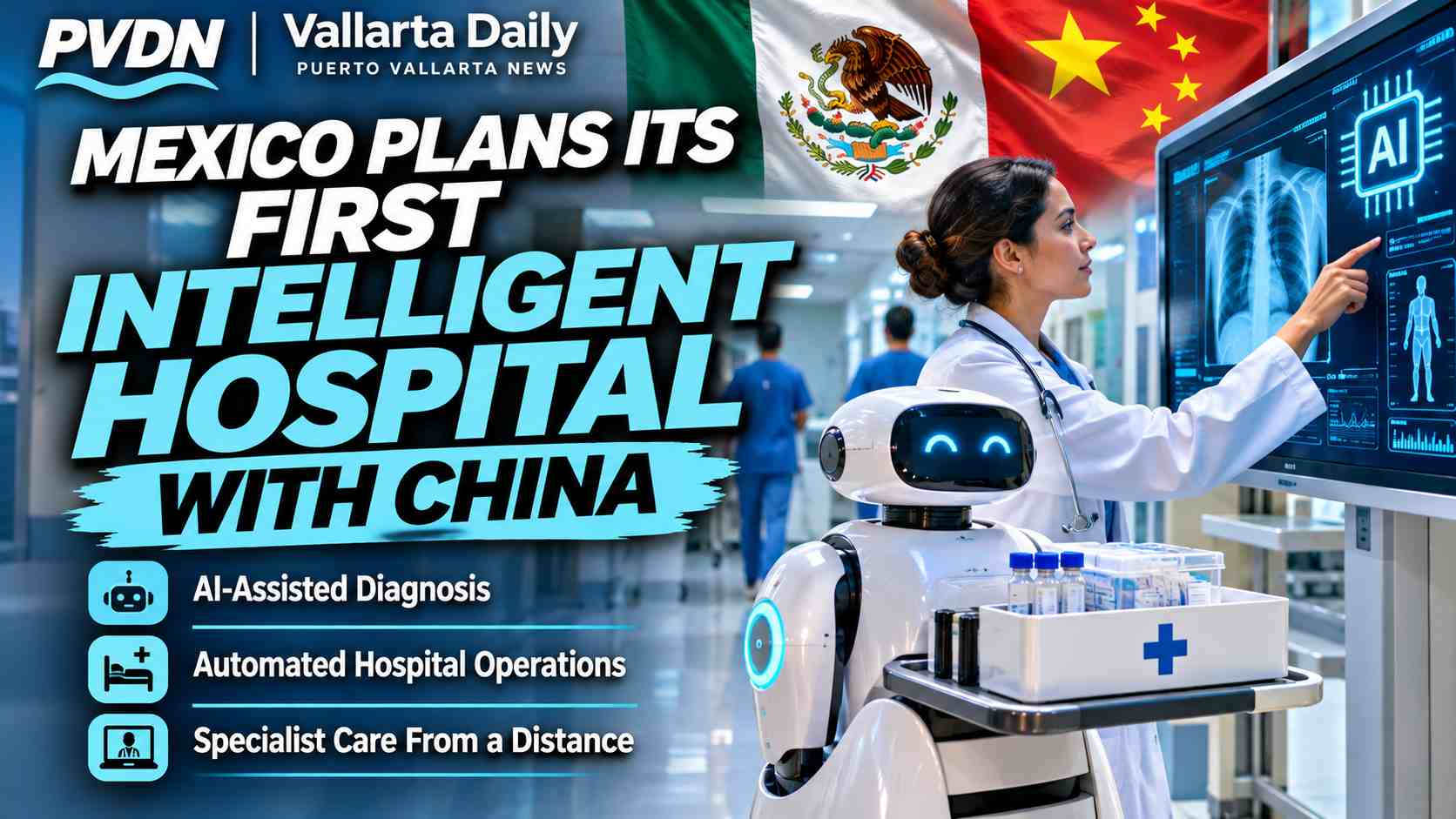
Mexico plans to introduce a smart hospital with Chinese technology, using artificial intelligence and automation to improve public healthcare.
Mexico City, November 24, 2026 – Imagine walking into a Mexican public hospital where artificial intelligence helps doctors identify diseases, robots deliver medications to different departments and medical specialists can examine laboratory results from hundreds of miles away.
That’s the kind of healthcare experience Mexico is hoping to introduce through a new partnership with China.
President Claudia Sheinbaum announced Tuesday morning that the two countries have agreed to cooperate on establishing Mexico’s first intelligent hospital based on a Chinese model, along with expanding medical training and scientific research between the two nations.
The intention is to introduce the technology at one Mexican hospital before exploring opportunities to expand it to other facilities.
Exactly which hospital will receive the technology has yet to be decided.
What exactly is an intelligent hospital?
During her recent visit to China for the Asia-Pacific Economic Cooperation (APEC) summit, Sheinbaum toured the Hospital Popular del Distrito de Nanshan in Shenzhen.
According to an official statement from the Mexican government, the hospital uses artificial intelligence to assist with diagnoses and treatments, while robots transport medications and laboratory samples throughout the facility.
The hospital has approximately 1,500 beds.
An intelligent hospital doesn’t necessarily mean replacing doctors and nurses with robots. Instead, much of the technology is designed to support medical professionals and automate some of the routine tasks that consume their time.
Artificial intelligence can help doctors review medical images, identify abnormalities and evaluate information that might otherwise take considerably longer to process.
Automated systems can also help manage hospital inventories, distribute medications and improve coordination between departments.
For patients, the potential benefits include faster test results, fewer administrative delays and more efficient treatment.
Of course, those benefits depend on how effectively the technology is implemented.
Getting a diagnosis without traveling hundreds of miles
One particularly interesting aspect of the government’s plans involves the remote interpretation of medical tests.
Health Secretary David Kershenobich explained during this morning’s healthcare discussion that Mexico is already working toward establishing facilities capable of remotely analyzing biopsies.
The government has also discussed using artificial intelligence to support the interpretation of diagnostic images.
For people living outside Mexico’s largest cities, that could eventually make a considerable difference.
A smaller regional hospital might have the equipment necessary to perform a medical test but lack the specialist needed to interpret the results.
Rather than requiring patients to travel to another city, digital systems could allow specialists elsewhere to review those results and communicate their findings to the local medical team.
It’s particularly relevant to communities like Puerto Vallarta, where some patients needing highly specialized medical care must travel to larger metropolitan areas.
The technology wouldn’t eliminate the need for those trips altogether, but it could potentially reduce unnecessary travel and delays in obtaining certain diagnoses.
Puerto Vallarta is already seeing some technological improvements
Although there’s no indication that Puerto Vallarta is being considered for the intelligent hospital project, the city is already experiencing some of Mexico’s broader healthcare modernization efforts.
Last week, the Mexican Social Security Institute (IMSS) announced that a new 256-slice CT scanner at Puerto Vallarta’s Hospital General de Zona 42 was ready to begin attending patients.
During a November 17 federal healthcare briefing, IMSS Director General Zoé Robledo explained that the equipment allows for faster and more precise diagnostic imaging, including examinations involving the heart, trauma injuries and orthopedic conditions.
Meanwhile, the city continues to await the completion of its new public Civil Hospital, another project intended to expand local healthcare capacity.
These developments form part of the wider changes we continue to follow in our Puerto Vallarta healthcare coverage.
The partnership with China represents another direction for Mexico’s healthcare modernization, although its eventual reach remains uncertain.
Mexico is also sending doctors to China
The second component of the agreement might prove just as important as the hospital technology itself.
Mexico intends to establish medical training and scientific research exchanges that could allow Mexican doctors to receive specialized instruction in China and Chinese healthcare professionals to participate in similar programs in Mexico.
During the government’s November 19 press conference concluding its visit to China, Kershenobich also discussed potential exchanges involving nurses and other healthcare professionals.
Purchasing sophisticated medical equipment is one thing. Having enough qualified people to operate, maintain and understand that equipment is another.
Training medical professionals could help Mexico incorporate new technologies beyond the initial hospital, potentially allowing some of the knowledge gained through the partnership to benefit other public healthcare facilities.
The number of professionals who might participate, the duration of their training and the program’s budget have not been announced.
Can artificial intelligence fix Mexico’s healthcare problems?
Anyone who has spent several hours waiting for an appointment at a public hospital might reasonably wonder whether artificial intelligence is really what Mexico’s healthcare system needs most.
After all, technology alone cannot solve medication shortages, insufficient staffing, overcrowded emergency departments or a shortage of hospital beds.
Those problems require investment in people and infrastructure as much as they require investment in computers.
The federal government is attempting to address some of those issues through its broader healthcare reforms, including a planned network of 12,750 primary healthcare consulting offices, intended to improve access to routine medical care and reduce pressure on larger facilities.
There are also questions surrounding the implementation of artificial intelligence in healthcare.
How will sensitive patient information be protected? Who will be responsible when an automated system makes a mistake? And how will diagnostic software be tested to ensure it performs reliably for Mexico’s patient population?
These are questions healthcare systems around the world are confronting as artificial intelligence becomes more common in medicine.
The objective should be to give medical professionals better tools, not to replace their clinical judgment.
When will Mexico’s first intelligent hospital open?
That’s the question the government hasn’t answered yet.
Sheinbaum confirmed that a hospital has not been selected, and Tuesday’s announcement did not establish a construction budget, an opening date or whether the project would involve building a new facility or modernizing an existing one.
The government also acknowledged last week that the formal memorandum of understanding covering healthcare cooperation had not yet been signed. A subsequently signed document has not been independently confirmed.
For foreign residents who rely on Mexico’s public healthcare system, Tuesday’s announcement does not establish any changes to existing enrollment requirements, patient eligibility or healthcare benefits.
For now, the project remains a commitment to introduce and evaluate a new approach to hospital operations.
Whether it eventually improves the experience of ordinary patients will depend on how successfully Mexico can move from international agreements to functioning medical services.
And for most people sitting in a hospital waiting room, the measure of success won’t be how many robots are traveling down the corridors.
It will be how quickly they can see a doctor, receive a diagnosis and begin their treatment.