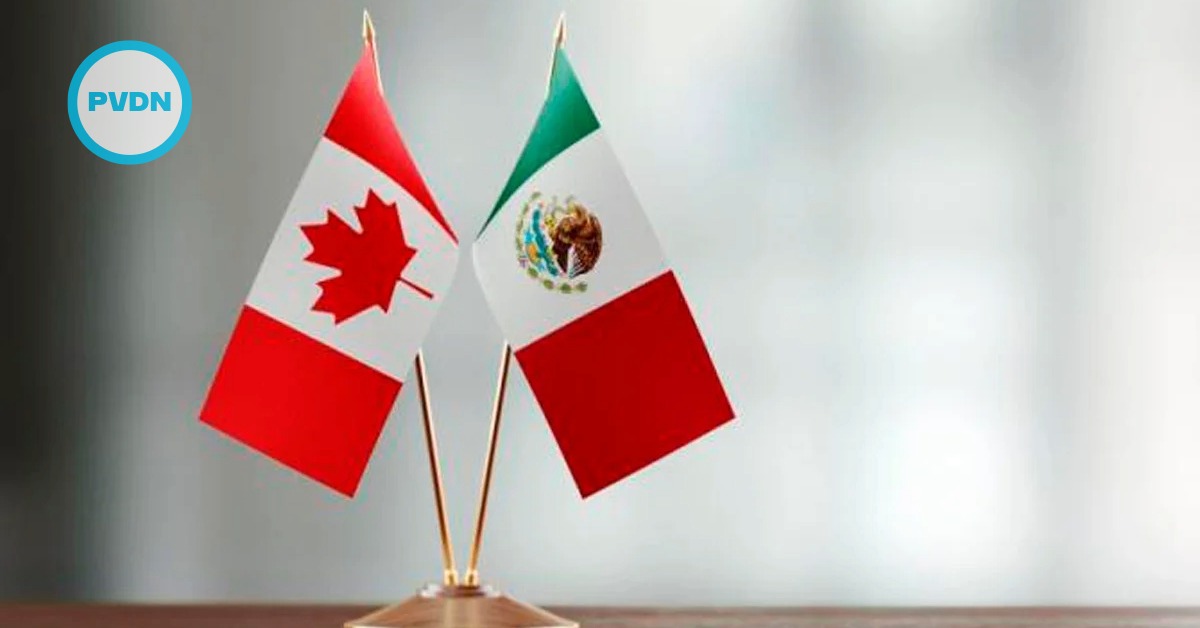
Mexico and Canada are forging a new economic game plan that goes beyond traditional trade deals. High-level talks in Mexico City have set the stage for a bilateral roadmap to boost investment and streamline commerce between the two countries. But it’s not just about business — Canada is pressing to weave a security alliance into the mix. With the blueprint expected later this year, could this ambitious initiative redefine the partnership between these North American neighbors?
Mexico and Canada are drawing up a new bilateral action plan to strengthen trade and investment ties. The aim is to reduce regulatory hurdles and open fresh opportunities for businesses in both countries. The initiative was announced in Mexico City this week. Mexico’s Economy Minister Marcelo Ebrard and Canada’s Trade Minister Dominic LeBlanc unveiled the plan during meetings with a large Canadian business delegation visiting Mexico. Officials say the plan will be finalized in the coming months. It is expected to be presented in the second half of 2026 as a roadmap for bilateral cooperation in the years ahead.
The move reflects a recognition that both countries need to move beyond the status quo. Ebrard put it bluntly at the conference: “We’re not in a comfort zone like in the past.” He suggested that shifting global dynamics demand a more active approach from Mexico and Canada. Both ministers framed the new plan as part of a renewed partnership that will guide bilateral priorities for the next several years. Significantly, this timing coincides with the scheduled 2026 review of the US–Mexico–Canada Agreement (USMCA). That backdrop puts pressure on North America’s trading partners to reaffirm their ties and competitiveness.
Broadening Economic Partnership
Ebrard indicated that the forthcoming plan will span a range of strategic fronts. It aims to boost traditional sectors such as mining and infrastructure while also entering cutting-edge industries. For example, both sides have a keen interest in critical minerals. Mexico hopes to leverage Canada’s mining expertise to move beyond being just a raw material supplier and develop its own processing capacity. Better integration of supply chains and joint investment in infrastructure, such as modernizing ports, is also on the table. Additionally, the two countries envision collaboration in advanced manufacturing, clean energy, aerospace, robotics, drones, and artificial intelligence. Even youth opportunities and skills training are expected to feature, reflecting an effort to deepen ties beyond trade alone. As a sign of growing two-way commitment, Ebrard revealed that a major Mexican company is poised to invest in the Canadian province of Quebec. He noted this would be an unprecedented step — the first time a Mexican firm undertakes a project of that scale in Canada.
The scale of the current Canada–Mexico business mission underscores that urgency. Around 400 companies and organizations from both countries convened in Mexico this week. Over a thousand one-on-one meetings were scheduled in Mexico City, Monterrey, and Guadalajara to hunt for opportunities. Ebrard noted he couldn’t recall a business dialogue of this magnitude in recent memory. Rather than being deterred by global uncertainty, officials argue it’s a reason to diversify and integrate even more. In the last three decades, bilateral trade has expanded twelvefold – now topping $56 billion annually – yet both sides see plenty of untapped potential. Canada is already Mexico’s third-largest trading partner, and millions of Canadians travel to Mexico each year. LeBlanc highlighted that an estimated 3 million Canadians will visit Mexico in 2026 – about 7% of Canada’s population. He said this figure underlines the deep people-to-people ties behind the economic relationship.
Security Partnership on the Agenda
Canadian officials have made clear that this partnership is not just about economics – it also has a security dimension. LeBlanc is pushing for the action plan to include a formal security component, arguing that a stable environment is necessary for prosperity. “The world is, in many ways, more complicated and in several cases more dangerous,” he warned. He urged even stronger cooperation between Canadian and Mexican law enforcement and military agencies. As an example, Canada’s Royal Canadian Mounted Police (RCMP) plans to double the number of officers stationed at its embassy in Mexico this year. These additional officers will work on joint operations with Mexican authorities. Security collaboration is seen as vital to the economic agenda. The two governments have even exchanged proposals on how to combat the illicit trafficking of firearms into Mexico. LeBlanc noted that if they want trade and investment to keep growing, people need to see both governments actively addressing security concerns.
As Mexico and Canada flesh out this action plan, it’s clear they intend to elevate their partnership to a new level. By tackling everything from cutting red tape to confronting security threats together, the two neighbors aim to build a more resilient, diversified North American alliance. The plan is scheduled to be unveiled later this year and will show how the countries intend to turn these ambitions into concrete steps. Observers will be watching to see how this bilateral bond might shape the region’s economic and strategic landscape in the years ahead.
With information from El Universal, El Economista, Expansión